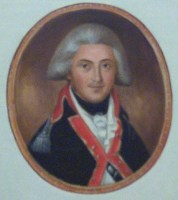
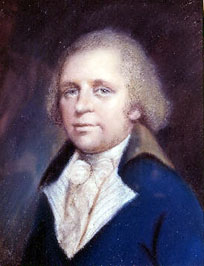
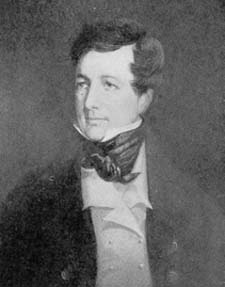
Alfred Jacob Miller (1810-1874)

Alfred Jacob Miller

Alfred Jacob Miller

In the War of 1812 galleries of the Maryland Historical Society in Baltimore, artist Alfred Jacob Miller’s famous panorama oil painting entitled “The Bombardment of Fort McHenry, September 13-14, 1814.” This unique painting, circa 1829, remains the quintessential War of 1812 image complete with “the rockets red glare and bomb bursting in air.”

Miller was born on January 2, 1810, to a successful sugar merchant and grocer, George Washington and Harriet Jacobs Miller. During the bombardment of Fort McHenry, George Miller, served as a private in Captain John Berry’s Washington Artillerist, 1st Regt. Maryland Artillery. He would later share his experiences for his son’s painting. Young Miller, while not a veteran of the war, but as an artist, captured the imagination of the events for history.

In the spring of 1829, eighteen year old Alfred Jacob Miller set up his easel and sketch book upon a promontory in South Baltimore, and sketched out the view of Fort McHenry in the distance. The site was old Camp Look-Out (Riverside Park), a circular earthen redoubt that took an active role in the city’s defense. Later at his studio/residence his canvas revealed the colorful events of what had occurred during September 13-14, 1814. The Baltimore Gazette gave notice of the young painter’s talents: “It is the production of a young gentleman of Baltimore…His painting is marked by a beautiful richness of colouring, and a graphic faithfulness in the delineation of the shores of the bay, the British fleet, the smoke of the cannon, and the bombs “bursting in air” over the Fort. With attention instruction commensurate with his genius, he will most assuredly attain a high rank as an historical painter.”

Alfred Jacob Miller is best remembered for his famous paintings and watercolor sketches of his 1837 travels to the American West, capturing the scenes of the American native Indians and early western plains culture. He died on June 26, 1874 at the age of seventy-four and was buried, it is believed, with his parents in the Old Glendy Burying Ground (est. 1807) of the 2nd Presbyterian Church at Broadway and Gay, near Baltimore’s Fell’s Point.

Sources: “Alfred Jacob Miller and ‘The Bombardment of Fort McHenry, Sept. 13-14, 1814.” by Scott S. Sheads (New Discoveries and Interpretations: The War of 1812 in Maryland, (unpublished, No. 14); “On the Trail of Alfred Jacob Miller,” Maryland Historical Magazine, vol. 97, Fall, 2002); Baltimore American, July 23, 27, 1874; Six Months in America, by Godfrey T. Vigne (London: 1831).

Published in: on March 25, 2011 at 8:30 pm  Comments Off on Alfred Jacob Miller (1810-1874)  

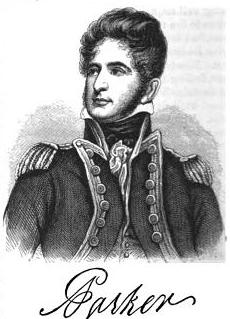
Sir Captain Peter Parker, R.N. (1785-1814)

Sir Peter Parker

Sir Peter Parker. From Lossing’s Field Book to the War of 1812

In October 1902, eighty-eight years after the War of 1812, a monument was dedicated on Caulk’s Field battlegrounds on Maryland’s Eastern Shore of Kent County. It commemorates both the British and American militia midnight encounter here on August 31, 1814. Sir Capt. Peter Parker was a descendant of several Royal Navy flag officers, he receiving command of H.M. frigate Menelaus in 1810. A popular often told story has been that Capt Parker, having received a mortal wound, was carried from the field to the Thomas Mitchell House (Maryland Pkwy. off Rt. 21) where he died in the kitchen, the soldiers having “got a blanket and sheet to wrap Sir Peter in.” The legend became interwoven into the popular culture of the War of 1812 and has become an integral myth of Kent County’s history. The house today is a popular bed and breakfast inn. Captain Parker’s remains however were never carried to the Mitchell House, but directly to his command, H.M. frigate Menelaus lying off today’s Parker Point. The origin of the story first appeared in the Daily National Intelligencer (D.C) soon afterward the battle.

Lieutenant Henry Crease, R.N., who assumed command upon Capt. Parker’s death, stated in his report: “It was at this time, while animating his men in the most heroic manner that Sir Peter Parker received his mortal wound which obliged him to quit the field and he expired in a few minutes.” After been taken onboard his remains were “placed into a coffin filled with whiskey.” The morning after, Captain Peter Parker’s right shoe exhibited a great deal of blood inside was found with the inscription found inside: “No. 20169 Parker, Capt. Sir Peter. Bt.” On September 3, the British made another raid in Kent County at the bay-shore farm of the same Thomas Mitchell who served as Commissary of Supplies for the Kent County militia, thus the story became linked to his death at the Mitchell house.

On September 7, the HM frigate Menelaus sailed down the bay “with her pennant half-mast high, a sign indicative of the death of Sir Peter Parker.” The Menelaus anchored with the ships in Baltimore harbor during the Battle for Baltimore. Afterwards his remains were transferred to H.M. frigate Hebrus for conveyance to Bermuda and buried at St. George’s Church, Bermuda. In the Spring of 1815 his remains were conveyed to St. Margaret’s Church at Westminster, London where he was buried.

Sources: Baltimore Federal Gazette, September 7, 1814; Baltimore Patriot, September 5, 1814; The Bermuda Historical Quarterly, Winter, 1944), 189-195; Logbook, HMS Tonnant, September 12, 1814 (Public Records Office, Admiralty Records 53/1385); Lt. Henry Crease, RN, HMS Menelaus to Vice Admiral Alexander Cochrane, September 1, 1814 (Alexander Cochrane Papers, Library of Scotland with copies at the Library of Congress, MS2329).

Published in: on March 25, 2011 at 7:15 pm  Comments Off on Sir Captain Peter Parker, R.N. (1785-1814)  

Brig. General Leonard Covington (1768-1813)

Leonard Covington

Leonard Covington

Leonard Covington, the son of Levin and Susannah (Maguder) Covington was born in Aquasco, Prince George’s County, Md., on October 30, 1768. At 24 years of age he entered the U. S. Army as a cavalry cornet (Mar. 14, 1792); a lieutenant of U.S. Dragoons in 1793, joining the army under General Wayne during the Battle of Fallen Timbersand subsequently promoted to a captaincy. On Sept. 12, 1795 he resigned and returned to Maryland engaging in agricultural pursuits; a Maryland Delegate (1802, 1807-09): U.S. House of Representatives (1805-1807). In January 1809 he was appointed lieutenant colonel of the U.S. Light Dragoons; colonel February 1809 serving at various stations (Baton Rouge, West Florida, 1810) and Fort Adams on the Mississippi (1810) until he was ordered to the Canadian frontier and appointed brigadier general on August 1, 1813.

In 1796 he married his second wife Rebecca Mackall of Calvert County and issued five children. He was mortally wounded at the Battle of Chryslers Field, Upper Canada on November 11, 1813, while animating his men forward in a charge, his last words being “Independence Forever.” He died at French’s Mills, N.Y., on November 14, 1813; his remains were removed to Sackets Harbor, Jefferson County, N.Y., August 13, 1820; place of burial now known as Mount Covington.

In early 1814, Fort Patapsco located to the west of Fort McHenry was renamed in his honor taking an active role in the Battle for Baltimore in Sept. 1814.

Source: Biographical Directory of the United States Congress; ‘Memoir of Leonard Covington’ by Benjamin Leonard Covington Wailes (Natchez Printing and Stationary Co., 1928): Marylanders Who Served the Nation, byGerson G. Eisenburg (Annapolis: Maryland State Archives, 1992).

Published in: on March 25, 2011 at 6:05 pm  Comments Off on Brig. General Leonard Covington (1768-1813)  

James McHenry (1753-1816)

James McHenry

James McHenry by DeNyse Turner. Maryland State Archives, MSA SC 1545-1029

James McHenry was born in Ballymena, County Antrim, Ireland, on November 16, 1753. He immigrated to America in 1771 and received a medical education at the Newark Academy (Delaware) under the tutorship of Dr. Benjamin Rush.

In 1776 he served as a physician during the Revolutionary War and then as an aide to General Lafayette. In 1781, having obtained the rank of major, he left the military and served in the Maryland Senate (1781-1783) and as a delegate to the Continental Congress (1783-1786) and delegate in 1787 to the federal Constitutional Convention. Following the convention he served in the Maryland State assembly (1787-1796).

In 1796, President George Washington offered McHenry a position in his cabinet as secretary of war until 1800 when he resigned under the John Adams administration. In 1798 Fort McHenry in Baltimore was named in his honor.Following his resignation, McHenry retired to Baltimore where he died on May 3, 1816 and is buried in Westminster Burying Ground.

Sources: The Life and Correspondence of James McHenry, by Bernard C. Steiner and James McHenry, (Cleveland: Burrows Brothers Co., 1907).

Published in: on March 25, 2011 at 1:30 pm  Comments Off on James McHenry (1753-1816)  

Congressman Charles Goldsborough (1765-1834)

Photo of portrait of Charles Goldsborough by C. Gregory Stapko. Maryland State Archives, MSA SC 1545-1006

He was the son of Charles and Anna Maria (Tilghman) Goldsborough of Hunting Creek, Cambridge, Md., a member of one Maryland Eastern Shore’s most oldest and prominent familes.

On April 2, 1813, two months after British warships entered the Chesapeake to enforce the blockade, Charles Goldsborough informed a congressional colleague, Harmanus Bleecker of New York, concerning the British depredations and consequent suffering among his constituents:

“…our bay trade has suffered extremely. Some of my poor neighbors are among the suffers, having lost their vessels and with them the principal source of support to their families…Our intercourse with Baltimore is entirely cut off, and consequently all of our means of procuring money. Should this blockade of the part of the bay continue three months longer, the Inhabitants of the Eastern Shore will be in extreme distress both for supplies for their families, and money to purchase them with. The War physics [is] working very well. No man, (not even the leading democrat) speaks in favor of the war. All express a wish for its termination. There will be nothing among us but poverty and privation…The old Muskets, which had been lying by for years in ignoble idleness and rust, were rubbed up, and some new ones procured. All the uniform coats which had been formerly got for show were now put on for fight; every hat was garnished with a red muslin band, the drums beat to Arms, and [the] American standard was unfurled…”

The British had anchored off Goldsborough’s Horn Point farm, but made no attempt to land. The British departed on March 20th, and sailed up the Chesapeake.

In June 1812, as a federalist he was one of three Maryland congressmen to vote against a declaration of war. A graduate of the University of Pennsylvania in 1784, he had served in the Maryland State Senate (1791-1795, 1799-1801); U.S. House of Representatives (1805-1817) and as Governor of Maryland (1818-1819). He died on December 13, 1834 and was buried at Christ Episcopal Church Cemetery in Cambridge, Md.

Sources: Eisenberg, Gerson G. Marylanders Who Served the Nation: A Biographical Dictionary of Federal Officials from Maryland. (Annapolis: Maryland State Archives, 1992); Easton Album by Norman Harrington (Easton: Historical Society of  Talbot County, 1986).

Published in: on March 25, 2011 at 10:25 am  Comments Off on Congressman Charles Goldsborough (1765-1834)  

Joseph Hopper Nicholson (1770-1817)

Joseph Hopper Nicholson, MSA SC 3520-1893

Joseph Hopper Nicholson was from one of the most influential and oldest families on Maryland’s Eastern Shore at Centreville, whose linelage dates back to 17th century Maryland. Born on May 15, 1770 in Chestertown, Queen Annes County, Maryland he graduated from Chestertown [Washington] College in 1787 and served in the Maryland House of Delgates (1796-1798), U.S. House of Representatives(1799-1806). In 1804 he conducted the impeachment hearings of Associated Chief Justice 0f the U.S. Supreme Court, Samuel Chase of Maryland. Two years later he introduced a House bill that became known as the “Nicholson Resolution” that became the first of several Non-Importation Acts that resulted in the unpopular Embargo Act of 1807. He resigned in 1806 to become the Chief Judge of the Maryland’s Court of Appeals in Baltimore, holding this post until his death.

On May 16, 1812 at Baltimore’s Old Fountain Inn, fifty delegates of the Democratic-Republican Party, with Judge Nicholson presiding as chairman, met to present several resolutions in a memorial to the President James Madison on the momentous decision that the nation was now affixed upon – a declaration of war with England. Foremost of the delegates was Hezekiah Niles, the influential editor of the Niles’ Weekly Register, who reported the evening’s proceedings arguing that England “… forcibly impresses our seamen, and detains them inhumanely in an odorous servitude – she obstructs our commerce in every channel…she had murdered our citizens within our own waters…” Such were the sentiments of the delegates many of whom were connected by livelihood to the popular “free trade and sailor’ rights” issues, one of several that led the U.S. to declare war upon England on June 18, 1812.

Judge Nicholson was a well known and eloquent orator rose to address the gathering:

“…We have assembled here to-night, for the purpose of determining whether we will give it our support in the might struggle into which [our country ] is about to enter …Is there an American sword that will not leap from its scabbard to avenge the wrongs and contumely treatment under which we have suffered? No, my countrymen, it is impossible. Let us act with one heart, and with one hand; let us show to an admiring world, that however we may differ among ourselves about some of our internal concerns, yet in the great cause of our country, the American people are animated by one soul and by one spirit…”

In May 1814, he organized a U.S. Volunteer militia artillery company known as the Baltimore Fencibles, whose muster rolls included mercantile merchants, ship-owners and bankers. In May 1814 with an invasion of the Chesapeake eminent, Nicholson informed the U.S. Naval Secretary “We should have to fight hereafter, not for ‘free trade and sailors’ rights,’ not for the conquest of the Canadas, but for our national existence.” During the bombardment of Fort McHenry they manned the guns within Fort McHenry. After the war he conbtinued on the judicial bench until his death in Baltimore on March 4, 1817. He was buried at Wye House, home of the Lloyds of Maryland in Talbot County, on Maryland’s Eastern Shore.

Source: “Joseph Hopper Nicholson: Citizen-Soldier of Maryland,” by Scott S. Sheads (Maryland Historical Magazine, vol. 98, No. 2, 2003).

Published in: on March 25, 2011 at 10:05 am  Comments Off on Joseph Hopper Nicholson (1770-1817)  

Sheppard Church Leakin (1790-1867)

Sheppard Church Leakin’s ancestors emigrated from Northumberland, England, in 1684, acquiring an estate on Humprhey’s Creek on the Patapsco Neck at Baltimore. The son of John and Elizabeth (Irvine) Leakin of Govanstown, Md., he was born on April 25, 1790 and later married Margaret Dobbin of St. Michaels’ on Maryland’s Eastern Shore. Prior to the war he served in various occupations as printer and book store proprietor. During the war he resided at “Lodge Farm” on on Humphrey’s Creek with a townhouse in Fell’s Point.

At the age of twenty-three, Leakin received a captaincy on May 20, 1813 in the 38th U.S. Infantry under the command Lt. Colonel William Steuart. During the spring 1814 he commanded Fort Covington (a mile west of Fort McHenry) and during the summer we find him on the lower Patuxent River in concert with Commodore Joshua Barney’s U.S. Chesapeake Flotilla at the Battle of St. Leonard’s Creek. He also served at Fort McHenry during the bombardment of Sept. 13-14, 1814 and later in 1818 as captain of militia in the Eagle Artillery company. His character was described by none other than Lt. Colonel George Armistead of Fort McHenry as “…I found him vigilant and prompt, his company in a fine state of discipline – his conduct conduct during the bombardment was such as to deserve [my] entire approbabtion…”

He served as High Sheriff of Baltimore County (1822) and Mayor of Baltimore (1838-40). In 1836 he was one of the founders of what became known as the Old Defenders’ Association of Baltimore in 1814. In 1862 he was commissioned major general of the First Light Division of Maryland US Volunteers.

He died on November 20, 1867 at his country estate of “Spring Hill” near Relay, Md., at the age of 78.

Source: The Sun, November 21, 22, 1867; American & Commercial Daily Adv., May 11, 1814 and August 16, 1818;  Wilbur F. Coyle, The Mayors of Baltimore (Baltimore: The Baltimore Municipal Journal, 1919), p. 55-57.

Published in: on March 25, 2011 at 9:40 am  Comments Off on Sheppard Church Leakin (1790-1867)  

Thomas Ruckle (1776-1853):Veteran War of 1812 Artist

Battle of North Point by Thomas Ruckle

Within the galleries of the Maryland Historical Society are two paintings: Defense of Baltimore: Assembling of the Troops, September 12, 1814 and Battle of North Point, Near Baltimore, Sept.12, 1814. Both were by artist and veteran of the battle Thomas Ruckle, a corporal in Captain George Steuart’s the Washington Blues, 5th Maryland Regiment.

Little is known of his early life other than he was the son of John and Elizabeth (Piper) Ruckle born in Embery, Ireland in 1776. In the late 18th century the family immigrated to Baltimore where his father took up the dry goods trade in 1802 on Market Street. On Nov. 28, 1798 at the age of twenty-two, Thomas married and took up residence near the Roman cathedral, and in May 1811 entered into business advertised as “House and Sign Painters & Glaziers”

In 1812 Thomas enlisted as a corporal in Captain George H. Steuart’s (1790-1867) Washington Blues, 5th Maryland Regiment and was present at the Battle of North Point on Sept. 12, 1814. His experience enabled him to recollect the preparations and the battlegrounds for two of his most famous paintings, The Defense of Baltimore Assembling of the Troops, September 12, 1814” (c.1820) and Battle of North Point, near Baltimore, September 12, 1814. (c. 1830).

Two of his sons, Thomas Coke and William Hogarth became accomplished artists in their own right the latter wrote his father in 1830, , “…Painters must be ambitious to excel. Don’t stop for trifles…Push ahead and in time the name of the Ruckles shall make as much of a noise in the United States as the famous Peales’ [family]…” On September 4, 1853, Thomas died at the age of seventy-seven and was buried at Mount Olivet Cemetery in east Baltimore.

Sources: (Extract- New Discoveries and Interpretations: The War in the Chesapeake, 1812-1815 by Scott S. Sheads (unpublished, 2011); The Sun, Sept. 17, 1830; Sept. 6, 1853; July 3, 1903.

Published in: on March 25, 2011 at 9:15 am  Comments Off on Thomas Ruckle (1776-1853):Veteran War of 1812 Artist  

Lt. Colonel George Armistead, (1780-1818)

“The President promptly sent my promotion with a very handsome compliment. So you see me dear wife, all is well, at least your husband has got a name and standing that nothing but divine providence could have given him, and I pray to our Heavenly Father we may live long to enjoy.” Armistead to his wife Louisa Armistead, Sept. 1814.

George Armistead

George Armistead was born on April 10, 1780, in Caroline County, Virginia, to John and Lucinda (Baylor) Armistead, one of five brothers, three of whom later served in the War of 1812. Armistead enlisted in the U.S. Army in 1799, rising steadily through the ranks until March 3, 1813 when he received his majority and subsequently distinguished himself on May 18th while serving as an artillery officer at Fort Niagara, New York, in the capture of Fort George across the Niagara River in Upper Canada. He was accorded the honor of delivering the captured British flags to President Madison.

On his taking command of Fort McHenry in June 1813, Armistead requested a flag for his new garrison flag measuring 42’ x 30’, a standard size for the period. The flag and his victory over a British naval bombardment on Sept. 13-14, 1814 earned his enduring place in American history under that flag at Fort McHenry whose stalwart defense of Baltimore against the British attack in 1814 inspired Francis Scott Key to write The Star-Spangled Banner. Armistead would remained in command of the fort until his untimely death at age 38 on April 25, 1818.

In 1810, then Captain Armistead married at the Otterbein Church, Baltimore, Louisa Hughes (1789-1861), daughter of Baltimore silversmith Christopher Hughes, Sr. Colonel Armistead is buried along with his wife and nephew Brig. Gen. Lewis Addison Armistead, CSA (1817-1863) in Old St. Paul’s Cemetery in Baltimore.

Source: Sheads, Scott S., Guardian of the Star-Spangled Banner: Lt. Col. George Armistead and The Fort McHenry Flag (Baltimore: Toomey Press, 1999)

Published in: on March 24, 2011 at 9:43 pm  Comments Off on Lt. Colonel George Armistead, (1780-1818)  

“The Boy Martyrs of 1814”: Daniel Wells and Henry G. McComas

During the Battle of North Point, in a pre-battle skirmish these two “boys” (18 & 21 years of age) are reputed to have killed Major General Robert Ross, RA. as the army advanced towards Baltimore on September 12, 1814. This popular event heighten great interest in the “folklore” of the Battle for Baltimore.


The popularity of the Wells and McComas story was further heighten on the evening of September 15, 1859 at the Holliday Street Theatre in Baltimore, when the famous playwright, dramatis, actor and theatre manager Clifton W. Tayleure (1832-1891) produced in three acts “The Boy Martyrs of Sept. 12, 1814: A Local Historical Drama.” It was complete “with representations of The Battle of Bladensburg, The Rescue of the Colors, The Bombardment of the Fort, Death of Ross, and the Battle of Baltimore.”


Only a year before were the remains of Daniel Wells and Henry G. McComas were removed from their temporary graves at Green Mount Cemetery and reposed in state in the Hall of the Maryland Institute, then to Ashland Square in west Baltimore where they were interred, awaiting the completion of the monument in their honor in May 1872.


Sources: “The Boy Martyrs of Sept. 12, 1814: A Local Historical Drama.” (Boston: Wm. V. Spencer, 1859); The Sun, September 11, 1858.

Published in: on March 24, 2011 at 9:01 pm  Comments Off on “The Boy Martyrs of 1814”: Daniel Wells and Henry G. McComas  
Tags: