Elizabeth Sands (1789-1890): Angel on the Battlefield

Elizabeth Warner was born on March 7, 1789 in Darlington, Harford County, Md., the daughter of clockmaker Cuthbert and Ann Warner who removed their family to Baltimore shortly thereafter.

Following the Battle of North Point, Sept. 12, 1814, Elizabeth and several other ladies tended to the wounded and dying on the field. Three of her brothers had served in the battle; John S. Warner (Capt. Aisquith’s First Baltimore Sharp Shooters) and Thomas and Andrew E. Warner both captains in the 39th Maryland Militia. She made her brother John’s rifle uniform of “bottle green, including his hat with a double row of black bugles [buttons on his coat (?)].”

After the war Elizabeth, described as having “a sprightly conversation and is highly entertaining” was made “an honorary member” of the Old Defenders’ Association of 1814,  On each Defenders’ Day in September upon the anniversary of the battle, she wore with pride “the blue and gold badge of the association”, and through her remaining years witnessed in her later years the Defenders’ parade from a window at her home on Eutaw and Madison streets. 

In July 1824 she married John Sands who made “handsomely engraved minatures of the General Marque de Lafayette during the French officer’s to Baltimore. John Sands died in 1829. Elizabeth died on August 3, 1890 at the age of 101 years outliving all the known War of 1812 veterans of Maryland. Her final resting place is unknown.

Sources: The Sun, Sept. 7, 1887; March 6, 1888; July 26, 1890; Aug. 4, 1890; Sept. 29, 1890; Baltimore Patriot, Aug. 24, 1824.

Published in: on April 3, 2011 at 8:47 am  Comments Off on Elizabeth Sands (1789-1890): Angel on the Battlefield  

Federal Hill: Major General Samuel Smith Monument

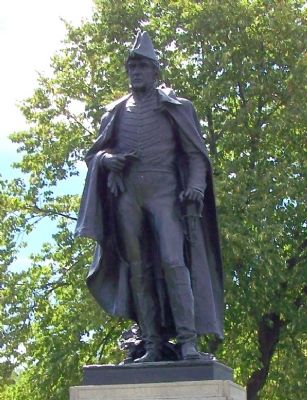
Major General Samuel SmithOverlooking Baltimore Inner Harbor waterfront on Federal Hill stands the statue of Major General Samuel Smith (1752-1839), Revolutionary War officer, merchant, ship-owner, and U.S. Senator earned him the experience and fortitude in the momentous crises before to successfully command Baltimore during the War of 1812 and it’s darkest hour the Washington-Baltimore campaign of 1814

The statue itself was by German sculptor Hans Schuler (1874-1951) who studied at the Maryland Institute College of Art in Baltimore. The original site location where the statue was erected in 1917 was Wyman Park at North Charles and 29th Street dedicated on Independence Day, July 4, 1918 funded by the 1914 centennial celebration four years earlier.

In 1953 Baltimore’s City of Recreation and Parks Department moved the sculpture to Sam Smith Park at the corner of Pratt Street and Light Street, the future waterfront site of the 1980 Rouse Company project – Harborplace Market. In 1970 with the Inner Harbor renewal project underway the statue was relocated to its present site on Federal Hill, where in 1814 a gun battery had been erected and the citizens of Baltimore witnessed the fiery bombardment of Fort McHenry.

Today, Federal Hill, a National Historic Landmark, shares its high honor with Maryland’s pre-imminent citizen soldier, both overlooking the city that gave birth to a new national hymn “The Star-Spangled Banner.”

[Monument Inscriptions]

MAJOR-GENERAL SAMUEL SMITH, 1752-1839 / UNDER HIS COMMAND THE ATTACK OF THE BRITISH UPON BALTIMORE BY LAND AND SEA SEPTEMBER 12-14, / 1814 WAS REPULSED. MEMBER OF CONGRESS FORTY SUCCESIVE YEARS, / PRESIDENT U.S. SENATE, SECRETARY OF THE NAVY, MAYOR OF BALTIMORE. /HERO OF BOTH WARS FOR AMERICAN INDEPENDENCE – LONG ISLAND – WHITE / PLAINS – BRANDYWINE – DEFENDER OF FORT MIFFLIN – VALLEY FORCE – / MONMOUTH – BALTIMORE. /

ERECTED BY THE NATIONAL STAR-SPANGLED BANNER CENTENNIAL

Source: (Extract) New Discoveries and Interpretations: War of 1812 in Maryland by Scott S. Sheads (unpublished, 2011)

Published in: on April 1, 2011 at 8:20 pm  Comments Off on Federal Hill: Major General Samuel Smith Monument  

Lt. Colonel George Armistead Monument, Federal Hill

Armistead Monument

Armistead Monument

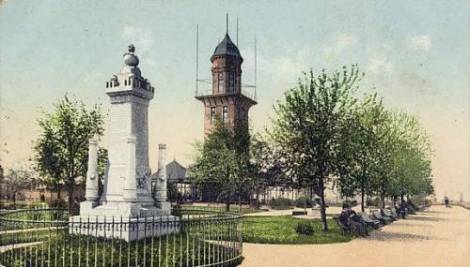
On April 25, 1818, Brevet Lt. Colonel George Armistead (1780-1818), age 38, died at the home of his brother-in-law Christopher Hughes, Jr. His funeral procession included the 1814 defenders’ of Fort McHenry and citizens who proceeded to Old St. Paul’s Cemetery while minute guns were fired from the Federal Hill Observatory. Here among the enclosing stone walls of the burying ground his remains were laid to rest. On the high earthen eminence of Federal Hill overlooking Baltimore’s waterfront is a marble monument to the commander of Fort McHenry during the War of 1812.

The City Spring, 1827 – Nine Years after his death the first monument was authorized by Mayor Jacob Small on March 24, 1827 and February 4, 1828 for its erection at the Old City Spring on Calvert and Saratoga Sts., the best known of the city’s many natural springs, located in what was a fashionable ornamental resort of Baltimore’s social elite. Its construction was directed by German merchants Peter Hoffman and Jesse Hollingsworth, the grounds designed by architect John Davis. By the Civil War the monument had already become dilapidated and in ruins from vandals and neglect. On September 12, 1882 was rebuilt and dedicated upon Federal Hill, a municipal park where it may be seen today.

The Monument – The monument represents “a cenotaph surmounted by a short column, and rests upon a plinth, or terrace, of the same material, forty feet square and four feet high. At each angle is placed a cannon, erect, having a [cannon] ball apparently issuing from its mouth.”

[Monument Inscriptions]

[North Side] – This monument is erected in honor of the gallant defender of Fort McHenry near this city during its bombardment by the British fleet on the 13th and 14th September 1814. He died universally esteemed and regretted on the 25th of April 1818 in the 39th year of his age.

[West side] – Appointed Second Lieutenant of 7th Infantry January 8th 1799. Appointed Ensign of Infantry January [illegible] 1799. Appointed First Lieutenant of the 7th Infantry May 14th 1800. Transferred to the 1st Regiment of Artillerists and Engineers February 16th 1804. Appointed First Lietenant in the Regiment of Artillerists April 17th 1802. Appointed Assistant Military Agent at Fort Niagara [NY] May 1802.

[East side] – Transferred to the [U.S.] Artillery Corps under the Act of May 20th 1814. Appointed Brev. Lieut. Col September 20th 1814 for gallant services in defense of Fort McHenry September 12th, 13th, and 14th 1814 [as] such from September 12th 1814.

[South side] – Erected by the Mayor and City Council of Baltimore September 12th 1882. Wm. Pinkney White, Mayor, in pursuance of a resolution approved May 3rd 1882, as a substitute for the monument erected by a former Mayor and City Council, in pursuance of resolutions approved March 4th 1827 and February 4th 1828, which stood in the Calvert street Spring grounds until it became defaced and destroyed by time during a period of thirty-five years.

Source: (Extract) The War of 1812 in Maryland: New Discoveries & Interpretations by Scott S. Sheads (2011, unpublished); Baltimore” Past and Present with Biographical Sketches of the Representative Men (Baltimore: Richardson & Bennett, 1871, 296; “Baltimore Water Works,” History of Baltimore City and County, by J. Thomas Scarf (Philadelphia: Louis H. Everts, 1881); Federal Gazette, April 25, 1812; Baltimore Gazette, April 6, 1827.

Published in: on April 1, 2011 at 8:15 pm  Comments Off on Lt. Colonel George Armistead Monument, Federal Hill  

Fort Covington (1813-1836)

During the summer of 1813 several shore fortifications were under construction contiguous to Fort McHenry as precautionary defenses to the west of Fort McHenry guarding the Ferry Branch approach to Baltimore. Among these was Fort Covington named for Brig. General Leonard Covington (1788-1813) a Maryland native who was killed at the Battle of Chrysler’s Field in Upper Canada, Nov. 11, 1813. Prior the site was known as Fort Patapsco or Fort Wadsworth, named for Decius Wadsworth, U.S. Chief of Ordnance Department.

The fort was designed by Capt. Samuel Babcock, U.S. Corps of Engineers as a V-shaped 10’ high brick wall enclosure. In front facing the harbor was a 16 foot high ditch and parapet calculated for a battery of 10 or 12 18-Pdr cannon mounted en-barbette (to fire over the earthen walls), with quarters sufficient for a company and a powder magazine. Completed that fall and renamed, it was garrison by Captain Matthew S. Bunbury’s naval company of U.S. Sea Fencibles.

During the Battle for Baltimore, Sept 12-14, 1814 the services of the Fencibles were replaced by Lt. Henry S. Newcomb’s U.S. naval command of eighty sailors who had arrived from Philadelphia with Commodore John Rodgers command of the U.S. frigate Guerriere. On the wind-swept stormy night of Sept, 13 Fort Covington along with nearby Battery Babcock and Fort Look-Out, successfully repulsed a British flotilla advance having past to the west of Fort McHenry. The advance was checked and the British withdrew to the safety of the fleet in the outer harbor.

In the post war years a small detachment guarded the government property until 1836 when all of its materials were sold at public auction. No remains are left today near the site of The Sun newspaper facilities.

Sources: Capt. Samuel Babcock to U.S. Secretary of War John Armstrong, Dec. 1, 1813; Lt. Henry S. Newcomb to Commodore John Rodgers, Sept. 18, 1814. Rodgers Papers, Library of Congress; The Rockets Red Glare: The Maritime Defense of Baltimore in 1814 by Scott S. Sheads (Centerville, Md., Tidewater Pub., 1986).

Published in: on April 1, 2011 at 8:15 pm  Comments Off on Fort Covington (1813-1836)  

Sailing Master Leonard Hall: Federal Hill, September 1814.

Baltimore From Federal Hill, c. 1822

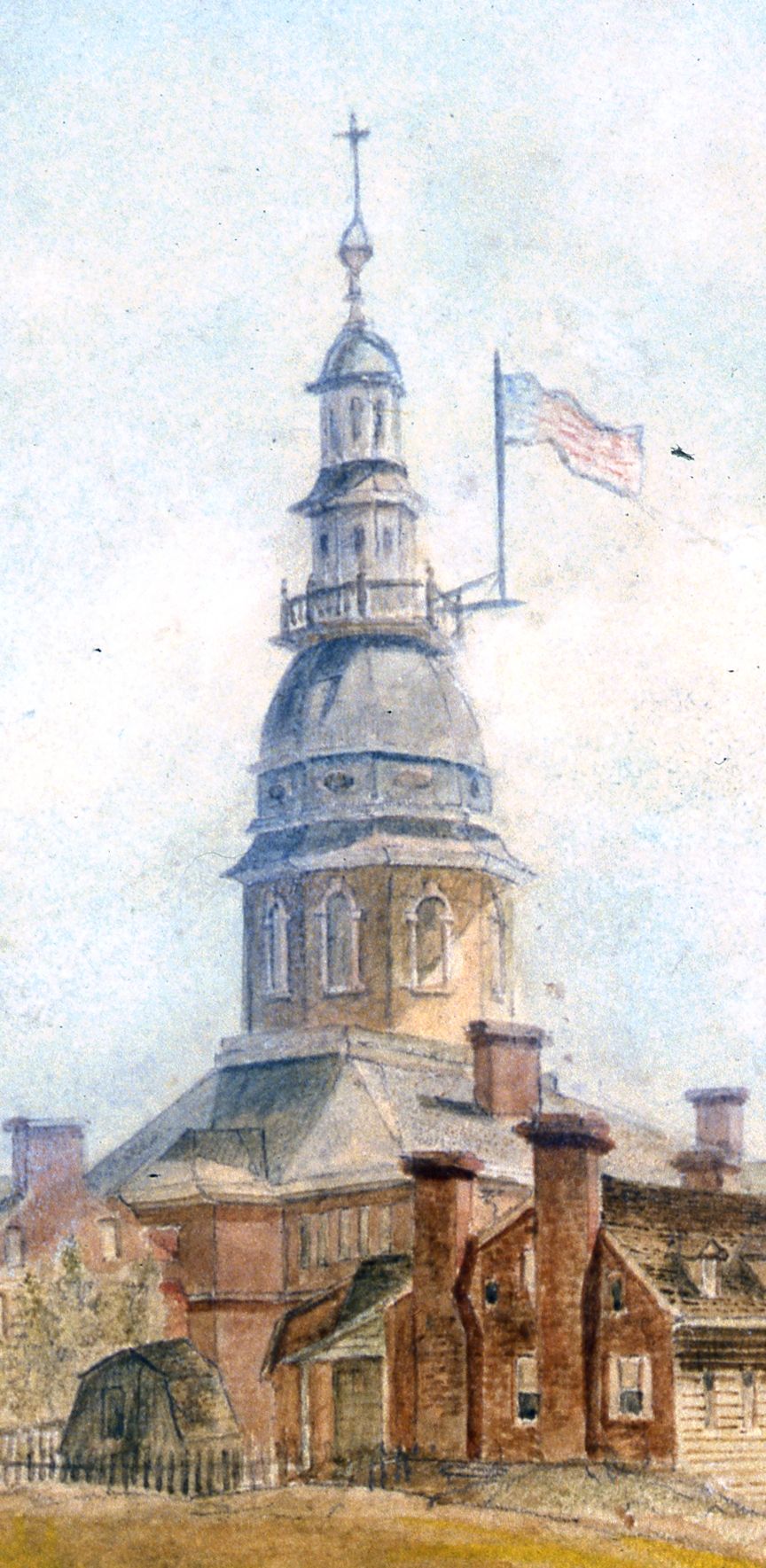
The Observatory of David Porter, Sr. –  As early as 1797 a wooden signal tower hoisted company merchant flags to merchants below of vessels arriving in from the bay ten miles down the Patapsco River. Thus the dock workers could prepare for arrival. His son David Porter, Jr. would later command the U.S. frigate Essex in it’s epic voyage to the Pacific in 1813-14 and later defend the British passage down the Potomac River from Alexandria, Va.,in August 1814. On September 12th the hill played a new role with the sighting of the British invasion fleet entering the Patapsco River when a 6-Pdr. field gun was fired three times warning the city on the approaching forces.

Sailing Master Leonard Hall, USN. – On the heights of Federal Hill overlooking Baltimore harbor, citizens gathered on the evening of August 24, 1814 to view the omnious glow of Washington burning fifty miles to the south. During the bombardment, Fort McHenry could be “…distinctly seen from Federal Hill, and from the tops of houses which were covered with men, women, and children…the whole awful spectacle of shot and shells, and rockets, shooting and bursting through the air. On the night of the bombardment, not withstanding his extreme indispodition bro’t on by excessive labor and indifference to the symptons of approaching illness, he insisted on remaining at the battery formed by himself on Federal Hill.”

Leonard Hall, a native of New Hampshire, died On September 22, 1814 “… occasioned by his excertions and nightly exposure…” His final resting place is unknown.

Sources: Salem Gazette, Mass., Sept. 28, 1814; “Defending Baltimore in the War of 1812″ Two Sidelights,” by Scott S. Sheads, Maryland Historical Magazine.

Published in: on April 1, 2011 at 7:55 pm  Comments Off on Sailing Master Leonard Hall: Federal Hill, September 1814.  

British Prisoners at North Point, Sept. 1814

In the early hours of September 14, 1814, the British began their withdraw from Baltimore down the North Point Road towards their awaqiting transports at North Point.  Captain James Bird’s U.S. Light Dragoons engaged the rear guard and captured the following prisoners.

William Corndoff……Corporal…..21st Royal Scots Fusileers

Hugh Brown………….Private……..21st Royal Scots Fusileers

Michael Boyle……….private……..21st Royal Scots Fusileers

George Hood………..private……..21st Royal Scots Fusileers

William Armor……..private……..21st Royal Scots Fusileers

Archibald Cotz……..private……..21st Royal Scots Fusileers

Charles Scoffin……..private………21st Royal Scots Fusileers

Joseph Davenport..private……….44th Regiment

William Matthews…private…………4th Regiment

William Riley……….private…………4th Regiment

William Hochreday.private…………4th Regiment

Edward Allison…….private………….4th Regiment

These British prisoners were taken under guard by Ensign Presley Cordell, 57th Virginia Militia to Frederick Town, Maryland arriving September 17 where District Marshall & Agent for Prisoners Capt. Morris Jones took charge of them. Thier final deposition is unknown.

Source: William H. Winder Papers, Maryland Historical Society.

Published in: on April 1, 2011 at 7:50 pm  Comments Off on British Prisoners at North Point, Sept. 1814  

“War Hawks” of the Twelfth U.S. Congress, 1812

“War Hawks” is a new coined phrase name for the democratic party that promises to become current in the federal papers. This is manufactured for the purpose of deceiving the people into the impression that the democrats have been desirous of provoking hostilities with England. ..Yet we are “war hawks” for maintaining those rights which we struggled for so long and so successfully, but which those peaceable lambs of federalism would have yielded at once to their much loved “mother Britain.”

The term “war hawk” has always been thought for the past century to have been coined by the prominent Virginia Congressman John Randolph of Roanoke, a staunch opponent of entry into the war in 1812, but now the ownership has been found to be in error.

The phase goes back as early as 1793 prior to the Quasi-War (1797-1800) with France. The phrase is rather an informal Americanism to describe a political position for war to be aggressive by diplomatic and ultimately military means, to improve one’s government or political party. In June 1812, as the nation prepared for a declaration of war against Britain, to was used to described members of the Twelfth U.S. Congress who advocated war against Britain and who had key positions to considerable influence in the course of congressional debates.

The phase has evolved into an informal term usually contrasted with the word dovish, alluding to a peaceful dove, and hark in modern use, describes those, like a bird of prey who seeks war. In Congress, the twenty or so members of the “war hawks” were Democratic-Republicans who had been imbued with the ideals of the American Revolution, and were primarily from southern Virginia, Kentucky, Tennessee, and Ohio and the western territories calling for an “Onward to Canada” invasion.

Those for war were mostly Republican-Congressional members who advocated towards war for the interference of the Royal Navy in American commerce of impressment of American sailors and to cripple the American economy and prestige by the English Orders of Council. There was never an “official” list of the war harks, rather it was used to described about a dozen congressional members and no less than the U.S. Speaker of the House Henry Clay of Kentucky and John Calhoun of South Carolina, both major players in American politics. Others were Richard Johnson (KY); William Lowndes (SC), Langdon Chevers (SC), Felix Grundy (TN) and William W. Bobb (GA).

Older members of the party led by U.S. President James Madison and Secretary of the Treasury Albert Gallantin tried unsuccessfully to defeat the war hawks movement feeling the nation was not yet prepared for war. Yet, on June 18, 1812 by a vote of 79 to 49 in the U.S. House of Representatives, and of 19 to 13 in the U.S. Senate, war was declared.

Sources: The Maryland Republican, July 15, 1809; The War of 1812: A Forgotten Conflict by Donald R. Hickey (Chicago: University of Illinois Press, 1990).

Published in: on April 1, 2011 at 7:35 pm  Comments Off on “War Hawks” of the Twelfth U.S. Congress, 1812  

A Meeting at the Fountain Inn, May 16, 1812: “Let us act with one heart…”

On this day, fifty delegates of the Democratic-Republican Party, with Judge Joseph Hopper Nicholson (1770-1817) presiding as chairman, met at Baltimore’s Old Fountain Inn to present several resolutions in a memorial to the President of the United States, James Madison, on the momentous decision that the nation was now affixed upon – a declaration of war with England. Mr. Nicholson, a former Congressman from Maryland, and a eloquent orator rose to address the gathering:
 

Fountain Inn

Fountain Inn. Maryland Historical Society, Baltimore.


 “…We have assembled here to-night, for the purpose of determining whether we will give it our support in the might struggle into which [our country ] is about to enter …Is there an American sword that will not leap from its scabbard to avenge the wrongs and contumely treatment under which we have suffered? No, my countrymen, it is impossible. Let us act with one heart, and with one hand; let us show to an admiring world, that however we may differ among ourselves about some of our internal concerns, yet in the great cause of our country, the American people are animated by one soul and by one spirit…”


Foremost of the delegates was Hezekiah Niles, the influential editor of the Niles’ Weekly Register, who reported the evening’s proceedings in his newspaper, arguing that England “… forcibly impresses our seamen, and detains them inhumanely in an odorous servitude – she obstructs our commerce in every channel…she had murdered our citizens within our own waters…” Such were the sentiments of the delegates many of whom were connected by livelihood to the popular “free trade and sailor’ rights” issues, one of several that led the U.S. to declare war upon England on June 18, 1812.


Source: “Joseph Hopper Nicholson: Citizen Soldier of Maryland,” by Scott S. Sheads (Maryland Historical Magazine, Summer 2003),132-151.


Published in: on April 1, 2011 at 7:27 pm  Comments Off on A Meeting at the Fountain Inn, May 16, 1812: “Let us act with one heart…”  

“The Alarm Guns Have Just Fired – Every Man Is In Arms!” September 10, 1814

On September 7, following the capture of Washington on August 24, the British consolidated their naval and military forces at Tangier Island, Va. The British fleet, consisting of ships-of-the-line, frigates, sloops, schooners, troop transports, and bomb ships sailed up the Chesapeake – an armada of fifty warships.

At 1:30 p.m. on September 10th the alarms guns at Forts Madison and Severn were fired and church bells tolled as the British fleet, stretching to the horizon made their passage past Annapolis. “They could be distinctly ascertained from the haziness of the weather.” Panic overtook the city as residents gathered their belongings in wagons, militia companies assembled on the town greens, as express riders carried the news to Baltimore and Washington. The offices of the Maryland Gazette have all been called out for the city’s defense. Militia look-out posts on the Patapsco River ten miles northward raised their signal flags to like flags in Baltimore. The broad pennants of three British Admirals – Cochrane, Cockburn and Malcolm flew from the mastheads of His Majesty’s Ships Marlborough, Albion and Tonnant. Two weeks before in a letter to President Madison, Vice Admiral Cochrane declared his intention “to destroy and lay waste such towns and districts upon the coasts as may be found assailable.” Annapolis would be spared as the British sailed northward towards Baltimore.

Maryland and Virginia militia companies began to march to Annapolis, then to Baltimore. Seven days later, with defeat at Baltimore and the last major campaign in the Chesapeake, Annapolis for the last time witnessed the passing of the Royal Navy.

Sources: Maj. Barney to Samuel Smith, September 10, 1814, Maine Portland Gazette, September 19, 1814.

Published in: on April 1, 2011 at 7:21 am  Comments Off on “The Alarm Guns Have Just Fired – Every Man Is In Arms!” September 10, 1814  

Tripoli Monument, U.S. Naval Academy

Naval Monument. From Lossing's Pictorial Field Book of the War of 1812.

Naval Monument. From Lossing's Pictorial Field Book of the War of 1812.

The ornate, allegorical Tripoli Monument, as it is better known today, is one the oldest military monuments in the U.S. that honors the heroes of the First Barbary War (1801-1805) against the North African Barbary pirates; Captain Richard Somers, Lieutenant James Caldwell, James Decatur Henry Wadsworth, Joseph Israel and John Dorsey. Commodore David Porter (father of David Porter, Jr. of 1812 fame) initiated the project to create a memorial for the six U.S. naval officers who perished.

In 1804, to protect our Mediterranean trade, President Thomas Jefferson ordered the nation’s tiny naval force to protect U.S. trade against the pirates, who demanded ransom for safe passage of merchant ships. “Millions for defense, but not on cent for tribute” had became the rallying cry for this war. Jefferson’s action established the doctrine of extension of power overseas and created a permanent United States Navy.
The monument was carved in 1806 in Italy by Giovanni Charles Micali, of Leghorn, Italy, who designed and executed the Tripoli Naval Monument, with marble from Carrara. The disassembled monument arrived in New York in November 1807 onboard the US frigate Constitution and was soon on its way to the U.S. Naval Yard at Washington..

The monument suffered damage during the British occupation of the yard during the War of 1812, whether it was due to the British or the firing of the yard remains still unclear. The monument remained at the Navy Yard until 1831, when Congress ordered it placed in the center of the reflecting pool at the base of the steps on the west side of the Capitol. In 1860 it was moved to the U.S. Naval Academy.


Published in: on April 1, 2011 at 7:00 am  Comments Off on Tripoli Monument, U.S. Naval Academy