Baltimore Bellona Gunpowder Manufactory (1801-1856)

“Baltimore Bellona Gunpowder Manufactory. The proprietors have commenced manufacturing and offer for sale Gunpowder of a superior quality, and refined Saltpetre. NATHAN LEVERING.” Federal Gazette, December 5, 1801.

The Bellona Gunpowder Manufactory was Maryland’s most extensive powder works established seven miles north of Baltimore along the Jones Falls west of Towson, Baltimore County, Maryland, receiving its name from the Roman Goddess of War – Bellona. It was one of four known Baltimore powder mills, all competing with the famous Eleuthere Irenee du Pont de Nemours & Company along the Brandywine River in Delaware. All delivered gunpowder to Maryland during the War of 1812. The manufactory in 1810 was capable of making thirty-two quarter casks per day. It was governed by several leading citizens, one of whom was James Beatty, U.S. Naval Agent in Baltimore who later had the company incorporated by an act of the General Assembly on April 16, 1815.

 The company’s agent, Aaron Righter Levering (1784-1852) of German descent, served during the war as captain of the Baltimore Independent Blues, 5th Maryland Regiment at the Battle of North Point, Sept. 12, 1814. Subsequent explosions at the mill in 1812, 1820-21, and 1833 did not diminish its production until 1856 when the site was sold to the City of Baltimore as a water works and soon found itself submerged below the waters of Lake Roland, Baltimore County.

 Sources: “An Act to Incorporate the Bellona Gunpowder Company of Maryland,” Archives of Maryland, Vol. 192, pp. 1625-1626, Maryland State Archives; Maryland Gazette, June 13, 1810; The Sun, June 28, 1852.

Published in: on March 29, 2011 at 8:30 pm  Comments Off on Baltimore Bellona Gunpowder Manufactory (1801-1856)  

British “Return of Killed and Wounded in action with the Enemy, near Baltimore, on the 12th of September 1814.”

During the two hour Battle of North Point the number of killed and wounded may be established correctly with the following report made by Assistant Adjutant General Major Henry Debbieg of the 44th Regiment (East Essex) Foot under Lt. Colonel Arthur Brooke who assumed command of the land forces following the death of Maj. General Robert Ross.

Killed

Major General Robert Ross…1

Royal Marine Artillery…1

4th Regiment (King’s Own) , 1st Battalion…1

21st Regiment (Royal Scots Fusileers), 1st Battalion.….11

44th Regiment, 1st Battalion (East Essex)…11

85th Light Infantry, 1st Battalion…3

Royal Marines, 2nd Battalion…4

Royal Marines, 3rd Battalion…2

Royal Marines detached from ships attached to 2nd Battalion…2

Detachment of Royal Marines under Captain Robyns…2

Wounded

Royal Artillery…..6

Royal Marine Artillery…3

4th Regiment (King’s Own) , 1st Battalion…13

21st Regiment (Royal Scots Fusileers), 1st Battalion.…81.

44th Regiment (East Essex), 1st Battalion…88

85th Light Infantry, 1st Battalion….29

Royal Marines, 2nd Battalion..10

Royal Marines, 3rd Battalion…11

Royal Marines detached from ships attached to 2nd Battalion…1

Detachment of Royal Marines under Captain Robyns…10

Total Killed…38

Total Wounded..252

Officers Killed…2

Officers Wounded..11

Source:“Return of the Killed and Wounded in Action with the Enemy, near Baltimore, on the 12th of September 1814,” by Assistant Adjutant General Major Henry Debbieg of the 44th Regiment (East Essex) Foot. Printed in the Baltimore Patriot, November 30, 1814

Published in: on March 29, 2011 at 4:32 pm  Comments Off on British “Return of Killed and Wounded in action with the Enemy, near Baltimore, on the 12th of September 1814.”  

Defenders of Fort McHenry, September 13-14, 1814

“…O thus be it ever when freemen shall stand / Between their lov’d home and the war’s desolution!  / Blest with vict’ry and peace may the heav’n rescued land / Praise the power that hath made and preserv’d us a nation!…” Francis Scott Key, 1814.

With the arrival of the British expeditionary forces landing at Benedict, Maryland on August 19, 1814, Major General Samuel Smith and Major George Armistead, commanding Fort McHenry  began to assemble those militia and federal forces for the defense of Fort McHenry. The following are those companies and officers that defended Fort McHenry during the bombardment of September 13-14, 1814.

U.S. Garrison of Fort McHenry

Capt. Frederick Evans – U.S. Corps of Artillery (60)

Capt. Matthew S. Bunbury, U.S. Sea Fencibles (60)

Capt. William H. Addison, U.S. Sea Fencibles (50)

 Maryland Militia, 1st Regiment of Artillery

Capt. John Berry, Washington Artillery, (100)

Lt. Commander Charles Pennington, Baltimore Independent Artillery (75).

U.S. Volunteers

Capt. Joseph H. Nicholson, Baltimore Fencibles, U.S. Volunteers (75)

U.S. Infantry

Lt. Colonel William Steuart, 38th U.S. Infantry

Capt. Joseph Hook, 36th U.S. Infantry (125)

Capt. William Rogers, 36th U.S. Infantry (130)

Capt. Sheppard Church Leakin, 38th U.S.Infantry (?)

Capt. Joseph H. Hook, 38th U.S. Infantry (100)

Capt. John Buck, 38th U.S. Infantry (100)

Capt. Thomas Sangsten, 14th U.S. Infantry (100)


U.S. Chesapeake Flotilla

Sailing Master Solomon Rodman, (60)

Total: 1035

Sources: “Report of Fort McHenry, September 13 & 14, 1814 in the Bombardment” Captain Thomas Sangsten, February 22, 1815; Major Armistead to Acting Secretary of War, James Monroe, September 24, 1814. “Letters Received, Secretary of War John Armstrong,” September 24, 1814.

Published in: on March 29, 2011 at 3:10 pm  Comments Off on Defenders of Fort McHenry, September 13-14, 1814  

Battery Babcock, 1813-1814

“I deem it absolutely necessary top erect a small Battery, south of the [powder] Magazine on the [Patapsco]river bank. It mounted six 18-pounder French naval guns behind a four foot high breastwork with a powder magazine in the rear covered with earth.”  Maj. General Samuel Smith, May 1813.

Known as the Six Gun Battery or the Sailor’s Battery, this  half-eliptical earthen gun battery built of sod, was located one and a half miles west of Fort McHenry upon the shores of the Patapsco Ferry Branch, southwest of present day Riverside Park in South Baltimore.

The U.S. was not willing to provide the expense of erecting it, so the City of Baltimore hired Captain Samuel Babcock, U.S. Engineers to lay out a plan requiring twenty or thirty men to dig the foundation. By the summer of 1813 it was completed and was garrisoned  by a company of  U.S. Sea Fencibles under Capt. William H. Addison. In September 1814 during the Battle for Baltimore, Sailing Master John Adams Webster (1786-1877) commanded the battery with seventy-five sailors from the U.S. Chesapeake Flotilla.   His 1853 account  provides a detailed report on the heroic occurences that took place on the night of September 13-14, 1814 when Battery Babcock, Forts Covington and McHenry, repulsed a  British barge offensive, the last action of the Battle for Baltimore.

“…Day and night we were on the alert, until hope was nearly extinct, when on the night of the 13th, about eleven o’clock, the bomb vessels appeared to renew their fire with redoubled energy. It was raining quite fast, and cold for the season. The rapid discharge of the bombs from the enemy’s shipping excited great vigilance among my officers and men. I had the cannon double shotted with 18-pound balls and grape shot and took a blanket and laid on the breastworks, as I was much exhausted.  About midnight I could hear a splashing in the water.The attention of the others was aroused and we were convinced it was the noise of the muffled oars of the British barges. Very soon afterwards we could discern small gleaming lights in different places. I felt sure then that it was the barges, which at that time were not more than two hundred yards off…”

Battery Babcock  soon thereafter opened its fire upon the barges, along with nearby Forts Look-Out, McHenry and Covington. Captain Charles Napier,RN commanding the British flotilla of barges, caught in a whethering cross-fire, soon retreated to the fleet having lost two barges in the attempt. However he had done his duty in providing “a diversion” for the land forces before Hampstead Hill for a midnight assault that never, though planned, materilized. 

In 1914 during the centennial celebration of the battle, a 6-pounder cannon was mounted near the original site on a granite stone monument pedestal.

Sources: The battery site, no longer extant, is located under the I-95 southern approach to the Fort McHenry Tunnel. Samuel Smith to the Committee of Public Supplies, May 4, 1813, Baltimore City Archives, RG 22; John A. Webster to Mayor Brantz, July 2, and August 10, 1853, The [Baltimore] Sun, Sept. 23, 1928. The British Invasion of Maryland, 1812-1815 by William M. Marine (Baltimore: 1913, reprinted by Genealogical Pub. Co., 1977), 177-181.

Published in: on March 29, 2011 at 2:50 pm  Comments Off on Battery Babcock, 1813-1814  

Battle of the Ice Mound, February 7, 1815 – Dorchester County

On February 7, 1815 in what will be the last known skirmish of the British in the Chesapeake, HM schooner Dauntless was off shore having sent her tender’s crew previously on James Island near the mouth of the Choptank River to raid livestock on nearby farms. On February 7 the Dauntless ships log recorded; “at daylight saw ourselves surrounded with ice and by 7 o’clock the ship was fast…Noon. Fine hard weather saw nothing of our boats…8 p.m. fresh breezes with severe frost the boats not having returned fear they are frozen in.”

The tender had come within 400 yards off shore and soon became enclosed by ice. The militia gathered by Joseph Fookes Stewart (1777-1839), a private in Captain Thomas Woolford’s company of the 48th Maryland Regiment gave his report that the tender was “described afloat between the body of ice attached to the shore and the cake which had drifted in from the bay, and at about 400 yards distance from the shore. – They descried, too, a mound of ice, which had been formed at about 150 yards from the tender…” The militia made there careful way across the pack ice and commenced firing their muskets, the crew of tender retired with their own.

Lieutenant Matthew Phibbs, R.N., the tender’s commander, a midshipman, three Royal Marines and thirteen sailors soon found themselves in a difficult situation. On board was a black man named Abraham Travers and a black woman cook named Becca. For nearly two hours the musketry continued until suddenly the entire crew of nineteen men and a colored woman came up from the tender’s hold and surrendered under a white handkerchief, were made prisoners and taken ashore.

Onboard the militia found a 12-Pounder carronade, a swivel gun, seventeen muskets and six pistols and amounts gunpowder. The militia known to have accompanied Stewart in the capture and listed in his report were: Moses Navy, William Geohagan, John Bell, Moses Geoghegan, Robert Travers, Henry K. Travers, Daniel Travers, Mathias Travers, Nicks North, William Dove, Thomas Tolly, John Tolly, James Hooper, Hugh Roberts, Moses Simmons and a unknown black man. In all sixteen militia had taken the HM schooner Dauntless tender. Afterwards in a deposition to attain the prize money, Stewart gathered another twenty six other militia who had served. On February 27, H.M. ship Dauntless departed the Maryland waters of the Chesapeake Bay.

A question arises of why had not the tender’s crew utilized their carronade? It may have been due to the constant musket fire poured upon them and realizing their being encased in ice, surrendered.

Joseph F. Stewart died at his residence on August 4, 1839 at Tobacco Stick (Madison), Dorchester County. Though the attack was successfully made, a musket ball only has a range of 75 yards! The carronade taken from the tender was named for two of the twenty captured. Commander Lt. Matthew Phibbs, and a African-American cook Becca. By tradition the carronade on exhibit at MAdison, Md., has come to be called “Becky Phipps”.

The site of the captured “Becky-Phillips” carronade is on the westserb side of the Taylor’s Island Bridge on Maryland Route 16.

Sources: Stewart, Robert G. “The Battle of the Ice Mound, February 7, 1815” (Maryland Historical  Magazine, vol. 70, No.4, Winter, 1975), 372-378; Captain’s Logbook, HMS Dauntless, Public Records Office, Admiralty 52/3902, London; Joseph was the son of John T. and Elizabeth Fookes of Church Creek, Cambridge, Md; “Battle of the Ice Mound,”Baltimore American and Commercial Daily Adv., February 22, 1815; Somerset Herald (Md.), August 20, 1839.

Published in: on March 29, 2011 at 9:48 am  Comments Off on Battle of the Ice Mound, February 7, 1815 – Dorchester County  

Frenchtown: April 29, 1813 – Cecil County

I have the honor to acquaint you that having yesterday gained information of the Depot of Flour…being with some Military and other Stores situated at a Place called French Town, a considerable distance up the River Elk. Rear Admiral George Cockburn to Admiral John Warren, April 29, 1813.

The first British landing incursion in Maryland occurred at Frenchtown and Elk Landing (Elkton), Cecil County on April 29, 1813. Thirty-six years before in August 1777, three hundred British warships, carrying 15,000 British and German Hessian troops had anchored off Elk Landing, fifteen miles above Frenchtown, then marched north to Philadelphia. That winter while General Washington’s continental army encamped at Valley Forge, the British occupied and entertained themselves in hospitable and warm Philadelphia.

In late April 1813, British warships again sailed up the Chesapeake towards Frenchtown a prosperous commercial port on the Elk River, a mile below Elkton on the upper bay. (Located on Frenchtown Road off Route 213.)

Frenchtown Gun Battery was an unfinished earthen battery mounted with four 6-pounder field guns which commanded the river channel at the Lower Wharf Landing, The battery was commanded by Captains Edward Oldham and William Garrett of the local militia all under the command of Major James Sewall of the 49th Maryland Regiment. He hastily assembled thirty to forty militia stage drivers and merchants along the Frenchtown waterfront as citizens began removing store goods, livestock and personal valuables into the back country.

April 29 – At 7 a.m. British barges advanced upon the town. While the militia “made a brave but ineffective effort to intercept their advance” the militia quit the battery and retreated. A Private Jess Ash offered his assessment, “I met the enemy in company with perhaps 40 others at Frenchtown, where the [British] crews of 11 barges, proved too strong for our resistance, and which caused our retreat, without effecting anything.” By 1:00 p.m. the British had captured and destroyed the town. Amidst the destruction were large quantities of U.S. army clothing, saddles, bridles and other cavalry equipage destined for the American army in Canada.

From Frenchtown the British moved onto Elkton but were repulsed by several earthen artillery redoubts along the river approach.

British ships that anchored nearby in the Elk River were HMS schooners Highflyer, Mohawke and Fantome, Arab, Lynx, Dolphin and Racer, and ships-of-the-lines Marlborough and Dragon from which the British barges had launched their attack.

Sources: George Cockburn Papers, Library of Congress, MSS 17576, Reel 4, Containers 6-7; Baltimore Patriot and Evening Advertiser, April 30, October 1, 1813; Donald G. Shomette, Lost Towns of Tidewater Maryland, (Centreville, Md.: Tidewater  Publishers, 2000), 254; “Extract from the Journal of H.B.M. tender Highflyer, April 28 -May 6, 1813.” Baltimore Patriot, October 18, 1813; (George Cockburn Papers, Library of Congress, MSS 17576, Reel 4, Containers 6-7); Alexandria Gazette, May 5, 1813.

Published in: on March 27, 2011 at 6:45 pm  Comments Off on Frenchtown: April 29, 1813 – Cecil County  

Camp Eagleston on Bear Creek

At the north side of the entrance to Sollers’ Point on Bear Creek was Camp Eagleston named for the nearby farm of John Eagleston, a private in Captain Samuel McDonald’s company, 6th Maryland Regiment. The camp was one of several strategic militia outposts along with Colegate Creek, Swann Point and North Point to detect British naval movements. On August 5, 1813 the British established a naval base of operations on Kent Island for their subsequent attacks on Queenstown (Aug. 13) and St. Michaels (Aug. 10, 26). Baltimore was threaten by several barges that had entered the mouth of the Patapso River that summer. With the Baltimore militia brought into federal service, various infantry regiments were encamped here among them Lt. Colonel Benjamin Fowler’s 39th Maryland Regiment (519 men). A year later on September 12, 1814, British naval barges with Congreve rockets entered Bear Creek towards the head of Bear Creek where the Battle of North Point had begun.


Source: William Jameson to Samuel Smith, August 7, 16, 1813. Samuel Smith Papers, MSS 18974, Reel 4, Containers 5-6, Library of Congress.

Published in: on March 27, 2011 at 1:15 pm  Comments Off on Camp Eagleston on Bear Creek  

Alfred Jacob Miller (1810-1874)

Alfred Jacob Miller

Alfred Jacob Miller

In the War of 1812 galleries of the Maryland Historical Society in Baltimore, artist Alfred Jacob Miller’s famous panorama oil painting entitled “The Bombardment of Fort McHenry, September 13-14, 1814.” This unique painting, circa 1829, remains the quintessential War of 1812 image complete with “the rockets red glare and bomb bursting in air.”

Miller was born on January 2, 1810, to a successful sugar merchant and grocer, George Washington and Harriet Jacobs Miller. During the bombardment of Fort McHenry, George Miller, served as a private in Captain John Berry’s Washington Artillerist, 1st Regt. Maryland Artillery. He would later share his experiences for his son’s painting. Young Miller, while not a veteran of the war, but as an artist, captured the imagination of the events for history.

In the spring of 1829, eighteen year old Alfred Jacob Miller set up his easel and sketch book upon a promontory in South Baltimore, and sketched out the view of Fort McHenry in the distance. The site was old Camp Look-Out (Riverside Park), a circular earthen redoubt that took an active role in the city’s defense. Later at his studio/residence his canvas revealed the colorful events of what had occurred during September 13-14, 1814. The Baltimore Gazette gave notice of the young painter’s talents: “It is the production of a young gentleman of Baltimore…His painting is marked by a beautiful richness of colouring, and a graphic faithfulness in the delineation of the shores of the bay, the British fleet, the smoke of the cannon, and the bombs “bursting in air” over the Fort. With attention instruction commensurate with his genius, he will most assuredly attain a high rank as an historical painter.”

Alfred Jacob Miller is best remembered for his famous paintings and watercolor sketches of his 1837 travels to the American West, capturing the scenes of the American native Indians and early western plains culture. He died on June 26, 1874 at the age of seventy-four and was buried, it is believed, with his parents in the Old Glendy Burying Ground (est. 1807) of the 2nd Presbyterian Church at Broadway and Gay, near Baltimore’s Fell’s Point.

Sources: “Alfred Jacob Miller and ‘The Bombardment of Fort McHenry, Sept. 13-14, 1814.” by Scott S. Sheads (New Discoveries and Interpretations: The War of 1812 in Maryland, (unpublished, No. 14); “On the Trail of Alfred Jacob Miller,” Maryland Historical Magazine, vol. 97, Fall, 2002); Baltimore American, July 23, 27, 1874; Six Months in America, by Godfrey T. Vigne (London: 1831).

Published in: on March 25, 2011 at 8:30 pm  Comments Off on Alfred Jacob Miller (1810-1874)  

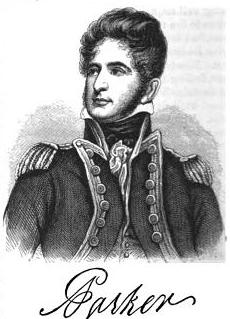
Sir Captain Peter Parker, R.N. (1785-1814)

Sir Peter Parker

Sir Peter Parker. From Lossing’s Field Book to the War of 1812

In October 1902, eighty-eight years after the War of 1812, a monument was dedicated on Caulk’s Field battlegrounds on Maryland’s Eastern Shore of Kent County. It commemorates both the British and American militia midnight encounter here on August 31, 1814. Sir Capt. Peter Parker was a descendant of several Royal Navy flag officers, he receiving command of H.M. frigate Menelaus in 1810. A popular often told story has been that Capt Parker, having received a mortal wound, was carried from the field to the Thomas Mitchell House (Maryland Pkwy. off Rt. 21) where he died in the kitchen, the soldiers having “got a blanket and sheet to wrap Sir Peter in.” The legend became interwoven into the popular culture of the War of 1812 and has become an integral myth of Kent County’s history. The house today is a popular bed and breakfast inn. Captain Parker’s remains however were never carried to the Mitchell House, but directly to his command, H.M. frigate Menelaus lying off today’s Parker Point. The origin of the story first appeared in the Daily National Intelligencer (D.C) soon afterward the battle.

Lieutenant Henry Crease, R.N., who assumed command upon Capt. Parker’s death, stated in his report: “It was at this time, while animating his men in the most heroic manner that Sir Peter Parker received his mortal wound which obliged him to quit the field and he expired in a few minutes.” After been taken onboard his remains were “placed into a coffin filled with whiskey.” The morning after, Captain Peter Parker’s right shoe exhibited a great deal of blood inside was found with the inscription found inside: “No. 20169 Parker, Capt. Sir Peter. Bt.” On September 3, the British made another raid in Kent County at the bay-shore farm of the same Thomas Mitchell who served as Commissary of Supplies for the Kent County militia, thus the story became linked to his death at the Mitchell house.

On September 7, the HM frigate Menelaus sailed down the bay “with her pennant half-mast high, a sign indicative of the death of Sir Peter Parker.” The Menelaus anchored with the ships in Baltimore harbor during the Battle for Baltimore. Afterwards his remains were transferred to H.M. frigate Hebrus for conveyance to Bermuda and buried at St. George’s Church, Bermuda. In the Spring of 1815 his remains were conveyed to St. Margaret’s Church at Westminster, London where he was buried.

Sources: Baltimore Federal Gazette, September 7, 1814; Baltimore Patriot, September 5, 1814; The Bermuda Historical Quarterly, Winter, 1944), 189-195; Logbook, HMS Tonnant, September 12, 1814 (Public Records Office, Admiralty Records 53/1385); Lt. Henry Crease, RN, HMS Menelaus to Vice Admiral Alexander Cochrane, September 1, 1814 (Alexander Cochrane Papers, Library of Scotland with copies at the Library of Congress, MS2329).

Published in: on March 25, 2011 at 7:15 pm  Comments Off on Sir Captain Peter Parker, R.N. (1785-1814)  

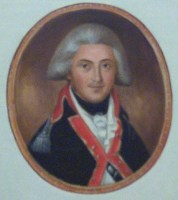
Brig. General Leonard Covington (1768-1813)

Leonard Covington

Leonard Covington

Leonard Covington, the son of Levin and Susannah (Maguder) Covington was born in Aquasco, Prince George’s County, Md., on October 30, 1768. At 24 years of age he entered the U. S. Army as a cavalry cornet (Mar. 14, 1792); a lieutenant of U.S. Dragoons in 1793, joining the army under General Wayne during the Battle of Fallen Timbersand subsequently promoted to a captaincy. On Sept. 12, 1795 he resigned and returned to Maryland engaging in agricultural pursuits; a Maryland Delegate (1802, 1807-09): U.S. House of Representatives (1805-1807). In January 1809 he was appointed lieutenant colonel of the U.S. Light Dragoons; colonel February 1809 serving at various stations (Baton Rouge, West Florida, 1810) and Fort Adams on the Mississippi (1810) until he was ordered to the Canadian frontier and appointed brigadier general on August 1, 1813.

In 1796 he married his second wife Rebecca Mackall of Calvert County and issued five children. He was mortally wounded at the Battle of Chryslers Field, Upper Canada on November 11, 1813, while animating his men forward in a charge, his last words being “Independence Forever.” He died at French’s Mills, N.Y., on November 14, 1813; his remains were removed to Sackets Harbor, Jefferson County, N.Y., August 13, 1820; place of burial now known as Mount Covington.

In early 1814, Fort Patapsco located to the west of Fort McHenry was renamed in his honor taking an active role in the Battle for Baltimore in Sept. 1814.

Source: Biographical Directory of the United States Congress; ‘Memoir of Leonard Covington’ by Benjamin Leonard Covington Wailes (Natchez Printing and Stationary Co., 1928): Marylanders Who Served the Nation, byGerson G. Eisenburg (Annapolis: Maryland State Archives, 1992).

Published in: on March 25, 2011 at 6:05 pm  Comments Off on Brig. General Leonard Covington (1768-1813)