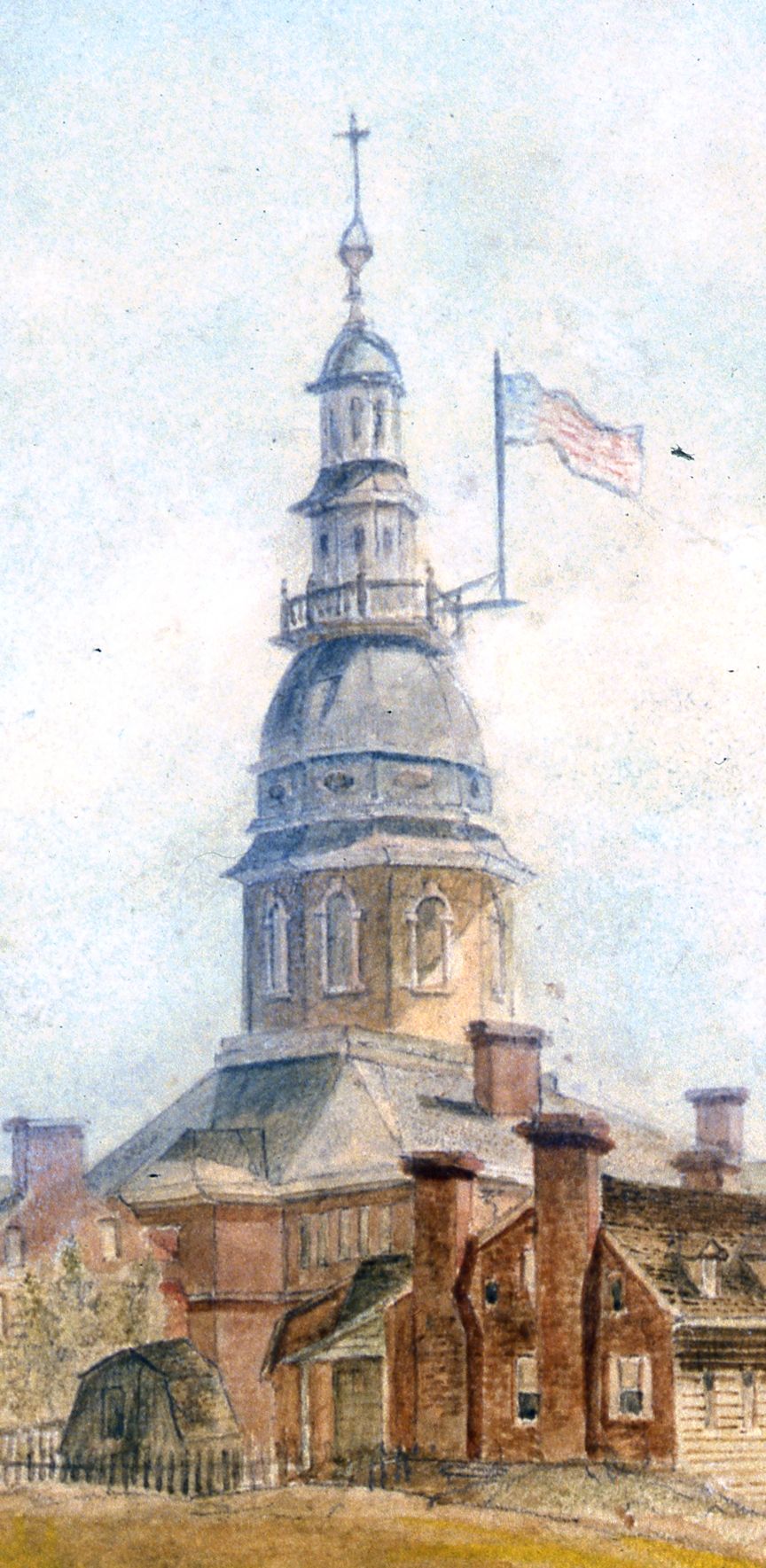
“The Star-Spangled Banner” and Divine Providence for the Colors of Red, White and Blue.

The answers as to what the colors and stars of the flag stand for in their symbolism are many. With the many patriotic and veteran organizations and official armed services various interpretations, there seems to be debate on who has the right answer. Herein the following are those interpretations of the founding fathers of our flag and symbolism of the Great Seal of the United States. These represent the earliest known, as yet, of the true meanings that we give to the flag. The symbols and colors reflect the Founding Fathers’ beliefs, values, sovereignty and interpretations of the new Nation.

Flag Act of  June 14, 1777 – The Continental Congress passed the first Flag Act: “Resolved,That the flag of the United States be made of thirteen stripes, alternate red and white; that the union be thirteen stars, white in a blue field, representing a new Constellation.”  No references or origins were given to the colors at the time of their adoption. However five years later in 1782 a specified reference is given.

The Great Seal of June 20. 1782 – Unlike the flag Act of 1777, the colors of the Great Seal had specific meanings as reported on June 20, 1782 by Charles Thompson, the Secretary of the Continental Congress, who was present at the signing of the Declaration of Independence in 1776 introduced this design for the new Seal of the United States:  “The colors of the pales are those used in the flag of the United States of America; White signifies purity and innocence, Red, hardiness and valour, and Blue, the color of the Chief signifies vigilance, perseverance and justice.”

On the Fourth of July 1840 the Boston, Massachusetts Emancipator and Republican newspaper gave the following interpretation that the author believes reflects those earlier meanings attributed to the flag.

 “The white stripes may remind us of the justice of our cause, and the honest principles that urged the Declaration of Independence; while, at the same time, they are expressive of the purity of virtue.”

“The red stripes will remind us that those primal patriots so loved liberty and their native land, that they were willing to shed their blood in the sacred cause.”

“The blue field, (or square,) is emblematic of the prosperity enjoyed in the smiles of good Providence, shining out upon us from heaven, and cheering us like a clear blue sky. The stars are an emblem of light, – of the light of the Gospel, – of civil and religious liberty. They are the emblems also of hope. The star of freedom is the hope of the world, for each earthly blessing, from a hand divine. Our star of freedom sheds a light, revealing to man the knowledge of his natural rights, and the value of them.”

 “The stars are an emblem of light, – of the light of the Gospel, – of civil and religious liberty. They are the emblems also of hope.”

Sources: “The Star-Spangled Banner.” Emancipator and Republican (Mass.), July 2, 1840; Reports of the Continental Congress, 1775-1782.

Published in: on June 27, 2011 at 12:22 am  Comments Off on “The Star-Spangled Banner” and Divine Providence for the Colors of Red, White and Blue.  

Quartering the Militia at Baltimore, September 1814

On August 19, 1814 when the British expeditionary forces landed at Benedict, Maryland General Orders were sent out by Major General Samuel Smith and consequently to those neighboring states of Virginia, Delaware and Pennsylvania to come to Washington and Baltimore’s defense. With the capture of Washington on August 24, it became apparent the next tarket was Baltimore, thus many of the arriving militia halted at Baltimore and camps were established within a ten mile radius of the city. In Baltimore it soon became a logistical problem to find quarters for the militia, including those from outlying Maryland counties. Major Paul Bentalouu, Quartermaster General stated that “fifteen thousand have assembled and many more are coming in daily.”  

The Third Division Quartermaster of Baltimore Major Jeremiah Sullivan, obtained the shelter of  numerous ropewalks whose protective sheds, some 1,000 feet long could accomodate 500 troops  each. Every available building including fifty-one storied warehouses and dwellings were utilized along the docks, even within the unfinished granite walls of the catholic cathedral rising up on Howard’s Hill (now the Basilica of the Assumption). Here are a few examples: 60th Virginia Regiment – Hadsgis Ropewalk; 56th Virginia Regiment – Piper’s Ropewalk; Pennsylvania Militia – Oliver’s Ropewalk; companies of the 36th, 38th and 14th U.S. Infantry were in tents on Hampstead Hill.

In addition the troops needed food, canteens, knapsacks, cooking kettles, musket cartridges all had to be procured locally. Many companies, some independently arriving from as faraway as Hagerstown, MD., Hanover, PA., and Wilmington, DE., were without muskets or adequte equipage. Within weeks after the Battle for Baltimore, militia companies continued to arrive who had to be accomodated. Such was the scene in Baltimore during the perilous days of September 1814. 

Sources: Samuel Smith Papers, Library of Congress, MSS18794, Reel 4, Cont. 5-6.


Published in: on June 21, 2011 at 12:59 am  Comments Off on Quartering the Militia at Baltimore, September 1814  

“Ross Tree” under which Major General Robert Ross Died, Sept.12, 1814

In the second of two skirmishes that led to the Battle of North Point, Major General Robert Ross, having been shot by members of Captain Edward Aisquith’s First Baltimore Sharp Shooters, who were in the forward advance, was taken in route back to the British landing site. Along the North Point Road, his staff laid the General by the side of the road under a large poplar tree that over hung the roadside. It was here he breathed his last. An entry in the captain’s log of HM Ship-of-the-line Royal Oak states clearly that Ross’ remains arrived onboard that evening at 9 p.m., some eight hours after having been shot.

The tree was situated on the farm of Mr. Vincent Green, a veteran of the battle near the crossroads of North Point Road and present day Wells Avenue. In March of 1844 the venerable old tree was cut down for fear it may fall on an unsuspected traveler. It was known as the “Ross Tree.” “Such was the veneration in which it was held that many individuals secured pieces as relics.”

Sources: The Sun, March 22, 1844;  September 8, 1907.

Published in: on June 15, 2011 at 2:53 am  Comments Off on “Ross Tree” under which Major General Robert Ross Died, Sept.12, 1814  

George Roberts- Privateersman on the Brig Chasseur

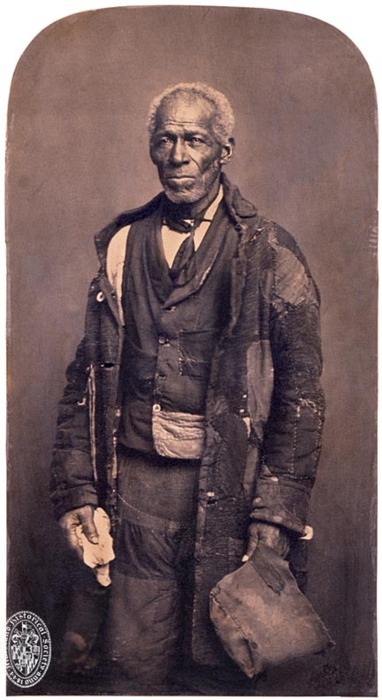
George Roberts. MdHS Z24.2560

George Roberts was not only one of the few defenders’ to have his portrait taken by a photographer, but he also provides a unique connection as one of the African-American maritime defenders on the high seas, known as privateersmen during the War of 1812.

In the fall of 1812 he served onboard Captain Richard Moon’s privateer Sarah Ann and was among six American seamen accused of being British subjects and taken prisoner when the Sarah Ann was captured by HMS Statira off the Bahamas on September 13, 1812. Captain Moon denied that they were British:

“George Robert [sic], (a coloured man and seaman.) This man I had not an opportunity of questioning; but I know him to be native born of the United States and of which he had every sufficient document, together with his free papers. He entered on board the Sarah Ann at Baltimore where he is married.”

Eventually, Roberts and the other American seamen were released. After the war it is unknown what trade he had as a freeman, or if he continued serving onboard various merchant vessels from the port of Baltimore. What is known is that he was allowed to participate as one of the Old Defenders’ of Baltimore of 1814 during parades commemorated the anniversary for many years.

  “…throughout his long life he was always highly though of by the citizen soldiery…his carriage was erect, and he never             appeared on parade except in uniform, and it was one of his highest aspirations to still be considered one of the defenders of his native city… He served during the war under several [privateer] commanders, and generally at sea, and he had in the service many hair-breath escapes. ”

Another Old Defender Gone.- For a number of years past an aged colored man, named George Roberts, has been allowed to parade with the military of the city on all occasions of importance; and was generally mounted as servant to major-general of the division. He died on Monday night, at the advanced age of ninety-five years, at his residence, at Canton. Old George was among thoise who took up arms in defense of the city of Baltimore in 1814, and throughout his long life was always highly thought of by the citizen soldiery.

Though laboring under the weight of so many years, his carriage was erect, and he never appeared on parade except in uniform, and it was one of his highest aspirations to still be considered one of the defenders of his native city should the necessity have arrived to take up arms in its defense. The deceased was one of the crew under the command of Capt. Thomas Boyle, of this city, in the privateer Chasseur, when Capt. Boyle declared the coast of Great Britain under blockade. He served during the war under several commanders, and generally at sea, and he had in the service many hair-breath escapes.

Sources:  Niles’ Weekly Register, November 14, 1812; “Another Old Defenders Gone,” The Sun (Baltimore), January 16, 1861..

Published in: on June 1, 2011 at 2:39 pm  Comments Off on George Roberts- Privateersman on the Brig Chasseur  

Jack Murray – “Fiddler Jack” An African-American ship’s caulker

On Wednesday, December 19, 1861, Jack Murray, died at his home on Caroline Street, Fell’s Point, at the age of 110 years. He was born in the year 1751 in Baltimore Town, prior to the city being incorporated in 1797. He was employed as a caulker in William Price’s shipyard at the Point, the first shipbuilder in Baltimore,and continue his employment until the infirmities of old age compelled him to relinquished it. He was born a slave, but obtained his freedom some seventy years ago. 

He learned to play the violin and was present at various dances, thus earning him the name of “Fiddler Jack.”  He was upwards of twenty five years old at the time of the American Revolution. “His recollections of General Washington and other revolutionary heroes were also very distinct, and many and interesting are the anedotes repeated by him of the trying times of the revolution.”

His final resting place is unknown.

Sources: The Sun, December 20, 1861; Baltimore Republican, December 20, 1861; Maryland News Sheet, December 20, 1861.

Published in: on June 1, 2011 at 1:20 pm  Comments Off on Jack Murray – “Fiddler Jack” An African-American ship’s caulker  

THE LAST “OLD DEFENDER” DEAD. Final Extinction of a famous War Association of Baltimore.

On December 17, 1888, Mr. James C. Morford, aged 98, died, the last member of the Old Defenders’ Association of Baltimore. His death marked the extinction of the famous Old Defenders’ Association, that was organized in 1842 with 1,259 members. It was the custom of the members to attend church in a body on the Sunday previous to each 12th of September, each member wearing a cockade and a piece of crape, the latter out of respect to the memory of the dead comrades. He was the only survivor who attended the anniversary of September 12th last.

During the Battle for Baltimore, September 12-14, 1814 he served as a private in Captain James Sterrett’s company of the First Baltimore Hussars and was present at the Battle of North Point.

Source: St. Louis Republic (Missouri), December 18, 1888; New York Times, September 13, 1888.

Published in: on June 1, 2011 at 12:41 pm  Comments Off on THE LAST “OLD DEFENDER” DEAD. Final Extinction of a famous War Association of Baltimore.  

Levi Claggett & John Clemm: Fallen Soldiers of Fort McHenry

In the aftermath of the bombardment of Fort McHenry, September 13-14, 1814, the Baltimore Patriot printed a obituary notice on two of the four defenders who had fallen during “the perilous fight.” The eloquence of the notice is an example of the words and expressions of those who had fallen during the conflict in the War of 1812.

OBITUARY NOTICE.

This afternoon, at 4 o’clock, the Baltimore Artillery Company of Fencibles, under the command of Captain [Joseph Hopper] NICHOLSON, will parade for the purpose of rendering the last tribuite of respect to Lieutenant LEVI CLAGGETT, & Sergeant JOHN CLEMM, who fell in defence of this city and their country’s rights, at Fort M’Henry, during the bombardment of that fortress by the enemy.

To have fallen in such a cause, would have, of itself, entitled the memory of the dead to respect and sympathy. But, they needed no such adventitious circumstance to excite the most poignant regret at thier untimely departure. They formed a prominent part of the rich price, which was paid for victory and safety. In civil life, they were men of the most amiable manners, honorable principles, and respectable standing in society. In the hour of danger, they evinced ardent and collected courage. Their friends lament their loss, with sorrow not loud but deep. May the reflection, that they died in a cause and at a time, when every tonque was eloquent in their praise; that they departed in the path of honor; that the gratitude of their countrymen will embalm their names in every heart, afford to the bereaved of their connections and friends, the only alleviation for such a loss.

Their brethren in arms will cherish their memory, with affectionate care. They sleep on the soldier’s bed, the bed of honor; and while their loss may call forth the manly tear of fraternal regret, their example will animate to deeds, such, as living, they would have approved and aided.

SOURCE: Baltimore Patriot, September 21, 1814.

Published in: on May 31, 2011 at 3:16 pm  Comments Off on Levi Claggett & John Clemm: Fallen Soldiers of Fort McHenry  

Francis Scott Key Remembers-September 1814

On August 6, 1834 Francis Scott Key returned to his hometown of Frederick, Maryland in company with his former law partner fifty-seven year old Roger Brooke Taney.  They had come to partake in a celebratory dinner on the Frederick Courthouse lawn. At one point Judge Taney stood up during dinner and introduced Key, who needed no introduction as the author of “The Star-Spangled Banner.”

In a brief speech, Key for the only known moment in his life after the War of 1812 expressed his feelings and how he came to be inspired to write the nation’s song so celebrated on the “Defence of Fort McHenry.”

Herein are the words taken from Francis Scott Key: Life and Times by Edward S. Delaplaine published in 1937.

“You have been pleased to declare your approbation of my song. Praise to a poet could not be otherwise than acceptable; but it is peculiarly gratifying to me, to know that, in obeying the impulse of my own feelings, I have awakened yours. The song, I know, came from the heart, and if it has made its way to the hearts of men, whose devotion to their country and the great cause of freedom I know so well, I could not pretend to be insensible to such a compliment.

You have recalled to my recollection the circumstances under which I was impelled to this effort. I saw the flag of my country waving over a city – the strength and pride of my native State – a city devoted to plunder and desolution by its assailants. I  witnessed the preparation for its assaults, and I saw the array of its enemies as they advanced to the attack. I heard the sound of battle; the noise of the conflict fell upon mylistening ear, and told me that “the brave and the free” had met the invaders. Then did I remember that Maryland had called her sons to the defense of that flag and that they were the sons of sires who had left their crimson footprints on the snows of the North and poured out of the blood of patriots like water on the sands of the South. Then did I remember that there were gathered around that banner, among its defenders, men who had heard and answerred the call of their country – from these mountain sides, from this beautiful valley, and from this fair city of my native Country; and though I walked upon a deck surrounded by a  hostile fleet, detained as a prisoner, yet was my step firm, and my heart strong, as these recollections came upon me.

Through the clouds of war, the stars of that banner still shone in my view, and I saw the discomforted host of its assailants driven back in ignominy to their ships. Then, in that hour of deliverance and joyful triumph, my heart spoke; and “Does not such a country, and such defenders if their country, deserve a song?” was its question.

With it came an inspiration not to be resisted; and even though it had been a hanging matter to make a song, I must have written it. Let the praise, then, if any be due, be given. not to me, who only did what I could not help doing; not to the writer, but to the inspirers of the song!”

…I again thank you for the honor you have done me; but I can only take the share of it. I was but the instrument in executing what you have been so pleased to praise; it was dictated and inspired by the gallantry and patriotism of the sons of Maryland. The honor is due, not to me who made the song, but to the heroism of those who made me make it…

Source: Francis Scott Key: Life and Times by Edward S. Delaplaine (New York: Biography Press, 1937), 378-380. Mr. Delaplaine’s archival source of Key’s remarks remains a mystery.

Published in: on May 22, 2011 at 8:31 am  Comments Off on Francis Scott Key Remembers-September 1814  

Battle Acre: A Deed of Land by Dr. Jacob Houck (1792-1850) “for the purpose of erecting a Monument thereon….”

On the eve of the 25th Anniversary of the Battle of North Point, a prominent physician of medicine and purveyor of his famous “Houck’s Remedies” gave to the State of Maryland an acre of land on the battlefield for the princely sum of One Dollar. His gift today is known as Battle Acre along the North Point Road in Baltimore County.

He was born in Frederick County, the son of a prominent merchant, and came to be a graduate of the Maryland University School of Medicine. In December 1839 he purchased the land called “Swan Harbour” and soon thereafter built “one of the most splendid hotels in the vicinity,” that became known as “Houck’s Pavilion” that for years thereafter served as a prominent annual commemorative gathering site for the Old Defenders’ of Baltimore. 

The following is an extract of the deed of land to the State of Maryland.

“Know all men by these presents, that I Jacob Houck of the city and county of Baltimore in the State of Maryland am held and firmly bound unto the State of Maryland in the full and just sum of one Dollar lawful money to be paid to the said state, or to its attorney to the payment whereof. I bind myself, my heirs Executors and Administrators firmly by these presents, sealed with my seal, and dated this eleventh day of September in the year of our Lord one thousand eight hundred and thirty nine.

Whereas the said Jacob Houck in consideration of the sum of one dollar to him paid at or before the sealing and delivery hereof, the receipt whereof is hereby acknowledged and also delivered good causes and valuable considerations herein thereunto moving, hath contracted to give grant and convey or to cause and procure to be granted and conveyed unto the said state this or part of a tract, piece or parcel of herein after described the same constituting a part of the North Point Battle Ground “for the purpose of erecting a Monument thereon.” Now the Condition of the foregoing obligation is such, that the said Jacob Houck, or his heirs do and shall within six months next ensuing the date hereof, grant and convey, or cause and procure to be granted and conveyed to the State of Maryland aforesaid, to be held by the said State for ever, for the use and purpose aforesaid. All that Lot or parcel of Land situated and lying in Baltimore County aforesaid being part of a tract called “Swan Harbour” which is contained  within the meter and bounds, courses and distances following, that is to say; Beginning for the same part at a stone standing in the ground on the southwestern most side of the road leaving from the City of Baltimore to North Point…” [the remainder of document shows survey points of distances.]

For 75 years no monument was erected, despite the elaborated ceremonies held on September 12, 1839. A granite monument was finally dedicated in 1914 on the centennial of the battle.

Jacob Wever Houck was the father of Mrs. Ella Virginia Houck (Mrs. Reuben Ross Holloway/1862-1940) who often was described as the “number one patriot in Baltimore” who consistently advocated for the making The Star-Spangled Banner” the official national anthem and other patriotic causes. Dr. Jacob Houck, Sr. died in 1850 and is buried in Mount Olivet Cemetery in West Baltimore.

Source: Baltimore County Court (Land Records) TK 292, pp. 246-247 Jacob Houck, “Swan Harbor,” 11 September 1839 [MSA CE 66-342]. His son, not to be confused with his father, was Dr. Jacob Wever Houck, Jr. (1822-1888); The Sun, May 23, 1888.

Published in: on May 17, 2011 at 10:55 pm  Comments Off on Battle Acre: A Deed of Land by Dr. Jacob Houck (1792-1850) “for the purpose of erecting a Monument thereon….”  

Jean Michel (Michael) Jamart (1780-1860)– An Old Defender of Baltimore

On February 5, 1860, Michael Jamart, a native of Paris, France died at the age of eighty, in Baltimore, one of the Old Defenders’ of Baltimore of 1814.

Mr. Jamart arrived in Maryland onboard the French seventy-four ship-of-the-line L’Eole in 1806, the ship having been nearly dismasted in a gale off the Virginia seaboard. The ship was towed to Baltimore from Annapolis, where under the direction of a French official was condemned and sold at auction, her armament of cannon were stored in a Fell’s Point warehouse. In 1813 the U.S. Government purchased the 18- and 36-pounder naval guns and mounted them at Fort McHenry, where they defied the British navy  during the War of 1812.

Mr. Jamart became an American citizen and enlisted in Captain Philip B. Sadtler’s rifle company, the Baltimore Yagers, 5th Maryland Regiment, who fought at the Battle of Bladensburg (August 24) and North Point (Sept. 12) in 1814.

After the war he became a “French Restorateur” at No. 40 Water Street near Gay, opposite the Exchange, offering “the delicacies of the French Restaurants.” As proprietor of the Exchange Coffee House, he continued his militia service as an officer with the Independent Blues until old age compelled him to decline his service.

He is buried in Greenmount Cemetery, Baltimore.

Source: Baltimore Patriot, September 9, 1830; The Sun, February 6, 1860.

Published in: on May 17, 2011 at 3:26 pm  Comments Off on Jean Michel (Michael) Jamart (1780-1860)– An Old Defender of Baltimore