Henry Lightner (1798-1883): The Drummer Boy of Fort McHenry

On the morning of Sunday, September 11, 1814, drummer Henry Lightner as well as other militia volunteers at Fort McHenry sounded the alarm at the approach of the British invasion fleet.  At sixteen years, Henry served in Captain John Berry’s Washington Artillery of the 1st Regiment, Maryland Volunteer Artillery. Captain Berry commanded the shore batteries along with two other militia companies.

Earlier, the company had marched from Baltimore to Fort McHenry earlier to the tune of Henry Lightner’s drum accompanied by fifes. It may well be that he played a favorite tune of his “The Girl I Left Behind.” As a member of the Association of Old Defenders’ of 1814  his presence was well known as he played the tune in the years to follow in many parades every Defenders’ Day in September. A tinner by trade in his adult years he was a member of the Methodist church. In the latter years of the 19th century as each of the participants in the defense of Baltimore past away, akin to the passing of the minute men of the days of the American Revolution, newspapers printed their passing – mutual respect for the citizen-soldiers of 1812.

Henry Lightner died in Baltimore on January 24, 1883 and was buried in Baltimore Cemetery.  

“The Drummer Boy’s Funeral.- The funeral of Mr. Henry Lightner, the drummer-boy of 1812, who died on Thursday in the 85th year of his age, took place yesterday afternoon, from the residence of his son-in-law, Mr. Richard McCullough, No. 49 East Eager street. Rev. Luther T. Widerman, pastor of Monument-Street M.E. Church, conducted the funeral services, and was assisted by Revs. A.M.Courtney, and A.S. Hank. The pallbearers were selected from the congregations of Monument-Street, Greenmount-Avenue and Madison-Square M.E. Churches and from Harmonia Lodge, I.O.O.F., a delegation from which also attended. Mr. W.H. Daneker, secretary of the Old Defenders’ Association, was present.” 

 The Sun, January 27, 1883. 

Sources: The Sun (Baltimore), January 25, 1883 and September 9, 1882.

Published in: on May 8, 2011 at 9:35 pm  Comments Off on Henry Lightner (1798-1883): The Drummer Boy of Fort McHenry  

A Corps of Colonial Marines, April 1814

“Their conduct was marked by great spirit and vivacity, and perfect obedience.”

Captain James Ross, HMS Albion, May 29, 1814.

On April 2, 1814, Admiral John B. Warren having been relieved, Vice-Admiral Alexander I.F. Cochrane took command of the British North American Station and issued the following to encourage those blacks or settlers who so desired to imigrate or enlist in his Majesty’s forces (Corps of Colonial Marines). Within the year an estimated 300 runaway slaves having escaped their masters plantations on the Chesapeake tidewater.

PROCLAMATION OF VICE ADMIRAL SIR ALEXANDER F.I. COCHRANE, R.N.

By the Honorable Sir ALEXANDER COCHRANE, K.B. Vice Admiral of the Red, and Commander in Chief of His Majesty’s Ships and Vessels, upon the North American Station, &c, &c, &c.

A PROCLAMATION.

WHEREAS, it has been represented to me, that many Persons now resident in the UNITED STATES, have expressed a desire to withdraw therefrom, with a view of entering into His Majesty’s Service, or of being received as Free Settlers into some of His Majesty’s Colonies.

This is therefore to Give Notice,

That all those who may be disposed to emigrate from the UNITED STATES will, with their Families, be received on board His Majesty’s Ships or Vessels of War, or at the Military Posts that may be established, upon or near the Coast of the UNITED STATES, when they will have their choice of either entering into His Majesty’s Sea or Land Forces, or of being sent as FREE settlers to the British Possessions in North America or the West Indies, where they will meet with due encouragement.

Given under my Hand at Bermuda, this 2nd day of April, 1814, ALEXANDER COCHRANE.

By Command of the Vice Admiral, WILLIAM BALHETCHET. GOD SAVE THE KING.

Source: Proclamation, April 2, 1814. Admiralty Archives 1/508,579, London Public Records Office. Printed in Easton, Md., Republican Star, May 3, 1814.

Published in: on May 1, 2011 at 12:37 pm  Comments Off on A Corps of Colonial Marines, April 1814  

Fell’s Point: Prize of the Chesapeake

A Baltimore Privateer, c. 1812 (Maryland Historical Society)

Fell’s Point, founded in 1730 by William Fell attracted by its deep water proximity to agricultural mills and abundant forests, became an influential commercial and shipbuilding seaport. In 1797 the Point was incorporated with Baltimore Town and Jones Town to the west to form the City of Baltimore. The port grew wealthly from its exports and imports of flour, tobacco and coffee and the trades of early 19th century seafarers, maritime artisians, sea captains and merchants.

Letters of Marque and Reprisal – On July 26, 1812, the U.S. State Department issued official Letters of Marque and Reprisal “to destroy and hender the mercantile trade of Great Britain.” Such letters authorized shipowners to convert their schooner rigged vessels into legalized privateers under the auspices of the U.S. During the war 126 private armed vessels sailed out of Baltimore, the largest number from any US port.

The Chasseur The most famous was the Chasseur that in 1814 sailed off the coast of England declaring by proclamation the entire coast of the British Isles under “a strict naval blockade.” The audacity of this single ship brought the indignation of the renown insurance firm of Lloyd’s of London, the merchants of Glasgow, Liverpool and London upon the Royal Navy to subdue these Baltimore privateers that weaked economic havoc on their mercantile trade. The Chasseur returned unscathed to Baltimore on March 15,1815 and as she sailed into the harbor she was greeted as “the pride of Baltimore.”  Today a replica design of The Pride of Baltimore II sails once more.

Merchant’s Coffee House – Throughout Fell’s Point there were numerous coffee houses. Here citizens, sea captains and politicians gathered for the latest news, foreign and domestic. Adjacent to one was the office’s of Hezekiah Niles’ Weekly Register the nation’s foremost influential weekly news magazine of its day, chronicleing the political, agricutural, war corresponce and events around the world. It remains an indispensable resource chronicle for historians for the War of 1812.

Today, Fell’s Point National Historic District is a vibrant working waterfront community of 18th and 19th century residential and commercial stores along its cobblestone streets and alleys.

Sources: The Fell’s Point Story by Norman G. Rukert (Baltimore: Bodine & Associates., 1976);

Published in: on April 19, 2011 at 2:37 pm  Comments Off on Fell’s Point: Prize of the Chesapeake  

Lt. Colonel George Armistead (1780-1818): Commander, Fort McHenry

On September 13-14, 1814, in the third year of the War of 1812, this 34 year old Virginia born artillery officer ordered an American flag raised over the ramparts of Fort McHenry in Baltimore harbor following a 25-hour British naval bombardment. The flag itself inspired a Maryland lawyer to write a song that would become the U.S. national anthem on March 3, 1931.

George Armistead was born near Bowling Green in Caroline County, Virginia, on April 10, 1780, to a well-established Virginia family along the Rappahannock River. He was one of six sons and three daughters born to John and Lucinda (Baylor) Armistead.

He entered the U.S. military in 1799 and rose through the ranks, serving at Fort Niagara, New York (1801-1805); Fort Pickering, Arkansas Territory (1807-1808); and Fort McHenry, Baltimore (1809-1813), where he arrived in January 1809 as second in command. In Baltimore he wedded Louisa Hughes (1789-1861), daughter of a wealthy Baltimore silversmith. In 1812 he returned to Fort Niagara, where on May 27, 1813, he distinguished himself during the American siege of Fort Niagara by capturing the British flags. For his gallantry he was appointed a major in the Third Regiment U.S. Artillery. Armistead returned to Baltimore in June 1813, and remained until his death five years later.

Armistead’s name has been immortalized in U.S. history because of one simple act. In August 1813, he requisitioned a U.S. ensign measuring 42′ x 30′ having fifteen stars and fifteen-stripes that gave inspiration to the defenders’ of Baltimore and inspired a new national song. Ever since, he has been known as the “Guardian of the Star-Spangled Banner.”

After the bombardment, President James Madison brevetted Major Armistead to the rank of lieutenant colonel to date from September 12, 1814. Upon this promotion, Armistead remarked to his wife that “he hoped they would both live long to enjoy.” Four years later, at the age of thirty-eight, Armistead died of causes unknown and was buried with full military honors by a grateful city.

His brother-in-law Christopher Hughes Jr. (1786-1849) served as secretary to the American Peace Commission at Belgium that concluded the War of 1812 on Christmas Eve, 1814. It is Hughes who brought the Treaty of Ghent to Annapolis, then Washington for the President’s signature

Fifty years later, his soon-to-be equally famous nephew, Brigadier General Lewis Addison Armistead, C.S.A. (1817-1863) died of wounds suffered in the Confederate assault (Pickett’s Charge) at Gettysburg on July 3, 1863. Two months after the battle his remains were secretly brought to Baltimore and buried next to his famous uncle. A hero of Gettysburg lies with the hero of Fort McHenry within the grounds of Old St. Paul’s Cemetery in downtown Baltimore.

Two monuments honor Lt. Colonel George Armistead in Baltimore. The earliest, erected in 1882, stands atop historic Federal Hill overlooking Baltimore’s downtown waterfront; the other, at Fort McHenry, dedicated during the Battle for Baltimore Centennial Celebration in September 1914

Source: Guardian of The Star-Spangled Banner: Lt. Colonel George Armistead and The Fort McHenry Flag by Scott S Sheads (Baltimore: Toomey Press, 1999).

Published in: on April 14, 2011 at 5:38 pm  Comments Off on Lt. Colonel George Armistead (1780-1818): Commander, Fort McHenry  

A Flag for Fort McHenry, August 1813

SHIPS COLOURS – For all nations, private signals, military flags, etc., An elegant assortment of American Colours, of every size, made of fiort quality bunting. Apply to Mrs. R. Young, Albermarle St.”

In the summer of 1813, soon after his arrival from the Canadian frontier in northern New York state, where he had taken part in the capture that spring of British held Fort George on the Niagara River,  Major George Armistead, U.S. Artillery was assigned to command Fort McHenry in Baltimore harbor. He found the fort without a suitable ensign and thus placed an order to James Calhoun, U.S. Deputy Commissary in Baltimore for two flags. Since the U.S. Arsenal in Phildelphia was currently without ensigns, Calhoun purchased locally for the ensigns from Mary Young Pickersgill (1776-1857) and her mother Rebecca Young (1739-1819), well established flag makers of colours since 1806.

 * * * *

Mr. James Calhoun, Jun., Deputy Commissary

To Mary Pickersgill

For 1 American Ensign 30 by 42 feet, first quality Bunting $405.90

For 1      do          do      17 by 25 feet,  do     do       do        $168.54

For Fort McHenry                                                                 $574.44   

August 19, 1813

Baltimore, 27th October 1813. Received from James Calhoun, Jun., Deputy Commissary, five hundred and seventy-four dollars and forty-four cents in full for the above bill.

Signed duplicates

For Mary Pickersgill

Eliza Young

* * * *

Received the within flags, signed duplicates

Gr. Armistead, Major Comm[andin]g.

A year later in September 13-14, 1814 both ensigns would be flown over Fort McHenry during “the perilous fight” and became the inspiration for a new national song – “The Star-Spangled Banner.”  The garrison flag (42’x30′) is on exhibit at the Smithsonian’s National Museum of American History in Washington, D.C.

Published in: on April 12, 2011 at 1:21 pm  Comments Off on A Flag for Fort McHenry, August 1813  

The Brig Chasseur of Fell’s Point issues a Naval Blockade of Great Britain, August 1814

 “She is, perhaps the most beautiful vessel that ever floated on the ocean…She has carried terror and alarm through the W. Indies…and frequently chased by British vessels…”  Niles’ Weekly Register, 1815

The Chasseur ’was launched at the Thomas Kemp’s shipyard at Fell’s Point on December 12, 1812, described as a topsail-schooner-rigged, sharp-built vessel documented for a letter-of-marque.  After two rather unsuccessful voyages she was sold at auction deliverable in New York. She had a new captain, well known in Fell’s Point, Captain Thomas Boyle (1775-1825) who had commanded the private armed vessel Comet a year before. She cleared New York on July 24 and charted her course to the English coast.

Having learned that the British admiralty had proclaimed the U.S. east coast under strict naval blockade, they having such great naval forces, Captain Boyle sent his own blockade proclamation into London. It was taken in by a captured an English merchantman and posted at the maritime insurance firm of Lloyd’s of London for all to see. The audacious proclamation read:

BY THOMAS BOYLE, ESQUIRE; COMMANDER OF THE PRIVATE ARMED BRIG CHASSEUR

Whereas, it has been customary with the admirals of Great Britain commanding small forces on the coast of the United States, particularly with Sir John Borlase Warren and Sir Alexander Cochrane to declare the coast of the said United States in a state of rigorous blockade, without possessing the power to justify such a declaration, or stationing an adequate force to command such a blockade.

I do, therefore, by virtue of the power and authority in me vested (possessing sufficient force) declare all the ports, harbors, bays, creeks rivers, inlets, outlets, island and sea coast of the United Kingdom of Great Britain and Ireland in a state of strict and rigorous blockade, and I do further declare that I consider the forces under my command adequate to maintain strictly, rigorously and effectually, the said blockade.

And, I do hereby require the respective officers, whether captains or commanding officers, under my command, employed or to be employed on the coast of England, Ireland and Scotland, to pay strict attention to this my proclamation.

And, I hereby caution and forbid the ships and vessels and every nation, in amity and peace with the United States, from entering or attempting to come out of any of the said ports, harbors, bays, creeks, rivers, inlets, islands, or sea coasts, on or under my pretense whatever; and that no person may plead ignorance of this my proclamation, I have ordered the same to be made public in England.

Given under my hand on board the Chasseur. By the commanding Officer, THOMAS BOYLE, J.B. STANSBURY, SECRETARY.

Sources: The Republic’s Private Navy: The American Privateering Business as practiced by Baltimore during the War of 1812, by Jerome R. Garitee (Mystic Seaport, 1977); Tom Boyle: Master Privateer by Fred W. Hopkins, Jr. (Tidewater, MD., 1976); The Fell’s Point Story by Norman G. Ricket (Baltimore: Bodine & Associates, Inc., 1976).

Published in: on April 12, 2011 at 12:18 pm  Comments Off on The Brig Chasseur of Fell’s Point issues a Naval Blockade of Great Britain, August 1814  

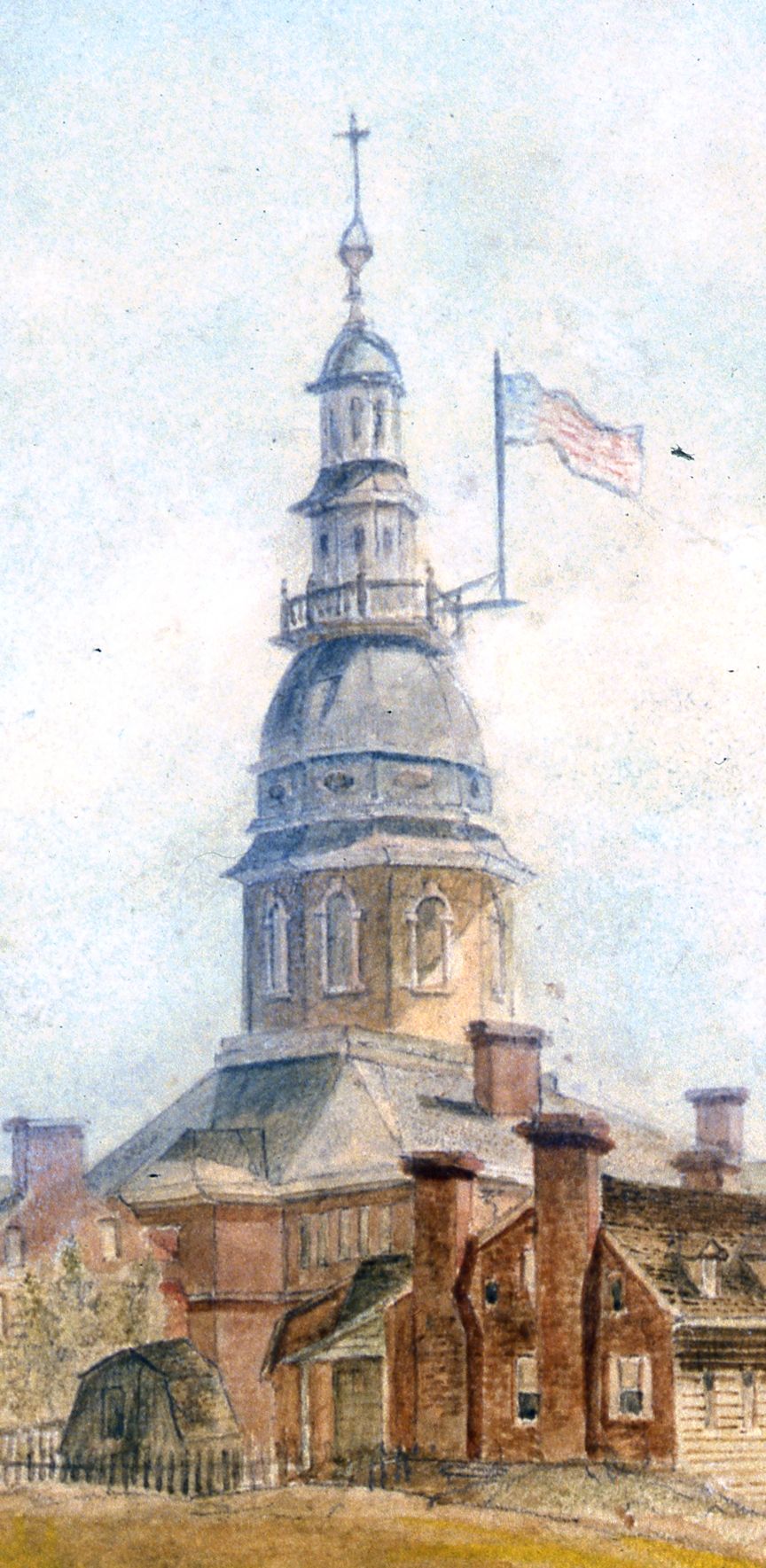
The Annapolis Armory

Though no images of the armory survive, early records mentioned the Armory of Annapolis in August 1716 for funding for “an handsome house be built for the lodging & Securing the publik Magazine of Arms in the City & also that part of the Ammunition consisting of Ball lead, Match & Flints…” It was completed a year later. A further description offered these notes: “The Armory stood at the north side [of the State House] at an equal distance from the Court House,…a wooden gilt chandelier suspended from the vaulted roof…”

With the declaration of war and the arrival of the British fleet in the bay in 1813, the Armory was too small for the storage of tens of thousands of military accroutrements needed to supply the militia. Supplies such as ball-lead, Du-Pont gunpowder, muskets, rifles, cannons, etc., all had to be contracted by the state and then sent to Annapolis for storage until distribution. It is very likely several large warehouses were used to store the enormous amount of supplies needed to furnish the Maryland militia during the war. Three other state armories were established that required supplies from Annapolis, Baltimore, Frederick-Town and Easton on the Maryland’s Eastern Shore. Each was managed by an Armorer.

The Annapolis Armorer was none other  than John Shaw (1745-1829), a cabinet-maker, custodian, and keeper of the state records.

Sources: The Ancient City, A History of Annapolis, 1649-1887 by Elihu S. Riley (Annapolis, 1887); Buildings of the State of Maryland at Annapolis, by Morris L. Radoff (Annapolis: Hall of Records Commission. 1954).

Published in: on April 12, 2011 at 11:41 am  Comments Off on The Annapolis Armory  

Recruitment Notice: U.S.Marines at Baltimore, 1813-1814

“FORTY DOLLARS! To Men of Courage, Enterprize & Patriotism. – A RENDEZVOUS for the Marine service is now opened at the house of Landlord Richard Lee, No. 76, Bond-st. Fell’s Point. FORTY DOLLARS – Is paid at the outset – and the service promises honor and rich reward. The men now wanted are principally for Sergeants and Non-Commissioned Officers of high grade, to command separate detachments on board some of the fastest sailing vessels in the service. If adverse to the Atlantic, they can have the privilege of asserting their country’s honor on the Lakes, or doing garrison duty. Few inducements need to be held out at a crises like the present, when the services of all are required, to excite the ardor and enthusiasm of enterprise and bravery. BENJAMIN HYDE, Lieutenant Marines.”

By the Spring of 1813 a detachment of twenty-four U.S. Marines were assigned at Fell’s Point to guard the Baltimore naval yard of Wm. Parsons & Wm. Flannagain’s shipyard where the U.S. sloops of war Erie and Ontario were to be completed that fall. A year later on August 1, 1814 they were joined by the launching of the U.S. frigate Java.

On August 24, 1814, one hundred U.S. Marines from the Washington U.S. Navy Yard made a valiant but futile stand on the battlefields of Bladensburg, Md., prior to the British capturing the Capital. Afterwards they marched for Baltimore to join Capt. Alfred Grayson’s marine detachment at Baltimore. Arriving with Commodore John Rodgers were fifty U.S. Marines from Philadelphia’s U.S. frigate Guerriere.

Captain Alfred Grayson, commanding 170 U.S. Marines, informed the Marine Commandant “The whole force, sailors and marines, will be tonight one thousand. The enemy is expected every hour.” Marine Lieutenant John Harris, in the center of the naval lines, remarked “I think the handsomest sight I ever saw was during the bombardment to se[e] the bombs and rockets flying and the firing from our three forts [McHenry, Covington, Lazaretto]. I could se[e] plenty of red coats but could not get within musket shot of them.”

Together these 170 U.S. Marines waited behind the naval lines of Commodore John Rodgers, USN upon Hampstead Hill (Patterson Park) for the British land assault that never came. Captain Grayson who commanded the U.S. Marines at Baltimore informed the U.S. Marine Commandant earlier that “…an opportunity will be afforded our little handful of men to take a part in the contest.”

Sources: History of the U.S. Marine Corps by Maj. Edwin N. McClellan. (Washington: 1925); Commodore John Rodgers: Captain, Commodore, and Senior Officer of the American Navy, 1773-1838, by Charles O. Paullin (Annapolis: U.S. Naval Institute Press, 1909, 1967); Baltimore Patriot, May 13, 1813; Hyde died on Feb. 10, 1815. Grayson died on June 28, 1823.

Published in: on April 12, 2011 at 11:34 am  Comments Off on Recruitment Notice: U.S.Marines at Baltimore, 1813-1814  

Recruitment Notice: “First Marine Artillery of the Union”

In the summer of 1814, Captain George Stiles (1760-1819), veteran sea captain of Fell’s Point issued a recruitment notice for those to enroll in this amphibious corps of 200 seamen and maritime artisans. The First Marine Artillery of the Union was organized in 1808 as a naval militia corps under the auspices of the City of Baltimore. During the War of 1812 “they were as a host to Baltimore.” This indefatigable corps of seamen built the marine dual gun batteries at Fort McHenry, Fort Babcock, and the Lazaretto as well as manning the gunboats of the harbor. In September 1814 they were stationed upon the defenses of Hampstead Hill (Patterson Park).  

First Marine Artillery on the Union

Meet at your gunhouse at 3 o’clock on Saturday next, in uniform complete, to exercise the heavy field ordnance. Knowing as you do, that the weight of this metal requires much strength, renders it unnecessary for any entreaties to be advanced by your captain, for your prompt attendance.

The object of this early hour is to admit agreeable to your constitution, new members; we have a right to expect every master and mate in port. The cloud gathers fast and heavy in the East, and all hands are called – few, very few, are the number of masters or mates belonging to this port that will be justified in excusing themselves from service by one of their skippers not being so firm as the other, or that he has seen five or forty; if he cannot sponge and ram as well as his messmates, he can pass a cartridge.

It is well known by all Tars the just stigma that is fixed by the ship’s crew on the man that skulks below, or under the lee of the long boat, when all hands are called; their services were not wanting until the present; but now your city calls all to arms, you are therefore invited and entreated to fall into our ranks.

Many 18 pounders are already manned and many more fit for service; come and join as we give a long pull, a strong pull and a pull altogether – and save the ship.

By order of the Captain, ROBT. G. HENDERSON, Secretary.

Source: Baltimore American and Commercial Daily Advertiser, July 22, 1814.

Published in: on April 12, 2011 at 11:10 am  Comments Off on Recruitment Notice: “First Marine Artillery of the Union”  

Salutes and Huzzas ! The American Frigate Java: Oliver Hazard Perry Commands

On August 1, 1814, at the shipyard of Messrs, William Parson and William Flannigan in Fell’s Point, the U.S. Navy’s newest frigate rated at 44 guns, was launched in the elegant naval tradition of her day. As she entered the water she was saluted by numerous discharges from U.S. Barges and the U.S. sloops of war, the Erie and Ontario that were launched a year earlier.

“She moved into her ‘destined element’ (as the phrase is ) in a very handsome style, amidst general and joyful cheers; that a very numerous assemblage of ladies and gentlemen attended…the Yager Band of music enliven the scene with appropriate marches and airs…”

Twenty thousand spectators, nearly one half the population of Baltimore had turned out to greet her and her commander Captain Oliver Hazard Perry, the “Hero of Lake Erie.”

The skilled craftsmen who built the Java, and those who cheered her at this moment, were unaware of other frigates and ships of war that were now moving under a full press of sail towards the Chesapeake from the British naval base in Bermuda. The festive spirit subsided as the war clouds approached Baltimore harbor.

Among the citizens who cheered her was John Murray, a free black ship’s carpenter. Born in Baltimore, the sixty-three old had been a caulker to shipbuilders since the inception of that craft on the Point. His well known self attained skill in playing a “few imperfect tunes” on the violin had earned him the name of “Fiddler Jack.”

She would take no part in the Battle for Baltimore as she was yet to be fitted with the armaments of war and her masts and rigging. Her commander stated, “It is, at this moment, said the enemy are now standing up the river for this place with about 40 sail. I shall stay by my ship and take no part in the militia fight. I expect to have to burn her.”

Sources: The Sun, December 20, 1861; Baltimore Patriot, August 1, 1814; American & Commercial Daily Adv., August 2, 1814. Dillon, Richard, We have met the Enemy (New York: 1980, 188.

Published in: on April 11, 2011 at 10:15 pm  Comments Off on Salutes and Huzzas ! The American Frigate Java: Oliver Hazard Perry Commands