William Grason (1788-1868)

The son of Richard and Ann Grason, William Grason was born on March 11, 1788 in Queen Anne’s County, Md.  He attended St. John ‘s College in Annapolis (c. 1801); enlisted in the U.S. Navy (1802) and later in 1813 served as a 3rd sergeant in the 38th Maryland Regiment under Colonel William H. Nicholson at the Battle of Queenstown, August 13, 1813 on the Chester River. He attained a commission as lieutenant on Sept. 12, 1813.

After the war he served in the Maryland House of Delegates (1828-29); Governor of Maryland (1839-1842); and as Maryland Senator (1852-1853). He died on July 2, 1868 at the age of 80 years and was buried on his estate “Wye River Farm” near Queenstown, Queen Anne’s County, Md.

Sources: Marylanders Who Served the Nation by Gerson G. Eisenberg (Annapolis: Maryland State Archives, 1992); The Sun, July 4, 1868.

Published in: on March 13, 2011 at 7:10 pm  Comments Off on William Grason (1788-1868)  

Christopher Hughes, Jr. (1786-1849)

Born on 1786, Christopher Hughes, Jr., was the son of Baltimore famed silversmith Christopher Hughes, and the brother of Louisa (Hughes) Armistead, wife of Maj. George Armistead. A law graduate of Princeton University in 1809, in 1811 he married Laura Sophia Smith, daughter of Maj. Gen. Samuel Smith. In March 1813 Hughes received a commission as captain of the Baltimore Independent Artillerists, 1st Regt. Md. Artillery that defended Fort McHenry in 1814. With his militia tour of duty expired in August he relinguished his command. On February 2, 1814, Hughes was appointed to be “secretary of the joint mission for negotiating a treaty of peace and of commerce with Great Britian” at Ghent, Belguim.

On Oct 23, 1814, the American flag-of-truce vessel Fingal left New York for LOndon, then on to Ghent, Belgium arriving on November 24. Mr. Hughes having received letters from home entered the following in his dairy:

“Received per Ship Fingal on the 24th November 1814 in Ghent, giving me the most acceptable news of the Health of my inestimable Laura & of all my Family. This letter occasioned me the happiest emotions; it had been written but a Month [ago and] gave me the account of the brave and honorable conduct of my Brother-in-law Major Armistead; and the manly conduct of Thomas Russell & of all my company [Baltimore Independent Artillerists]. The exemplary behavoir of my Townsmen of Baltimore under the management of Gen’l [Samuel] Smith afforded me the sincerest satisfaction…”

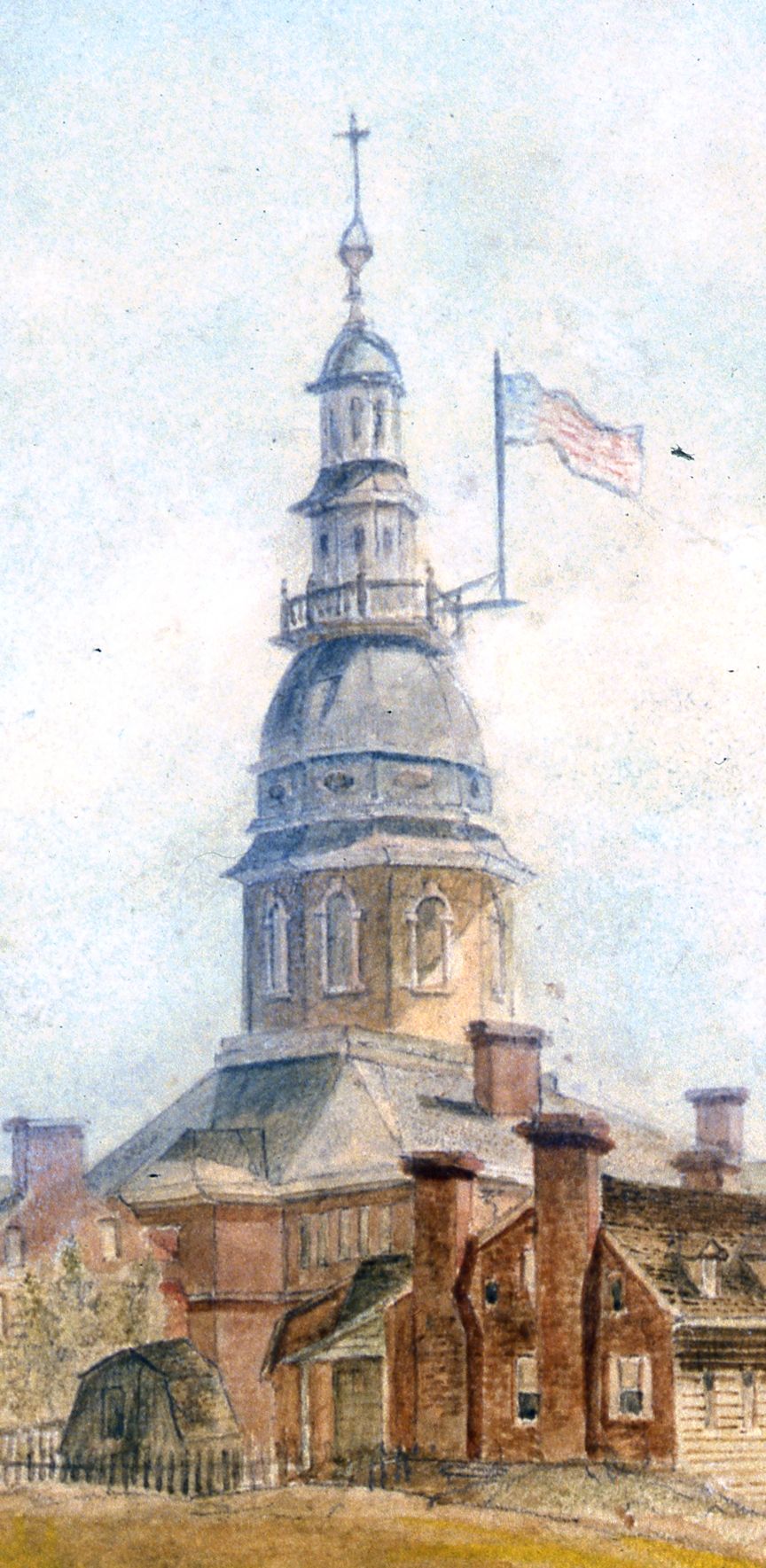
As Legation Secretary to the American Peace Commission at Ghent, Belgium, a treaty was signed by the Plenipotentiaries of both powers on December 24, 1814. Leaving Bordeaux, France he arrived in Annapolis on board the U.S. schooner Transit on February 13 carrying the treaty to Washington.

He returned briefly to Maryland serving in the Maryland House of Delegates (1815-1816), afterwards resuming his diplomatic service as U.S. Charge d’affaires in the Netherlands until retirement in 1845.

Source: U.S. Secretary of State James Monroe to Hughes, February 2, 1814. Christopher Hughes Papers, Clements Library, University of Michigan; “Christopher Hughes, Jr. At Ghent, 1814.” Maryland Historical Magazine, 1971; Baltimore Patriot, August 21, 1813;

Published in: on March 11, 2011 at 11:54 pm  Comments Off on Christopher Hughes, Jr. (1786-1849)  

Elijah Stansbury (1791-1883): An Old Defender

When he died in December 1883 Elijah Stansbury was one of the last of the Old Defenders’ of 1814 that had served in Maryland during the War of 1812. He was the sixth child of Elijah Stansbury, Sr. and his wife Eliza Eckel, born in 1791. His early years were as a bricklayer and later a successful builder.

Elijah Stansbury was one of six brothers who fought at the Battle of North Point, Sept. 12, 1814. and who served as a private in Capt. John Montgomery’s Baltimore Union Artillery, 1st Maryland Regiment of Artillery. The company was in the first forward skirmish along the North Point Road prior to the main battle ensued. A second skirmish resulted in the death of Maj. Gen. Robert Ross .During the m Battle of North Point the Union Artillery’s four guns were situated in the center of the American lines on the North Point Road. His father had remarked: “I had seven sons under arms the day the battle of North Point was fought, and I would rather see all of them weltering in their own blood than to hear that even one of them had shown the white feather [of cowardness].”

Afterward the war he was appointed colonel of the 27th Maryland Regiment which also served at North Point. He served in the Maryland Legislature from 1843-1845 and three years later was elected as Mayor of Baltimore (1843-1845). A biography of his life by Archibald Hawkins was published in 1874 entitled The Life and Times of Hon. Elijah Stansbury with interesting accounts of his early and later years. Upon his death on December 19, 1883 at the age of ninety-three. the belfry bells of the city tolled and flags were lowered to half-mast. A member of the Episcopal Church he was buried at Baltimore Cemetery in east Baltimore.

Sources: The Life and Times of Hon. Elijah Stansbury, an “Old Defender” and Ex-Mayor of Baltimore; by Archibald Hawkins (Baltimore, John Murray, 1874).

Published in: on March 11, 2011 at 11:49 pm  Comments Off on Elijah Stansbury (1791-1883): An Old Defender