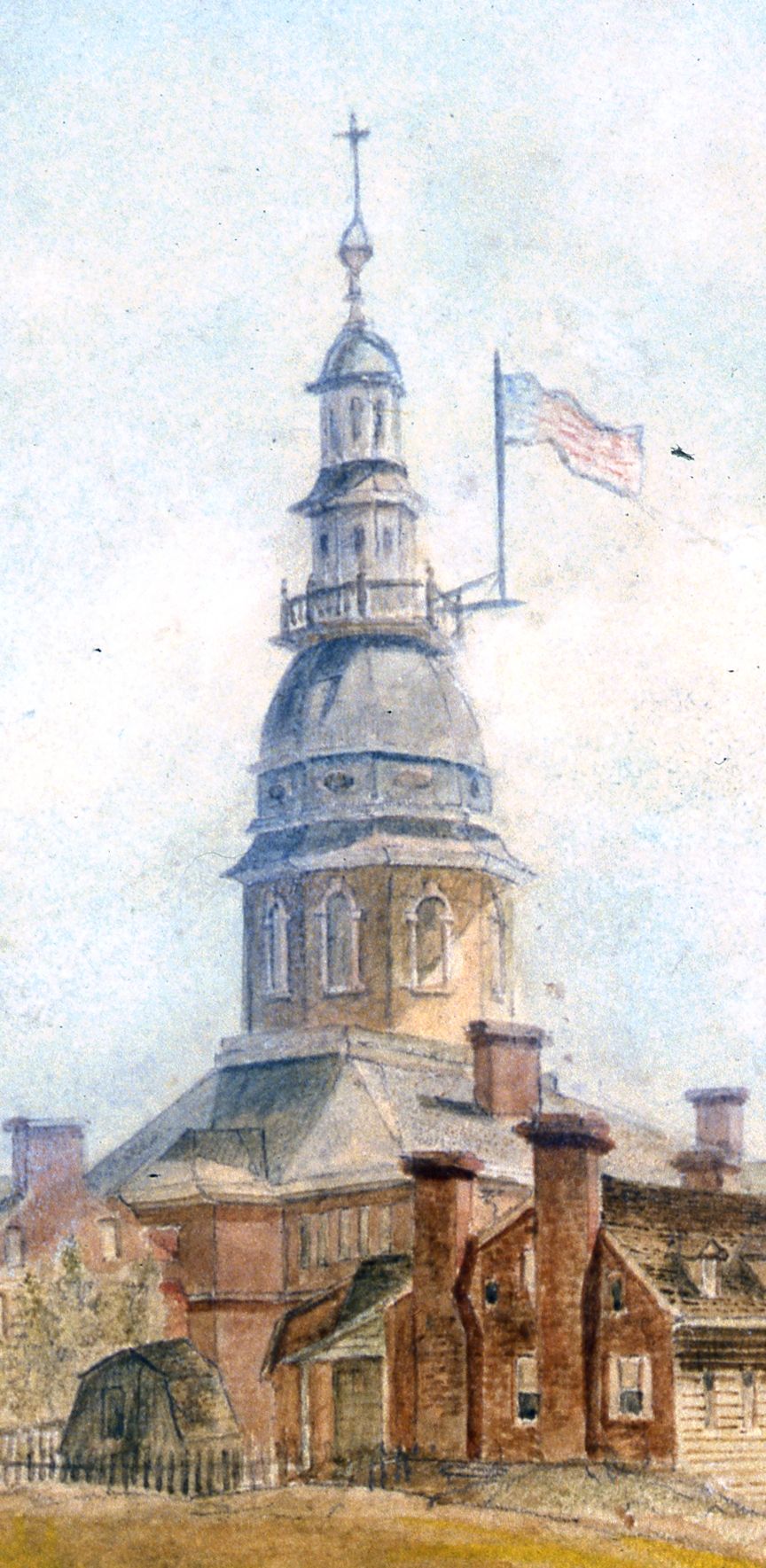
St. John’s College Liberty Tree, July 4, 1812

Mayor Claude and children in Liberty Tree, MSA SC 1477-1-5592

Mayor Claude and children in Liberty Tree, MSA SC 1477-1-5592

On July 4, 1812, the thirty-sixth year of American Independence, the citizens of Annapolis gathered on St. John’s College green under the shade of a majestic tulip poplar tree. It had once sheltered the soldiers of the French and American armies in 1781 on their march to Yorktown, Virginia.

On this day four weeks after the declaration of war, citizens of Annapolis assembled under the venerable poplar as their fathers had done for the purpose of “expressing their devotion to the sacred cause of their country.” A handsome dinner was prepared with state officials and military officers in attendance amidst patriotic toasts and the discharge of saluting cannons.

St. John’s College was also where a promising young Francis Scott Key studied law who very likely sought the shade of the tree in study.

In September 1999 Hurricane Floyd damaged the tree and was removed. It messured 102 inches in diameter and stood 60 feet in height. On March 30, 2007 a tulip poplar was planted to begin a new liberty tree. 

Source: Maryland Gazette, July 9, 1812.

Published in: on March 31, 2011 at 9:25 pm  Comments Off on St. John’s College Liberty Tree, July 4, 1812  

A Congreve Rocket Burns Henry Waller’s Kent County Farmhouse, August 28, 1814

In late August 1814, HM frigate Menalaus, Captain Peter Parker, was ordered north of Baltimore to the Upper Chesapeake Bay as a diversion during the Baltimore campaign.

On Sunday, August 28 just before dawn, British Royal Marines and sailors landed on the shore of Fairlee Creek, Kent County, on Maryland’s Eastern Shore. At 10 a.m. the British encountered a militia troop of horse gathered around the 308 acre bayside farm of Henry Waller (b.1774), described as “among the best on the Eastern Shore, both for prospect and convenience.” consisting of a two-story farmhouse with extensive outbuildings for meat, grain, corn and milk, and an extensive apple orchard. To dislodge the militia, The British officer, Lt. Henry Crease ordered Congreve rockets and 18-pounder carronades be fired upon the shore, one of which failed to launch and burned furiously onboard the ship and was thrown overboard. Crease’s shore detachment returned to the Menelaus.

Later that afternoon a second British landing was made upon Waller’s Farm setting on fire the farm house and cornfields, while the Royal Marines fired musket volleys at the militia troop of horse “smashingly dress’d in Blue and long white feathers in their hats.” Royal Marine Benjamin Benyon admirably noted in his journal that the Waller house was, “by far the finest part that I have seen in America, the house was elegant.” The next morning, Lt. Benyon noted onboard H.M. frigate Menelaus that the Waller house “was burning most furiously & all the out houses and corn stalks.”

Seventeen years later, in 1829, the Federal Government began to receive claims for war damages of private property, one of whom was Henry Waller for the destruction of his property. He retained a Georgetown attorney named Francis Scott Key to represent his case. Mr. Waller did receive compensation for his home. One of the Congreve rockets that set his farmhouse ablaze is on display at Fort McHenry National Monument and Historic Shrine (NPS) in Baltimore. It is one of the rare Maryland War of 1812 artifacts known to have survived the war with a provenance with it.

Sources: The Waller farm was formerly owned by Colonel James Lloyd (1745-1820), member of the U.S. Congress and Maryland Legislature. In 1807 he sold the farm to Henry Waller. After Waller house was destroyed, Henry sold the farm to Richard Frisby. Michael Owen Bourne, Historic Houses of Kent County: An Architectural History: 1642-1860, (Chestertown, Maryland: The Historical Society of Kent County, Inc., 1998), 295, 405-407; Baltimore Federal Gazette & Evening Advertiser, August 8, 1814; Captain Parker to Vice Admiral Cochrane, August 29, 1814. HMS Menelaus off Pooles Island. (Alexander Cochrane Papers, Library of Congress, MS 2329); Benyon Journal, August 28, 1814;

Published in: on March 31, 2011 at 9:00 pm  Comments Off on A Congreve Rocket Burns Henry Waller’s Kent County Farmhouse, August 28, 1814  

African-Americans: Citizen-Soldiers of Maryland

“I have yet to learn that the color of the skin, or cut and trimmings of the coat can effect a man’s qualifications…many of them are amongst my best men”. Commodore Isaac Chauncey on the Great Lakes frontier, 1813.

Private William Williams, 36th U.S. Infantry (National Park Service)

One of the least known aspects of the war on the Chesapeake has been the role of Maryland African-Americans. Renewed interest in the varied military, maritime and civilian roles of Maryland’s free men and slaves are now being rediscovered. The Federal and Baltimore Daily Advertiser in 1812 reported Baltimore’s African-Americans represented one fifth of the city’s 50,000 population which were “of native and West Indian blacks, nearly one half of whom are free and entitled to hold property…”

England abolished the slave trade in 1807, the United States responded a year later prohibiting slave importation into the United States. In Maryland, a large percentage of African-Americans were freemen. By law, African-Americans could not vote nor bear arms, but documents prove otherwise and reveal a broader context in the roles of the naval and military experience whether as free men or slaves. From their peculiar inherited situation they would seek their own roads to freedom, placing themselves in a decision crossroads – between servitude and freedom. In 1814 the British offered slaves an apportunity to join the Corps of Colonial Marines. It is unknown the extact number that responded by running away from their masters. In March 1813, Congress passed “An act for the Regulation of Seamen on board the public and private vessels of the United States” allowing “persons of color” to enlist.

A member of the Committeee of Vigilance and Safety, merchant William Lowery stated that “Many peoples among us assert that the Free people of Colour may be safely employed in the plans of defense as many of them it is said are processed of property and about all are zeaous in their wish to preserve our City.”

Here are a few of the African- Marylanders who illustrate their role in the War of 1812 on the Chesapeake.

William Williams (alias Frederick Hall), a runaway mulatto slave from Prince George’s county served as a private in the 38th U.S. Infantry at Fort McHenry in Sept. 1814.

George R. Roberts (1766-1861), served onboard Captain Thomas Boyle’s privateer Chasseur (‘pride of Baltimore’) during their famous blockade of England in August 1814. Captain Boyle noted that Roberts “displayed the most intrepid courage and daring” and later was “highly thought of by the citizen-soldiery” of Baltimore.

Perry Sullivan and Henry James, served onboard the privateer Tartar.

Cyrus Warren a native of Kent County served onboard U.S. Gun Boat No. 139 at Baltimore.

George Anderson, Solomon Johnson, Elisha Rhody, Jack Murray all served in the Fell’s Point shipyards as naval mechanics. Murray (1751-1861) became one of the celebrated Old Defenders’ of Baltimore.

Charles Ball chronicled his life in an autobiography A Narrative of the Life and Adventures of Charles Ball. A Black Man who fought at the Battles of St. Leonard’s Creek, Bladensburg and Baltimore with the U.S. Chesapeake Flotilla.

Gabriel Roulson and Caesar Wentworth, served respectfully as a landsman and cook in the U.S. Chesapeake Flotilla in 1814.

Colonial Corps of Marines – While others served in the American forces, others choose freedom, escaping from ther masters seeking the protection and guidance of the Royal Navy. Organized in the Spring of 1813, they fought in the Bladensburg-Baltimore campaigns in 1814.

African-Americans played a significant role in Maryland during the War of 1812. Freemen volunteered and served shoulder to shoulder with other Americans on land and sea. The extent of their contributions are still to be found, but Marylanders can take pride in the contribution of these “men of color” who fought and worked alongside others, friends and owners to help save Baltimore and their native state during the War of 1812.

Sources: Slavery in the United States: A Narrative of the Life and Adventures of Charles Ball. A Black Man (Lewistown, Pa. 1836); Amongst my best men: African-Americans and The War of 1812 by Gerald T. Altoff (Ohio: The Perry Group, 1996); Baltimore American & Commercial Daily Adv., May 18, 1814; Military Collector & Historian, vol. 41, No.1, (Journal, The Company of Military Historians, Spring, 1989; Baltimore American & Commercial Daily Adv., May 25, 1814; George Cockburn Papers, Library of Congress. Baltimore City Archives, RG 22. War of 1812 Collection.

Published in: on March 31, 2011 at 9:00 pm  Comments Off on African-Americans: Citizen-Soldiers of Maryland  

Chesapeake Bay under Blockade: February 5, 1813

On October 1812 the London Times published the following:

“The American navy must be annihilated – her arsenals and dockyards must be consumed; and the turbulent inhabitants of Baltimore must be tamed with the weapons [bombs and rockets] which shook the wooden turrets of Copenhagen…All the prating about maritime rights, with which the Americans have recently nauseated the ears of every cabinet minister in Europe must be silenced by the strong and manly voice of reason- America must be BEATEN INTO SUBMISSION!”

Following the declaration of war against England on June 18, 1812, the effect of Maryland privateers on British trade, the Lords Commissioners of the Admiralty issued a directive on December 26, 1812 for a blockade of the Chesapeake and Delaware Bays. To enforce the blockade fifty-six year old Admiral Sir John Borlase Warren was appointed to command the North American Station, consisting of five naval districts; Newfoundland, Halifax, Leeward Islands, Jamaica, and Bermuda, with one hundred and forty-two warships under his command.

The blockade of the Chesapeake was effected by His Majesty’s frigates Junon, Belvidera, Statira, and the schooner Sophie all under Captain George Burdett onboard H.M. frigate Maidstone. They were to destroy the naval resources and arsenals of tidewater Virginia and Maryland. Burdett’s squadron was smaller than anticipated and was restricted to blockading duties. On Feb. 4, accompanying the squadron was Admiral Warren onboard H.M. ship-of-the-line San Domingo, flying his broad blue pennant from the main mast. On February 5, 1813 the following notice of the enforcement of the blockade proclamation of December 26 was issued:

I do hereby certify to all of whom it may concern, that the ports and harbors of the Bay of the Chesapeake are this day put in a state of strict and rigorous blockade. Given under my hand, on board the San Domingo, in Lynnhaven Bay in the Chesapeake, this 5th day of February, 1813, Captain George Burdett, R.N.”

Private armed vessels (privateers) who had been leaving the bay since last July 1812 to scour the seas for British merchantmen and achieving their prizes, were now forced to wait for the cover of night or a snowstorm. American merchant vessels, if detected were either captured or, if lucky turned about and returned to their port of origin. For the next twenty-five months the great estuary of the Chesapeake was blockaded by the Royal Navy.

Sources: Daily National Intelligencer, April 2, 1813; Lords Commissioners of the Admiralty to Admiral John Warren, December 26, 1812. The Naval War of 1812: A Documentary History, vol.1, (Washington: GPO, 1985), 633-634; Baltimore American and Commercial Daily Advertiser, February 13, 1813 and Baltimore Patriot and Evening Advertiser, February 11, 12, 1813.

Published in: on March 31, 2011 at 8:45 pm  Comments (1)  

U.S. Sea Fencibles at Fort McHenry, 1813-1815

AN ACT to Authorize the Raising a Corps of Sea Fencibles.
Be it enacted by the Senate and House of Representatives of the United States of America in Congress assembled, That the President of the United States be, and he is hereby authorized to raise for such term as he may think proper, not exceeding one year, as many companies of sea fencibles as he may deem necessary, not exceeding ten, who may be employed as well on land as on water, for the defense of the ports and harbors of the United States.

Sec. 2. And be it further enacted, That each of the said companies of sea fencibles shall consist of one captain, one first, one second, and one third lieutenant, one boatswain, six gunners, six quarter gunners, and ninety men.

Sec. 3. And be it further enacted, That the commissioned officers shall receive the same pay and rations as officers of the same grade in the army of the United States; that the boatswains, gunners, quarter gunners, and men shall receive the same pay and rations as warrant officers of the same grade and able seamen receive in the service of the United States.

Sec. 4. And be it farther enacted, That the officers, warrant officers, boatswains, and men raised pursuant to this act, shall be entitled to the like compensation in case of disability incurred by wounds or otherwise in the service of the United States, as officers, warrant officers, and seamen in the present naval establishment, and shall be subject to the rules and articles which have been or may hereafter be established by law, for the government of the army of the United States.

Sec. 5. And be it further enacted, That this act shall be and continue in force during the present war between the United States of America and their territories, and the United Kingdom of Great Britain and Ireland, and the dependencies thereof.

Sec. 6. And be it further enacted, That in the recess of the Senate, the President of the United States is hereby authorized to appoint all the officers proper to be appointed under this act, which appointments shall be submitted to the Senate at their next session for their advice and consent.

Sec. 7. And be it further enacted, That the sum of two hundred thousand dollars be, and the same is hereby appropriated to carry this act into effect, to be paid out of any money in the Treasury not otherwise appropriated.

APPROVED, July 26, 1813.


AT BALTIMORE, MARYLAND

SEA FENCIBLES, A number of men are wanting to make a company of Sea Fencibles. Seamen, Ordinary Seamen or Landsmen. It will be a comfortable situation during the Embargo, for those who are out of employ. The pay is 12 dollars per month and navy rations; to serve one year, and paid their whole wages monthly. Those who enlist are not liable to be transferred to the Flotilla or any other corps, but are to act as occasion may require under their own Officers, for the defense of Baltimore. Those who wish to enlist will apply at the rendezvous, No. 70 st. F[ell’s] P[oint] or at Fort McHenry. None need apply but healthy men. M. SIMMONES BUNBURY, Capt. U.S. Sea Fencibles.”

On July 26, 1813 Congress passed “An Act authorizing the raising a corps of sea fencibles,” who may be employed as well on land as on water, for the defense of the ports and harbors of the United States.” Congress authorized ten companies along the eastern seaboard of which two were raised in Baltimore. These unique amphibious artillery companies were under captains Matthew S. Bunbury and William H. Addison.

The word “fencibles” were defined as corps raised for limited service, exercised in the use of musketry and sea-board defense fixed fortifications and the maneuvering of gunboats. Though seamen in general they were under the U.S. War Department and issued muskets and acroutrements. They, except for the officers who wore the standard U.S. Infantry uniform, the enlisted men wore no standard uniform, only the clothing of their trade.

Their defense of the marine shore batteries at Fort McHenry in September 1814 helped give inspiration to a new national hymn “The Star-Spangled Banner.” In June of 1815 the corps was discontinued.

Sources: Baltimore Patriot, April 13, 1814; Acts and Resolutions of Congress, Record Group 11, National Archives; Scott S. Sheads, “U.S. Sea Fencibles at Fort McHenry, 1813-1815,” (Military Collector & Historian, vol. 34, No. 4, Winter 1982), 159-163.

Published in: on March 31, 2011 at 7:10 pm  Comments Off on U.S. Sea Fencibles at Fort McHenry, 1813-1815  

Capt. George Stiles (1760-1819) & The First Marine Artillery of the Union

In the War of 1812 military annals, no other militia corps raised in Baltimore equaled the services in encouraging their fellow citizen-soldiers and sailors than Captain George Stiles and his Fell’s Point naval militia corps, The First Marine Artillery of the Union, which defended Baltimore during the British invasion of the Chesapeake in 1813-1814.

George Stiles was born in 1760 to Joseph and Phoebe “Hannah” Stiles of Harford (Bush) Town, Harford County, Maryland. During the war his seamen’s corps of 200 mariners were responsible for building the shore gun batteries at Fort McHenry, the Babcock and Lazaretto Batteries, rowing guard below the Fort, and sinking merchant ships in the channel. Maj. General Samuel Smith called Stiles’ corps of mariners his “strong right arm.”

“[George Stiles] countenance [was] marked with traits of intelligence and energy with standing as a ship-master and ship-owner…with the sound principles of science…life of public spirit, of open patriotism and fervent benevolence…without wishing to disparage the great services of many brave men…Capt. Stiles did more than any other man to serve Baltimore.”

During the Battle for Baltimore they took part in the defenses on Hampstead Hill (Patterson Park today) with their five heavy 18-pounder field guns – ” were as a host to Baltimore.”

Captain George Stiles died in 1819, with none other than General Andrew Jackson, who was visiting Baltimore, was by his side. He lies buried with his “lads of the ocean a-shore” in unmarked graves near Fell’s Point within the old Second Presbyterian Church graveyard (John Glendy Graveyard) at Gay and Broadway, forgotten by the city they served and saved.

 Sources: Niles’ Weekly Register, June 26, 1813: Baltimore Patriot, September 30, 1818.

Published in: on March 31, 2011 at 1:03 pm  Comments Off on Capt. George Stiles (1760-1819) & The First Marine Artillery of the Union  

Queenstown on the Chester River: August 13, 1813

Just before dawn on August 12, 1813, four miles east of Kent Narrows, Queens Annes County, Major William Nicholson (1770-1815) commander of the 38th Md. Regiment established his headquarters and encamped on Bowlingly estate (1733), Queenstown Creek overlooking the Chester River. Major Nicholson informed his superior Lt. Colonel Thos. Wright of the situation he and his command found themselves:

“I had strong reasons to believe the [British] could [bring forth] a land force of 3000 men, and of course all the barges and men belonging to the shipping by water. In this position I could not but be sensible of the extreme danger of my situation, and felt that there was but little for me to do, but use great caution and vigilance.”

On Friday, August 13. Major Nicholson received news that 300 Royal Marines and Royal Artillery armed with Congreve rockets were advancing east along the Kent Island Road (Rt. 18). By 3:15 a.m. his 244 militia assembled and finding “the enemy was advancing in such force, as to make it impossible that [he] could oppose them.” Two miles west of Queenstown, his advanced guard of twenty militia stood between Queenstown and the advancing British. Soon, musket volley’s commenced, leaving Nicholson no hope that not an individual of the twenty militia remained alive, having faced such odds. However, the militia withstood, if only briefly, a force of 300 Royal Marines. And so it continued, a steady retreat, fire, retreat, fire, and retreat again, in an orderly fashion as the British steadily advanced. The twenty militia fell back to Maj.Nicholson’s main lines – the British now 400 yards away and advancing. A thankful Nicholson wrote “…If anything I could say, would add to the reputation of those [twenty] gentlemen, how freely would I say it.”

By 4 a.m. With the British pressing forward, Major Nicholson received a report from behind his lines, relating that a large British naval force in barges were entering Queenstown Creek behind his position. The British confronting Major Nicholson in front were a company of Royal Marine Artillery, the 102nd Regiment Foot and two battalions of Royal Marines.

Finding himself in a precarious situation with overwhelming forces advancing both in front by land and behind by water, tightening the noose around him, Major Nicholson judiciously pulled back through Queenstown towards Centreville six miles distant, while the British occupied Queenstown before returning to their barges, and by land to Kent Island.

Among the militia who fought at Queenstown was Private William Grason of Wye River Farm who later entered state politics served as Governor of Maryland (1839-1842). The skirmish at Queenstown was Queen Anne’s County only conflict during the war.

Source: Major William Nicholson to Lt. Colonel Thomas Wright, August 16, 1813. Easton Republican Star, August 24, 1813.

Published in: on March 30, 2011 at 9:00 pm  Comments Off on Queenstown on the Chester River: August 13, 1813  

A Flag Hoisted, A Moment to Remember, September 14, 1814

“At this time our morning gun was fired, the flag hoisted, and Yankee Doodle played…”  Private Isaac Munroe, U.S. Volunteers, Sept. 1814.

The words of Francis Scott Key still echo over the Patapsco River and Baltimore, when literally “by the dawn’s early light,” the American ensign was hoisted over the walls of Fort McHenry to the tune of Yankee Doodle, a young nation’s national air. What actually happened at that moment on September 14, 1814?  Was the flag hoisted in victory as the British sailed away?

These are the questions that often have been misrepresented in telling this compelling story that occured two hundred years ago. The answer lies not in the national anthem, nor in the “retreat” of the Royal Navy before Baltimore, but in the U.S. Army Regulations of 1813 and 1821 and eyewitness’ of the battle.

The Dawn’s Early Light – On the early morning hours of September 14, 1814, following a 25 hour naval bombardment at 4:30 a.m., the American batteries at Fort McHenry fell silent. Three hours later the British ships ceased firing. The tumultuous night of thunderstorms had now stopped. The sun had been up since 5:40 a.m. The bombardment smoke reflected the morning mists drifting along the shores of marsh grass and river surfaces.

The British fleet that had unleashed its armaments bombs and rockets against Fort McHenry, hoisted their sails and one by one began to sail down river – the Battle for Baltimore had ended. The garrison within, while overwhelmed of having survived the bombardment, now unexpectedly viewed the sudden withdrawal of the British navy from Baltimore.

At 9 a.m. four fifers and drummers of the U.S. Corps of Artillery lined up within the Star Fort parade ground for the raising of the morning colors. The 17’x 25’ storm flag that had flown during the tumultuous night was lowered. The great garrison flag measuring 42′ x 30′ was then ceremoniously raised over the star fort “In full glory reflected how shines in the stream,…” as remembered by Francis Scott Key. A month earlier a newspaper correspondent witnessed at Fort McHenry:

“Who that has ever heard the Reveille played at Fort McHenry by the skillful performers of that Garrison, but who will be ready to acknowledge the power of the “ear-piercing fife and spirit stirring drum,” when touched by the hand of a master? And who has not witnessed the effect produced on an audience at the Theatre, when some favorite air was struck up? Of National Airs we have as yet but few; but we have two that are sufficient for our purpose – Yankee Doodle and Hail Columbia – are as soul-aspiring airs as ever were composed…”

U.S. Army regulations make it very clear that daily at 9 a.m. the sentries of the Fort were changed, the fort’s cannon, a 6-pdr. is fired, and the fifes and drums played. However, amidst the celebration, remained a trepidation of another attack. Any clear celebration would  have to wait. The star-spangled banner that Key had witnessed was not raised in victory – but of U.S. Army regulations. It so happened the British departed on the very hour the U.S. regulations stated the flag be raised!

So much for the romantic nature of writers.

For the first time, an American had composed the words that gave the American flag new meaning and symbolism that had never been expressed before. From this moment, Americans began to refer to the flag as the star-spangled banner, so to the present day.

The flag that so inspired Francis Scott Key with the words that became a new national song is displayed at the Smithsonian’s National Museum of American Histiry in Washington, D.C.

Sources: “National Music,” Baltimore American and Commercial Daily Advertiser, August 17, 1814; Rules and Regulations of the U.S. Army, 1812;

Published in: on March 30, 2011 at 6:35 pm  Comments Off on A Flag Hoisted, A Moment to Remember, September 14, 1814  

Brigadier General John Stricker (1759-1825): Defender of the Battle of North Point, Sept. 12, 1814

“…Every praise was due to him; the city being threatened, it became the duty of the citizens to be foremost in its defense. He claims the honor, and its brave officers and men under his command hailed with delight the opportunity of meeting the enemy’s attack…” Division Orders, September 19, 1814.

He was the son Colonel George Stricker (1832-1810) a Revolutionary War officer born on February 15, 1759 in Frederick, Maryland. During the revolution he served in General William Smallwood’s’ First Maryland Regiment at the battles of Brandywine, Monmouth, and Princeton.

On August 28, 1807, he was commissioned a brigadier general of the Maryland Militia and commanded the Third Brigade of Baltimore City of the Third Division of the Maryland Militia. On September 11, 1814, Stricker led the Third Brigade and other militia from Pennsylvania and western Maryland to meet the British on what would be the Battle of North Point the following afternoon. He commanded 3,200 militia to confront the 4500 British veterans troops approaching Baltimore. In a two hour battle the Americans, under heavy fire and a flanking movement by the British withdrew steadily to Baltimore. On September 15th General Stricker wrote his official account of the battle.

General Stricker resigned his militia commission on November 10, 1814 and resumed his merchant career and became president of the Bank of Baltimore in 1824 until his death on June 23, 1825. He was buried in Westminister Burying Grounds in downtown Baltimore.

Source: Easton Republican Star, April 20, 1814 and January 25, 1825; “General John Stricker,” by John Stricker, Jr.” Maryland Historical Magazine, September 1914, vol. 9, No. 3), 209-218.

Published in: on March 30, 2011 at 12:50 pm  Comments Off on Brigadier General John Stricker (1759-1825): Defender of the Battle of North Point, Sept. 12, 1814  

Midshipman Robert J.Barrett (1799-1828), H.M.frigate Hebrus: Sept. 14. 1814

Robert John Barrett entered the Royal Mavy on December 11, 1813 and was asigned to HM frigate Hebrus of 44 guns.

September 14, 1814. Onboard His Majesty’s frigate Hebrus, Midshipman Robert Barrett recorded in his dairy as the British navy departed Baltimore harbor: “..thus, after bombarding the forts and harbor of Baltimore for twenty-four hours, the squadron of frigates weighed, without firing a shot, upon the forenoon of the 14th, and were immediately followed by the bombs [ships] and sloops of war. In truth, as the last vessel spread her canvas to the wind, the Americans hoisted a most superb and splendid ensign on their battery, and fired at the same time a gun of defiance…”

The “gun of defiance” was actually the morning gun being fired from Fort McHenry, during the changing of the guard and the U.S. flag being raised as per U.S. Army regulations and the national song “Yankee Doodle” played by the fifes and drums of the garrison.

In 1843 he wrote an article entitled “Naval Recollections of the Late American War,” in which he gave a detailed account of his services in the Chesapeake campaigns of 1814.

Sources: “Naval Recollections of the Late American War,” United Service Journal (London, April 1843), 464-465; “A Letter from Baltimore, 1814: Yankee Doodle played,” by Scott S. Sheads (Baltimore: Maryland Historical Magazine, 1982); A Navl Biographical Dictionay…by William R. O’Byrne (London: John Murray, 1849), 50.;

Published in: on March 29, 2011 at 11:20 pm  Comments Off on Midshipman Robert J.Barrett (1799-1828), H.M.frigate Hebrus: Sept. 14. 1814