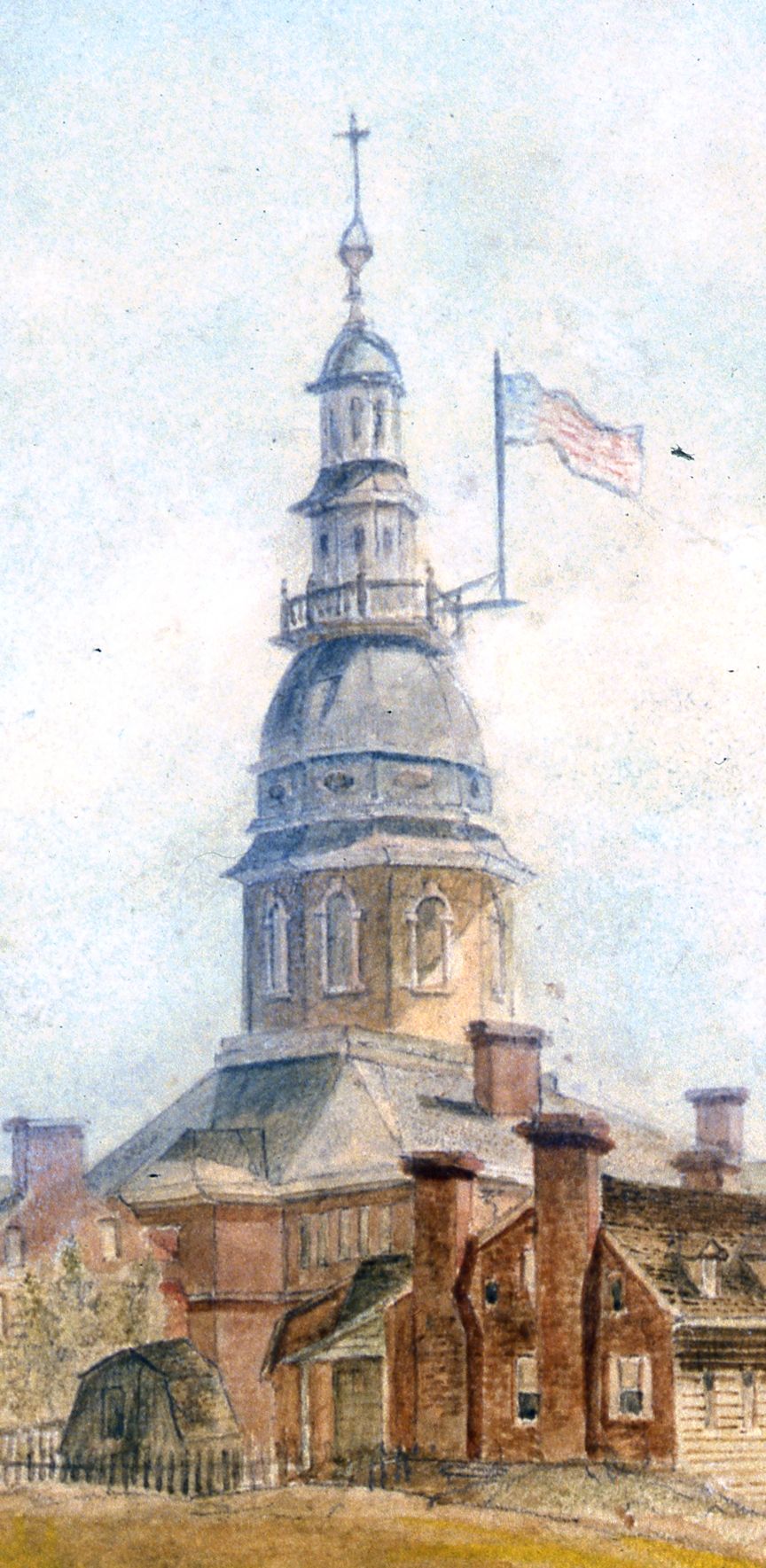
A Declaration of War, June 18, 1812

“Every body in this quarter [Albemarle County, Va.] expects the declaration of war as soon as the season will permit the entrance of militia into Canada…” Former President Thomas Jefferson to President James Madison, March 26, 1812.

The act was written by the U.S. Attorney General William Pinkney of Maryland, who in the spring of 1813 resigned to be commander of the 1st Rifle Battalion of Maryland with detachments that fought at  the Battle of Bladensburg (August 24) and North Point, Sept. 12, 1814.

AN ACT – Declaring War between the United Kingdom of Great Britain and Ireland and there dependences thereof, and the United States of America and their territories.

Be it enacted by the senate and House of Representatives of the United States of America in Congress assembled that War be and the same is hereby declared to exist between the United Kingdom of Great Britain & Ireland & the dependencies thereof & the United States of America & their territories; and that the President of the United States be and he is hereby authorized to use the whole land and naval force of the United States to carry the same into effect, and to issue to private armed vessels of the United States commissions or letters of marque and general reprisal in such form as he shall think proper, and under the seal of the United States against the vessels, goods and effects, of the government of the same United Kingdom of Great Britain and Ireland, and of the subjects thereof. June 12, 1812. Approved JAMES MADISON.

On the final passage of the act in the Senate, the votes were 19 to 13 and in the House, 79 to 49.

Sources: Jefferson and His Time: The Sage of Monticello by Dumas Malone (Boston: Little Brown and Company, 1981),91; Baltimore Federal Gazette, June 19, 1812.

Published in: on March 29, 2011 at 10:57 pm  Comments Off on A Declaration of War, June 18, 1812  

“Onward to Canada”: The First Baltimore Volunteers, 1812-1813

Not only was Captain Stephen Moore’s militia company the only Maryland company to serve outside the state during the war, but became the only militia company on September 28 to began the arduous march northward into Canada in the fall of 1812.

The company was organized as U.S. Volunteers for a year enlistment under the act of February 6, 1812 authorizing the President to accept volunteer militia corps, serving under the same rregulations and pay as the U.S. Army.  On September 9, they left Baltimore with an elegant silk flag made by the patriotic ladies of the seventh ward. After arriving at a rendezvous encampment, they marched northward to Sacketts Harbor, New York on April 27, 1813. From there they proceeded with the American army to attack York ( Toronto), the capital of Upper British Canada. In a letter home, Captain Moore related his near death during the attack:

“…at the opening of the main street [of York], the enemy sprung a mine upon us, which destroyed about 60 of his own men, and killed or maimed about 1230 of our men. This horrible explosion has deprived me of my left leg, and other wise grievously wounded me. I was taken from the field, carried on board the commodore’s ship, where my leg was amputated, and I now likely to recover. Two of my company were killed at the same time, and four or five more of my brave fellows were severely wounded…”

The Americans captured York, which they held on to for five days. The Baltimore “Bloodhounds” as they were nicknamed, proudly placed their ensign on the highest pinnacle of the Government House in the Capitol of Upper Canada. It had been made by the ladies of Baltimore. On September 7, 1813, at Fort George, Upper Canada, the Baltimore Volunteers were discharged and returned home, where they re-organized under Lt. Colonel Benjamin Fowler’s 39th Maryland Regiment, who would take an active role in the Battle of North Point, September 12, 1814.

1st Lieutenant John Gill  in the Spring of 1814 applied for a captain’s commission for a post in the newly organized national U.S. Sea Fencibles at Baltimore. These corps of seamen, under the U.S. War department were to serve as artillerist in protecting the harbors of the U.S. With two companies already assigned to Baltimore (out of ten raised in the U.,S.) the U.S. Senate declined Gill’s post.

Sources: Baltimore American and Commercial Daily Advertiser, September 2, 1812; The Baltimore Whig, September 12, 1812; Niles’ Weekly Register, October 3, 1812; Baltimore Patriot and Evening Advertiser, June 1, 1813; Easton Republican Star, May 25, 1813.

Published in: on March 29, 2011 at 10:54 pm  Comments Off on “Onward to Canada”: The First Baltimore Volunteers, 1812-1813  

Equinoctial Storms over the Chesapeake, Summer 1814

One reason that led to the British decision to attack Baltimore and not send the fleet north to Rhode Island as contemplated, then to return, was the annual autumn weather cycle of the equinoctial storm systems. These mid-Atlantic seasonal patterns along the coast played an integral role in the British strategy during their occupation of the Chesapeake. Now, it certainly became a factor in Vice-Admiral Alexander Cochrane’s decision to attack Baltimore and their subsequent raids in southern Maryland and Virginia in October before departing the Chesapeake.

In the early 19th century equinoctial storms were often referred to as heavy rain storms that occurred near the autumnal equinox (Sept. 22) in the Northern Hemisphere. This commonly used term has been replaced by the Lesser Antilles Carib word “hurricane” even though hurricanes are known to occur in the Northern Hemisphere as early as June and as late as November. When the British withdrew from Washington a severe squall line of intense thunderstorms struck, often inaccurately referred to as a hurricane that doused the flames of the city.

In Septmber 1814 Admiral Cochrane informed the First Secretary of the Admiralty in London, John W. Croker one of his reasons for attacking Baltimore: “…the approaching equinoctial new moon rendering it unsafe to proceed immediately out of the Chesapeake with the combined expedition, to act upon the plans which had been concerted previous to the departure of [HMS] Iphigenia; Major General [Robert Ross] and myself [have] resolved to occupy the intermediate time to advantage, by making a demonstration upon the city of Baltimore…”

During the Battle for Baltimore, such a thunderstorm made its appearance on September 13-14, 1814 when they augmented the flash of bombs and rockets that added to the grandeur and terror of the naval bombardment of Fort McHenry.

Sources: Dr. Kent Mountford, Estuarine Ecologist and Environmental Historian to the author on an investigation of weather patterns mentioned in Admiral Cochrane’s letter of September 17, 1814; Admiral Cochrane to Secretary Croker, H.M. ship-of-the-line Tonnant, Chesapeake, September 17, 1814. Printed in The Naval War of 1812: A Documentary History, vol. 3, (Washington, Naval Historical Center), 289-290; “Joseph Hopper Nicholson: Citizen Soldier of Maryland,” by Scott S. Sheads (Baltimore: Maryland Historical Magazine, vol. 98, No. 2,Summer 2003), 133-151.

Published in: on March 29, 2011 at 10:40 pm  Comments Off on Equinoctial Storms over the Chesapeake, Summer 1814  

Baltimore Bellona Gunpowder Manufactory (1801-1856)

“Baltimore Bellona Gunpowder Manufactory.The proprietors have commenced manufacturing and offer for sale Gunpowder of a superior quality, and refined Saltpetre.  LEVERING.” Federal Gazette, December 5, 1801.

The Bellona Gunpowder Manufactory was Maryland’s most extensive powder works established seven miles north of Baltimore along the Jones Falls west of Towson, Baltimore County receiving its name from the Roman Goddess of War – Bellona. It was one of four known Baltimore powder mills, all competing with the famous Eleuthere Irenee du Pont de Nemours & Company along the Brandywine River in Delaware. All delivered gunpowder to Maryland during the War of 1812.

The manufactory in 1810 was capable of making thirty-two quarter casks per day. It was governed by several leading citizens, one of whom was James Beatty, U.S. Naval Agent in Baltimore who later had the company incorporated by an act of the General Assembly on April 16, 1815.  The company’s agent, Aaron R. Levering (1784-1852) served during the war as captain of the Baltimore Independent Blues, 6th Maryland Regiment that was held in reserve during the Battle of North Point, Sept. 12, 1814. By 1816 the company was able to enter into contracts for 100,000 lbs of different descriptions of powder.

Subsequent explosions in 1812, 1820-21, and 1833 did not diminish its production until 1856 when the site was sold to the City of Baltimore as a water works and soon found itself submerged below the waters of Lake Roland, Baltimore County.

Sources: “An Act to Incorporate the Bellona Gunpowder Company of Maryland,” Archives of Maryland, Vol. 192, pp. 1625-1626, Maryland State Archives; Maryland Gazette, June 13, 1810; Baltimore Patriot, June 6, 1816.

Published in: on March 29, 2011 at 10:33 pm  Comments Off on Baltimore Bellona Gunpowder Manufactory (1801-1856)  

Baltimore Hibernian Corps of Union Greens

“Fostered under thy wing, we die in thy defense…It is a pleasing spectacle to view those foreigners who have made this country their home, embodying themselves for the defense of the Republic.”

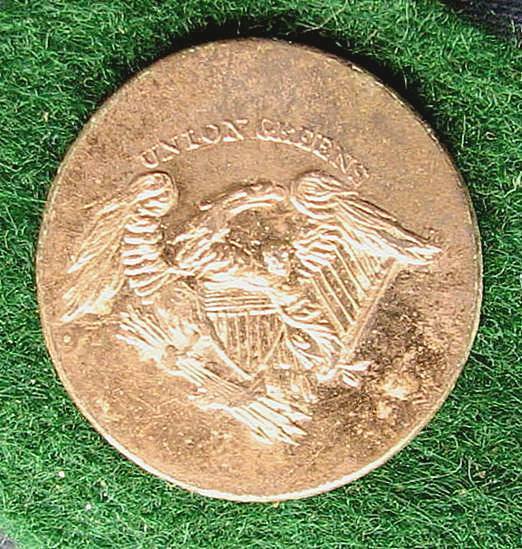
Union Greens Button

In June 1807  following the naval encounter between HM frigate Leopard and the US frigate Chesapeake that nearly brought a declaration of war. Among the Baltimore Irish militia companies raised were the United Republican Greens, the Baltimore Republican Greens and the Baltimore Union Greens. Company funding appears to have come from the Baltimore Hibernian Society whose organization fostered charitable assistance, immigrant advice and Maryland settlement. Their color standard was green, and like the button they wore was depicted “with a spread Eagle, and a Harp fostered under the wing. Upon the flag were these words proceeding from the Eagle’s mouth:  “Fostered under thy wing, we die in thy defense.” Among their duty assignments in 1813 was upon Camp Look-Out Hill (today Riverside Park in South Baltimore).

During the Battle of North Point, Sept. 12, 1814, the company was commanded by Captain John M. Kane and assigned to the 27th Maryland Regiment and served on the front lines of formation to the left of the Old North Point Road.

Sources: Republican Star, Aug. 11, 1807; Hibernian Chronicle, June 22, 1811; American & Commercial Daily Adv.., August 10, 1808 and October 27, 1813.

Published in: on March 29, 2011 at 10:31 pm  Comments Off on Baltimore Hibernian Corps of Union Greens  

Benedict, Maryland: A Secret Letter, July 17, 1814

The river port of Benedict on the Patuxent River in southern Maryland was founded in 1683 and named for Benedict Leonard Calvert (1700-1731) the Proprietory Governor of Maryland. The former tobacco port still retains its small hamlet look and the fields where the British encamped are still to be seen along the river. Several British incursions had taken place along the river with the lucrative prize lure of  “Upper Patuxent tobacco” numbering in the thousands of hogsheads either taken, burnt or sent adrift down the river. Such raids created a substantial loss of export revenue to Maryland and the destruction of farms.

Since June of 1814 the Patuxent River had become a constant tarket for British raiding parties. They landed at Benedict  where some heavy skirmishing took place. It would appear intelligence was gained and taken to Rear-Admiral Cockburn.  One resident wrote, “I found the whole country in a state of alarm..” Once the British had left, Maryland militia arrived in town to counter any threat and established Camp Benedict.

On July 17, 1814, a month before the main invasion fleet with Vice-Admiral Alexander Cochrane arrived in the Patuxent River from Bermuda, Rear-Admiral George Cockburn sent a secret letter to Admiral Cochrane:, The letter is dated: “HMS Albion off Jerome Point, Chesapeake, 17 July 1814.”

“…I feel no hesitation in stating to you that I consider the Town of Benedict in the Patuzent River to offer us advantages for this purpose beyond any other spot within the United States. It is, I am infoirmed, only 44 or 45 miles from Washington and there is a high road between the two places, which tho hilly is good…I therefore firmly beleive that within 48 hours after the arrival in the Patuxent of such force as you expect, the City of Washington might be possessed without difficulty or opposition of any kind…The army on their arrival would be sure of good quarters in the Town of Benedict, and a rich country around it to afford the necessary immediate supplies….”

On August 19th the main invasion force accompanying Vice-Admiral Alexander Cochrane arrived landed troops along a three mile shoreline of the Patuxent. The view must have been magnificant, the great sails of 46 ships, colorful pennants from the top masts, barges and small craft carrying the troops ashore, columns forming on the beach, and camp being place.  Tw0 days later the British army set off for Washington D.C., and as Admiral George Cockburn had predicted there was little “opposition of any kind” from the Americans.

Source: George Cockburn Papers, MSS18794, Reels 1-9, Library of Congress; Baltimore Patriot, June 25, 1814.

Published in: on March 29, 2011 at 9:55 pm  Comments Off on Benedict, Maryland: A Secret Letter, July 17, 1814  

Capt. Thomas Quantrill & the “Homespun Volunteers,” Hagers-town, Md.

“Volunteers —Attention!- ALL the volunteers attached to my Company, are ordered to repair to my quarters for the purpose of being uniformed – they are also ordered to bring their arms with them as they will be supplied with new arms for the purpose of marching immediately, according to orders. Thomas Quantrill, Capt. Hagers-town, August 11, 1812.”

Capt. Thomas Quantrill (1790-1854) was a blacksmith and slave-holder in Hagerstown, Md., who received on June 16, 1812 a militia commission for a rifle company known as the Homespun Volunteers, of the 24th Maryland Regiment from Washington County. In August 1812 they marched for Annapolis and garrisoned Fort Madison as part of Maryland’s militia quota for the War Department. A correspondent noticed that “they possessed all the essential qualities deemed necessary to form good soldiers…and will be found in merit, second to no company attached to the service…” In January they returned home having performed their first duty during the war.

In late August 1814 following the capture of Washington,  Captain Quantrill and his company marched for Baltimore and were attached to Lt. Colonel Joseph Sterett’s 5th Maryland Regiment, then transferred to the 39th Maryland Regiment who were in the front lines of the Battle of North Point, Sept. 12, 1814. Thomas and two others of the company of seventy-seven men were wounded.

After the war Capt. Quantrill migrated to Canal Dover, Ohio, married and had four sons, one of whom was William Clarke Quantrill (1837-1865) who became notorious in the Kansas border wars and his  infamous August 21, 1863 raid on Lawrence, Kansas.

Captain Thomas Quantrill died in Canal Dover, Ohio on December 7, 1854 apprently of tuberculosis.

Sources: Frederick-town Herald, Aug. 29, 1812: Maryland Adjutant General Papers, Militia Appointments, 2 1794-1816, Maryland State Archives, DE67-1; Niles’ Weekly Register, August 29, 1812;  Cincinnati Daily Gazette, May 14, 1869; Hagers-town Gazette, July 14, 1812.

Published in: on March 29, 2011 at 9:30 pm  Comments Off on Capt. Thomas Quantrill & the “Homespun Volunteers,” Hagers-town, Md.  

Captain James Roe (c.1784-?): 35th Maryland Regiment, Belle-Air, Kent County, 1814

The 35th Maryland Regiment was one of two regiments assigned to Queen Anne’s County during the war under the Maryland Militia Act of 1811. In August 1814 upon the advance of HM frigate Menelaus, Capt Peter Parker, RN, in the upper bay off Kent County. Brigadier General Benjamin Chambers, 6th Brigade, brought into service the 21st Maryland Regiment under Lt. Colonel Phillip Reed and Captain James Roe’s militia company of 100 men.  Captain Roe received his commission on October 17, 1810 by Governor Robert Bowie.

On August 31, 1814, HM frigate Menelaus landed their marines and seamen on the bay shore of Kent County and marched inland towards Belle-Air where intelligence reported their was a large militia camp and military depot of supplies. At midnight the British attacked the 21st Regiment upon the farm fields of Isaac Caulk. The Maryland militia made a heroic stand against overwhelming numbers and steadily withdrew from the field towards Chestertown five miles away. The action however caused the British commander Sir Captain Peter Parker to be mortally wounded. While Captain Roe’s company of fifty-nine militia were attached to the 21st Regiment from Aug 31 to Sept 7 they took no part in the midnight skirmish as they were encamped to guard the militia stores at Belle-Air.

In 2008 at the Poplar Grove/Brampton Plantation in Queen Anne’s County, documents were found relating to the War of 1812 among those “A Roster of the Attendance of Capt. Ja’s Roe’s Company Stationed at Bell Aire, August 31, 1814 – this campaign commenced.” While little is still unknown about Captain Roe and his company their role gives an insight of the company’s role during the Battle of Caulk’s Field on August 31, 1814.

Source: James Wood Poplar Grove Collection, Maryland State Archives, SC-5807; Maryland Militia in the War of 1812, Volume 1 (Eastern Shore), by F. Edward Wright (Westminster, Md.), 8, 38.

Captain John Pasco, RN (1774-1853): Flag Officer at Trafalgar

Captain John Pasco is along side Admiral Horation Nelson, remembered as one of the best known historic figures in British naval history – for that moment when he served as the flag-lieutenant on board HM ship-of-the-line Victory (100 guns) during the Battle of Trafalgar on October 21, 1805. It was this thirty-one year old signal officer who hoisted Admiral Lord Horatio Nelson’s famous battle signal ‘”England expects every man will do his duty.” Originally Nelson had asked Pasco to send the message “England confides that every man will do his duty.” Pasco suggested “expects” be substituted for “confides”, since the former was in the signal book, whereas confides would have to be spelt out letter-by-letter. Nelson agreed to the change, Pasco then recorded: “Engage the enemy more closely” to be sent. Pasco ran it up and it remained flying until shot away in the battle. Pasco was severely wounded in the right side and arm with grapeshot and carried below the decks.

On April 3, 1811, he received a captain’s commission and took command of HM schooner Tartarus (16 guns) during the Battle for Baltimore.

Sources: A Naval Biographical Dictionary: Comprising the Life and Services of Every Living Officer in Her Majesty’s Navy by William R. O’Byrne (London: John Murray, 1849).

Published in: on March 29, 2011 at 9:15 pm  Comments Off on Captain John Pasco, RN (1774-1853): Flag Officer at Trafalgar  

Captain Thomas Masterson Hardy, R.N. (1769-1839)

Among His Majesty’s naval officers who had been at the Battle of Trafalgar on October 21, 1805, Britain’s most famous naval engagement against the combined French and Spanish fleets was Captain Thomas Masterson Hardy, RN. the battle turned the tide of the naval warfare during the Napoleonic Wars (1793-1815) giving England control of the seas during the War of 1812. Hardy served with Admiral Lord Horation Nelson on board HM ship-of-the-line Victory (100 guns) as flag captain and commander. When Nelson was mortally wounded on the quarter deck by French marksmen, it was Hardy who held stricken Nelson below decks, and died in his arms.

Captain Hardy later served in the Washington-Baltimore campaign of August – September 1814. On August 9, 1814 it was Hardy commanding HM ship-of-the-line Ramilles (74 guns) directed the bombardment of Stonington, Connecticut that inspired a popular song by American poet Philip Freneau entitled “The Battle of Stonington,” prior to Baltimore’s own song by Francis Scott Key.

“Four gallant ships from England came, Freights deep with five and flame, And other things we need not name, To have a dash at Stonington..!”

A month later, September 13-14 the Ramillies anchored off North Point during the Battle for Baltimore, her size preventing navigation nearer to Baltimore.

Sources: A Naval Biographical Dictionary: Comprising the Life and Services of Every Living Officer in Her Majesty’s Navy by William R. O’Byrne (London: John Murray, 1849).

Published in: on March 29, 2011 at 9:10 pm  Comments Off on Captain Thomas Masterson Hardy, R.N. (1769-1839)