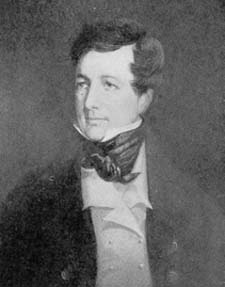
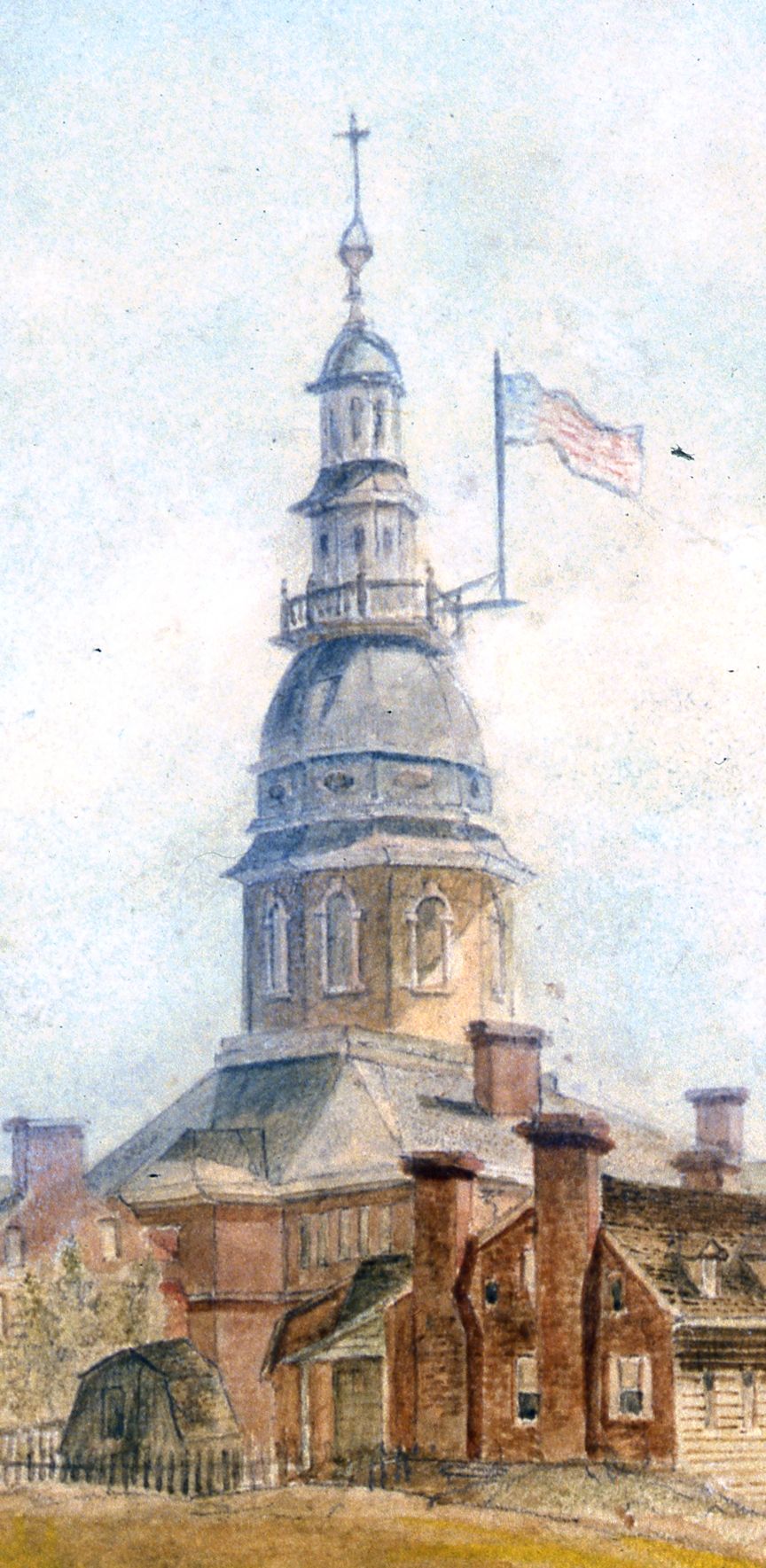
James McHenry (1753-1816)

James McHenry

James McHenry by DeNyse Turner. Maryland State Archives, MSA SC 1545-1029

James McHenry was born in Ballymena, County Antrim, Ireland, on November 16, 1753. He immigrated to America in 1771 and received a medical education at the Newark Academy (Delaware) under the tutorship of Dr. Benjamin Rush.

In 1776 he served as a physician during the Revolutionary War and then as an aide to General Lafayette. In 1781, having obtained the rank of major, he left the military and served in the Maryland Senate (1781-1783) and as a delegate to the Continental Congress (1783-1786) and delegate in 1787 to the federal Constitutional Convention. Following the convention he served in the Maryland State assembly (1787-1796).

In 1796, President George Washington offered McHenry a position in his cabinet as secretary of war until 1800 when he resigned under the John Adams administration. In 1798 Fort McHenry in Baltimore was named in his honor.Following his resignation, McHenry retired to Baltimore where he died on May 3, 1816 and is buried in Westminster Burying Ground.

Sources: The Life and Correspondence of James McHenry, by Bernard C. Steiner and James McHenry, (Cleveland: Burrows Brothers Co., 1907).

Published in: on March 25, 2011 at 1:30 pm  Comments Off on James McHenry (1753-1816)  

Congressman Charles Goldsborough (1765-1834)

Photo of portrait of Charles Goldsborough by C. Gregory Stapko. Maryland State Archives, MSA SC 1545-1006

He was the son of Charles and Anna Maria (Tilghman) Goldsborough of Hunting Creek, Cambridge, Md., a member of one Maryland Eastern Shore’s most oldest and prominent familes.

On April 2, 1813, two months after British warships entered the Chesapeake to enforce the blockade, Charles Goldsborough informed a congressional colleague, Harmanus Bleecker of New York, concerning the British depredations and consequent suffering among his constituents:

“…our bay trade has suffered extremely. Some of my poor neighbors are among the suffers, having lost their vessels and with them the principal source of support to their families…Our intercourse with Baltimore is entirely cut off, and consequently all of our means of procuring money. Should this blockade of the part of the bay continue three months longer, the Inhabitants of the Eastern Shore will be in extreme distress both for supplies for their families, and money to purchase them with. The War physics [is] working very well. No man, (not even the leading democrat) speaks in favor of the war. All express a wish for its termination. There will be nothing among us but poverty and privation…The old Muskets, which had been lying by for years in ignoble idleness and rust, were rubbed up, and some new ones procured. All the uniform coats which had been formerly got for show were now put on for fight; every hat was garnished with a red muslin band, the drums beat to Arms, and [the] American standard was unfurled…”

The British had anchored off Goldsborough’s Horn Point farm, but made no attempt to land. The British departed on March 20th, and sailed up the Chesapeake.

In June 1812, as a federalist he was one of three Maryland congressmen to vote against a declaration of war. A graduate of the University of Pennsylvania in 1784, he had served in the Maryland State Senate (1791-1795, 1799-1801); U.S. House of Representatives (1805-1817) and as Governor of Maryland (1818-1819). He died on December 13, 1834 and was buried at Christ Episcopal Church Cemetery in Cambridge, Md.

Sources: Eisenberg, Gerson G. Marylanders Who Served the Nation: A Biographical Dictionary of Federal Officials from Maryland. (Annapolis: Maryland State Archives, 1992); Easton Album by Norman Harrington (Easton: Historical Society of  Talbot County, 1986).

Published in: on March 25, 2011 at 10:25 am  Comments Off on Congressman Charles Goldsborough (1765-1834)  

Joseph Hopper Nicholson (1770-1817)

Joseph Hopper Nicholson, MSA SC 3520-1893

Joseph Hopper Nicholson was from one of the most influential and oldest families on Maryland’s Eastern Shore at Centreville, whose linelage dates back to 17th century Maryland. Born on May 15, 1770 in Chestertown, Queen Annes County, Maryland he graduated from Chestertown [Washington] College in 1787 and served in the Maryland House of Delgates (1796-1798), U.S. House of Representatives(1799-1806). In 1804 he conducted the impeachment hearings of Associated Chief Justice 0f the U.S. Supreme Court, Samuel Chase of Maryland. Two years later he introduced a House bill that became known as the “Nicholson Resolution” that became the first of several Non-Importation Acts that resulted in the unpopular Embargo Act of 1807. He resigned in 1806 to become the Chief Judge of the Maryland’s Court of Appeals in Baltimore, holding this post until his death.

On May 16, 1812 at Baltimore’s Old Fountain Inn, fifty delegates of the Democratic-Republican Party, with Judge Nicholson presiding as chairman, met to present several resolutions in a memorial to the President James Madison on the momentous decision that the nation was now affixed upon – a declaration of war with England. Foremost of the delegates was Hezekiah Niles, the influential editor of the Niles’ Weekly Register, who reported the evening’s proceedings arguing that England “… forcibly impresses our seamen, and detains them inhumanely in an odorous servitude – she obstructs our commerce in every channel…she had murdered our citizens within our own waters…” Such were the sentiments of the delegates many of whom were connected by livelihood to the popular “free trade and sailor’ rights” issues, one of several that led the U.S. to declare war upon England on June 18, 1812.

Judge Nicholson was a well known and eloquent orator rose to address the gathering:

“…We have assembled here to-night, for the purpose of determining whether we will give it our support in the might struggle into which [our country ] is about to enter …Is there an American sword that will not leap from its scabbard to avenge the wrongs and contumely treatment under which we have suffered? No, my countrymen, it is impossible. Let us act with one heart, and with one hand; let us show to an admiring world, that however we may differ among ourselves about some of our internal concerns, yet in the great cause of our country, the American people are animated by one soul and by one spirit…”

In May 1814, he organized a U.S. Volunteer militia artillery company known as the Baltimore Fencibles, whose muster rolls included mercantile merchants, ship-owners and bankers. In May 1814 with an invasion of the Chesapeake eminent, Nicholson informed the U.S. Naval Secretary “We should have to fight hereafter, not for ‘free trade and sailors’ rights,’ not for the conquest of the Canadas, but for our national existence.” During the bombardment of Fort McHenry they manned the guns within Fort McHenry. After the war he conbtinued on the judicial bench until his death in Baltimore on March 4, 1817. He was buried at Wye House, home of the Lloyds of Maryland in Talbot County, on Maryland’s Eastern Shore.

Source: “Joseph Hopper Nicholson: Citizen-Soldier of Maryland,” by Scott S. Sheads (Maryland Historical Magazine, vol. 98, No. 2, 2003).

Published in: on March 25, 2011 at 10:05 am  Comments Off on Joseph Hopper Nicholson (1770-1817)  

Sheppard Church Leakin (1790-1867)

Sheppard Church Leakin’s ancestors emigrated from Northumberland, England, in 1684, acquiring an estate on Humprhey’s Creek on the Patapsco Neck at Baltimore. The son of John and Elizabeth (Irvine) Leakin of Govanstown, Md., he was born on April 25, 1790 and later married Margaret Dobbin of St. Michaels’ on Maryland’s Eastern Shore. Prior to the war he served in various occupations as printer and book store proprietor. During the war he resided at “Lodge Farm” on on Humphrey’s Creek with a townhouse in Fell’s Point.

At the age of twenty-three, Leakin received a captaincy on May 20, 1813 in the 38th U.S. Infantry under the command Lt. Colonel William Steuart. During the spring 1814 he commanded Fort Covington (a mile west of Fort McHenry) and during the summer we find him on the lower Patuxent River in concert with Commodore Joshua Barney’s U.S. Chesapeake Flotilla at the Battle of St. Leonard’s Creek. He also served at Fort McHenry during the bombardment of Sept. 13-14, 1814 and later in 1818 as captain of militia in the Eagle Artillery company. His character was described by none other than Lt. Colonel George Armistead of Fort McHenry as “…I found him vigilant and prompt, his company in a fine state of discipline – his conduct conduct during the bombardment was such as to deserve [my] entire approbabtion…”

He served as High Sheriff of Baltimore County (1822) and Mayor of Baltimore (1838-40). In 1836 he was one of the founders of what became known as the Old Defenders’ Association of Baltimore in 1814. In 1862 he was commissioned major general of the First Light Division of Maryland US Volunteers.

He died on November 20, 1867 at his country estate of “Spring Hill” near Relay, Md., at the age of 78.

Source: The Sun, November 21, 22, 1867; American & Commercial Daily Adv., May 11, 1814 and August 16, 1818;  Wilbur F. Coyle, The Mayors of Baltimore (Baltimore: The Baltimore Municipal Journal, 1919), p. 55-57.

Published in: on March 25, 2011 at 9:40 am  Comments Off on Sheppard Church Leakin (1790-1867)  

Thomas Ruckle (1776-1853):Veteran War of 1812 Artist

Battle of North Point by Thomas Ruckle

Within the galleries of the Maryland Historical Society are two paintings: Defense of Baltimore: Assembling of the Troops, September 12, 1814 and Battle of North Point, Near Baltimore, Sept.12, 1814. Both were by artist and veteran of the battle Thomas Ruckle, a corporal in Captain George Steuart’s the Washington Blues, 5th Maryland Regiment.

Little is known of his early life other than he was the son of John and Elizabeth (Piper) Ruckle born in Embery, Ireland in 1776. In the late 18th century the family immigrated to Baltimore where his father took up the dry goods trade in 1802 on Market Street. On Nov. 28, 1798 at the age of twenty-two, Thomas married and took up residence near the Roman cathedral, and in May 1811 entered into business advertised as “House and Sign Painters & Glaziers”

In 1812 Thomas enlisted as a corporal in Captain George H. Steuart’s (1790-1867) Washington Blues, 5th Maryland Regiment and was present at the Battle of North Point on Sept. 12, 1814. His experience enabled him to recollect the preparations and the battlegrounds for two of his most famous paintings, The Defense of Baltimore Assembling of the Troops, September 12, 1814” (c.1820) and Battle of North Point, near Baltimore, September 12, 1814. (c. 1830).

Two of his sons, Thomas Coke and William Hogarth became accomplished artists in their own right the latter wrote his father in 1830, , “…Painters must be ambitious to excel. Don’t stop for trifles…Push ahead and in time the name of the Ruckles shall make as much of a noise in the United States as the famous Peales’ [family]…” On September 4, 1853, Thomas died at the age of seventy-seven and was buried at Mount Olivet Cemetery in east Baltimore.

Sources: (Extract- New Discoveries and Interpretations: The War in the Chesapeake, 1812-1815 by Scott S. Sheads (unpublished, 2011); The Sun, Sept. 17, 1830; Sept. 6, 1853; July 3, 1903.

Published in: on March 25, 2011 at 9:15 am  Comments Off on Thomas Ruckle (1776-1853):Veteran War of 1812 Artist  

Last Stand at the Cathedral: September 1814

The Baltimore Basilica

On September 6, 1814 Captain Samuel Babcock, U.S. Corps of Engineers reported on the state of fortifications at Baltimore to Major General Samuel Smith. Babcock had been ordered to Baltimore by the secretary of war “to direct the works of defense.” Among the various defensive sites Babcock pointed out were Hampstead Hill, Federal Hill and Camp Lookout all near the inner harbor. One of particular interest was the Roman Catholic Cathedral, the first such in the United States built between 1806-1821. The cornerstone was laid on July 7, 1806 and the church consecrated May 31, 1821. Today, it is known as the Basilica of the National Shrine of the Assumption of the Blessed Virgin Mary, considered one of the most beautiful neoclassical architectural structures in America, designed by America’s first architect, Benjamin Henry Latrobe (1764-1820). Latrobe also designed the U.S. Capitol,still under construction – that now laid in a fiery ruin when the British captured Washington on Aug. 24. During its construction a number of financial setbacks and the war interrupted the fifteen year building.

“…The new Cathedral from its commanding situation and the materials of which it is composed would I think be a valuable place to occupy; in a short time, it could be rendered susceptible of a good defense. At each end of the City, materials should be collected proper to barricade the avenues at a short notice…”

Cathedral Hill is located nearly two miles west of Hampstead Hill (Patterson Park), the main defenses of Baltimore itself and the second rise of ground above the Jones Falls. Here among the building stones a last stand could reasonably have been made. During the war various militia companies gathered and encamped on what was then known as Cathedral Hill, its eminence gave a panoramic view of Baltimore and the harbor.

Sources: Capt. Samuel Babcock to Maj. Gen. Samuel Smith, Sept. 6, 1814. Samuel Smith Papers, MSS 18794, Reel 4, Cont. 5-6, Library of Congress.

Published in: on March 24, 2011 at 11:30 pm  Comments Off on Last Stand at the Cathedral: September 1814  

1st Regiment, Maryland Volunteer Artillery, Maryland Militia

“This Regiment of Artillery, is emphatically the pride of Baltimore…”  (Baltimore Patriot, December 2, 1814.) 

Early 19th century 6 pounder field cannon

Organization – The First Regiment of Artillery of the 3rd Brigade, 3rd Division of the Maryland Militia was commanded by Lt. Colonel David Harris (1769-1844), consisting of ten companies of 70 men each, composed of “a very valuable portion of Baltimore’s society, young ardent, enterprising men, of reputable standing and honorable feeling…” During the Baltimore campaign of September 1814 they were distributed among the defenses at Hampstead Hill (*), Battle of North Point (**) and Fort McHenry (***).

Each company usually had four 6-pdr field cannon, a regimental total of thirty-four guns, each owned a company, each equipped with a common two-horse  two wheel-cart to carry munitions of cartridges, slow match, port-fires, and 60-70 rounds of cartidges each.

Artillery Effectiveness – Round-shot had a fearsome psychological effect on troops. Tests demonstrated that, under op­timum conditions, a 6 pound solid shot would cut through nineteen men, who were in close formation or seven feet of compacted earth.  The advantage of round-shot lay in its long zone of effectiveness which made it a useful projectile against targets as close as 250 yards and out to 1,100 yards (3,300 ft.) or more. It essense its volacity and low to the ground projection did extreme physical and psychological damage to soldiers in lineral firing formation.

Battle of North Point – Captain John Montgomery’s Baltimore Union Artillery with four guns was the only American artillery in the Battle of North Point on September 12, 1814. It is apparent that Brigadier General John Stricker’s troops at the Battle of North Point was only a delaying action, biding time for the American forces at Baltimore to prepare for the main assault. More artillery would have proved that General Stricker would have meant to make a stand on the grounds. The amount of the artillery upon Hampstead Hill (today Patterson Park) proved this.

First Regiment of Volunteer Artillery

Capt. George Stiles, The First Marine Artillery of the Union *

Capt. Samuel Moale, Columbian Artillery Co. *

Capt. James Piper, United Maryland Artillery *

Capt. George J. Brown, Eagle Artillerist Co. *

Capt. Joseph Myers, Franklin Artillery *

Capt. John Montgomery, Baltimore Union Artillery Co.**

Capt. John Berry, Washington Artillerist Co. ***

Capt. Charles Pennington, Baltimore Independent Artillerist Co.***

Attached

Capt. Joseph H. Nicholson, Baltimore Fencibles, owing they were U.S. Volunteers they were allowed to parade and exercise with the First Regiment. During the bombardment the Fencibles assisted the regular garrison at Fort McHenry, the U.S. Corps of Artillery, in manning the much heavier and powerful 24-pdr garrison artillery mounted on the fort walls.

Sources: “Military Notice,” Baltimore Patriot, December 2, 1814;  Col. Decius Wadsworth to Maj. General Samuel Smith , July 25, 1814. Samuel Smith Papers, MSS 18974, Library of Congress; “Field Artillery of the War of 1812: Equipment, Organization and Tactical Effectiveness,” by Donald E. Graves, The War of 1812 Magazine (Issue 12, November 2009); Citizen Soldiers at North Point and Fort McHenry, September 12 & 13, 1814 by James Young (Baltimore, 1889).
Published in: on March 24, 2011 at 10:48 pm  Comments Off on 1st Regiment, Maryland Volunteer Artillery, Maryland Militia  

Lt. Colonel George Armistead, (1780-1818)

“The President promptly sent my promotion with a very handsome compliment. So you see me dear wife, all is well, at least your husband has got a name and standing that nothing but divine providence could have given him, and I pray to our Heavenly Father we may live long to enjoy.” Armistead to his wife Louisa Armistead, Sept. 1814.

George Armistead

George Armistead was born on April 10, 1780, in Caroline County, Virginia, to John and Lucinda (Baylor) Armistead, one of five brothers, three of whom later served in the War of 1812. Armistead enlisted in the U.S. Army in 1799, rising steadily through the ranks until March 3, 1813 when he received his majority and subsequently distinguished himself on May 18th while serving as an artillery officer at Fort Niagara, New York, in the capture of Fort George across the Niagara River in Upper Canada. He was accorded the honor of delivering the captured British flags to President Madison.

On his taking command of Fort McHenry in June 1813, Armistead requested a flag for his new garrison flag measuring 42’ x 30’, a standard size for the period. The flag and his victory over a British naval bombardment on Sept. 13-14, 1814 earned his enduring place in American history under that flag at Fort McHenry whose stalwart defense of Baltimore against the British attack in 1814 inspired Francis Scott Key to write The Star-Spangled Banner. Armistead would remained in command of the fort until his untimely death at age 38 on April 25, 1818.

In 1810, then Captain Armistead married at the Otterbein Church, Baltimore, Louisa Hughes (1789-1861), daughter of Baltimore silversmith Christopher Hughes, Sr. Colonel Armistead is buried along with his wife and nephew Brig. Gen. Lewis Addison Armistead, CSA (1817-1863) in Old St. Paul’s Cemetery in Baltimore.

Source: Sheads, Scott S., Guardian of the Star-Spangled Banner: Lt. Col. George Armistead and The Fort McHenry Flag (Baltimore: Toomey Press, 1999)

Published in: on March 24, 2011 at 9:43 pm  Comments Off on Lt. Colonel George Armistead, (1780-1818)  

“Guardians of Annapolis”: Harbor Defenses

Rough plan of the defences of the harbour of Annapolis in Maryland

Rough plan of the defences of the harbour of Annapolis in Maryland / taken from a penciled sketch made by Brig. General Wm. Winder, 1814.

As early as 1776 the Annapolis Council of Safety petitioned for the erection of several earth fortifications at four strategic points to protect Annapolis harbor. These were at Horn Point, Greenbury Point, Beaman’s Point and Windmill Point. By the late 18th century the bay had become a crucial transportation route for the Continental army, supplies and communications. To protect the colonial capitol, in 1808 these four points of land became the foundations of the following U.S. fortifications.

Spring 1813 – With the arrival of British naval forces in the Chesapeake, Governor Winder reported to the legislature that “due to the defenseless situation of the forts”  he ordered a detachment of 1500 militia to Annapolis for the city’s protection and to supplement the small detachments of U.S troops at the forts.

Fort Severn (1808-1904) – On November 1808 the land was ceded to the U.S. War Department. In January 1809 President Jefferson reported to Congress: ” A circular battery of mason-work at Windmill Point, for the protection and defense of Annapolis is nearly completed – the cannon are mounted. Another battery [Fort Madison]on the bank of the Severn, below the town, is also nearly finished.”

It was described as a circular 14′ high stone masonry work, mounting twelve guns at Windmill Point. During the war it was intermittently garrisoned by Captain Samuel Sterett’s Co. 5th U.S. Infantry, Aug – Dec 1812; Lieutenant Satterley Clark, 1st Regiment, U.S. Artillery, June 1813. In 1845 Fort Severn was transferred to the U.S. Navy for the U.S. Naval Academy and in 1909 was demolished. Today the site is occupied by Bancroft Hall.

Fort Madison (1809-1909) – Located on Carr Point, Fort Madison, was described by U.S. Secretary of War Wm. Eustis in Dec. 19, 1809: “Fort Madison, an enclosed work of masonry, comprehending a semi-elliptical face, with circular flanks, calculated for thirteen guns: with a brick magazine, and barracks for one company.” On April 19, 1813, Fort Madison fired her alarm guns when several Maryland privateers sought shelter from being chased by British warships. The fort remained garrisoned until transferred to the U.S. Naval Academy in 1845. It was removed in 1909. The site is the U.S. Yard Patrol boats across the river from Bancroft Hall. Among the troops who garrisoned the fort were Capt. George C. Collin’s Baltimore Union Artillery, 1st Regt. Md Artillery, Aug 1812.

It was demolished in 1909 by the U.S.Navy, the site to be used for the U..S. Naval Academy.

Fort Nonsense (c. 1808- c. 1815) – Very little is known of the site other than it was located on Carr Point and may have been used during the Revolutionary War as a lookout post through the War of 1812. Located below Fort Madison on a high prominence it appears to have been a small circular earthen redoubt of 2 acres. Remnants of the redoubt have survived of the three forts that had defended Annapolis during the war. Today it is located on U.S. Navy property and is off limits to civilians.

Sources: “Fort Severn, Forerunner of U.S. Naval Academy,” by Ruby R. Duval, Shipmate, Oct. 1958; Correspondence between Gov. Levin Winder and U.S. Secretary of War John Armstrong, March – April 1813, Baltimore Patriot, May 22, 1813.

Published in: on March 24, 2011 at 9:17 pm  Comments Off on “Guardians of Annapolis”: Harbor Defenses  

Annapolis, 1783-1812

…our fellow Citizens in Arms are ready to do their duty
and believe with me that the Liberties of America
can never be lost
while every citizen is a Soldier
and every Soldier the Sentinel of his own…”

Governor Robert Wright to the Honorable General Assembly, November 7, 1807.

A Front View of the State House & c. at Annapolis the Capital of Maryland

A Front View of the State House & c. at Annapolis the Capital of Maryland. Maryland State Archives, Thomas Bond Collection, MSA SC 194

American Revolution, 1776-1783: Prelude to 1812. – Following the Battle of Yorktown in Virginia in October 1782, the last major campaign of the American Revolution, that General George Washington resigned his commission as commander-in-chief of the Continental army within Maryland’s Old State House Senate Chamber on December 19, 1783. Following the ceremony, private citizen-farmer from Virginia, George Washington, left the State House, mounted his horse and left for Mount Vernon for Christmas Dinner. On January 14, 1784, the Treaty of Paris was ratified here, officially ending the Revolutionary War. Twenty-eight years later in a declaration of war on June 18, 1812, America once more was at war with England.

On May 7, 1784, the chamber was the scene of Thomas Jefferson’s appointment as the first United States minister plenipotentiary to foreign governments. In 1786, what became known later as the Annapolis Convention was convened, a gathering of the delegates from the thirteen states of the Union to consider better regulation measures of commerce; but only the mid-Atlantic states came. Without the full support of all the states a resolution was called to meet in Philadelphia the next year. It would be in Carpenters Hall where the Declaration of Independence was signed that the assembly of states drafted and approved the Constitution of the United States in 1788.

Prologue to War – The news reached the capitol within the day. The Annapolis Gazette, July 2, 1807 informed its readers that HM frigate Leopard had fired a warning shot, then boarded in force the U.S. frigate Chesapeake. “The Chesapeake is lying in Hampton Roads [Virginia] without any colors! And strange to tell, the Leopard is triumphantly riding at anchor within our waters near the [Virginia] capes.” The Republican Star reported that “We do not, indeed, that this savage outrage has a precedent in naval annals.” For the residents of Queen Anne’s County on the Eastern Shore it was personal. One of the three American crew taken off and impressed into service was John Stachen, a native Marylander who had enlisted on board the Chesapeake two years earlier. This infringement on an American frigate brought the impeding crisis of America’s sovereign neutrality into a ready state of war. Five years later on June 18, 1812 the United States of American declared war on Great Britain.

A Maryland Declaration of War – The response to war was not unexpected. During the autumn of 1811 the Maryland State Senate introduced six resolutions that were unanimously adopted, with the house of Delegates following three weeks later with the resolutions adopted by a vote of 34 to 23 in support of President James Madison in the impeding crisis.

“That in the opinion of this legislature, the measures of the administration with respect to Great Britain have been honorable, impartial and just; that in their negotiations they have evinced every disposition to terminate our differences on terms not in compatible with national honor, and that they deserve the confidence and support of the nation…”

On November 23, 1812, Levin Winder was elected Governor of Maryland. A federalist, Winder opposed the war. The House delegates voted for him, but the majority of the Senate was controlled by the Republicans. For the remainder of the war, without federal support, Winder depended, as the U.S. Secretary of War responded, to depend on the resources of the state.

Sources: The Governors of Maryland, 1777-1970, by Frank F. White, Jr. (Annapolis: Hall of Records Commission, 1970)

Published in: on March 24, 2011 at 9:10 pm  Comments Off on Annapolis, 1783-1812