“The Boy Martyrs of 1814”: Daniel Wells and Henry G. McComas

During the Battle of North Point, in a pre-battle skirmish these two “boys” (18 & 21 years of age) are reputed to have killed Major General Robert Ross, RA. as the army advanced towards Baltimore on September 12, 1814. This popular event heighten great interest in the “folklore” of the Battle for Baltimore.


The popularity of the Wells and McComas story was further heighten on the evening of September 15, 1859 at the Holliday Street Theatre in Baltimore, when the famous playwright, dramatis, actor and theatre manager Clifton W. Tayleure (1832-1891) produced in three acts “The Boy Martyrs of Sept. 12, 1814: A Local Historical Drama.” It was complete “with representations of The Battle of Bladensburg, The Rescue of the Colors, The Bombardment of the Fort, Death of Ross, and the Battle of Baltimore.”


Only a year before were the remains of Daniel Wells and Henry G. McComas were removed from their temporary graves at Green Mount Cemetery and reposed in state in the Hall of the Maryland Institute, then to Ashland Square in west Baltimore where they were interred, awaiting the completion of the monument in their honor in May 1872.


Sources: “The Boy Martyrs of Sept. 12, 1814: A Local Historical Drama.” (Boston: Wm. V. Spencer, 1859); The Sun, September 11, 1858.

Published in: on March 24, 2011 at 9:01 pm  Comments Off on “The Boy Martyrs of 1814”: Daniel Wells and Henry G. McComas  
Tags:

The Aquila Randall Monument, 1817


Aquila Randall Monument

Aquila Randall Monument. From Lossing's Pictorial Field Guide of the War of 1812

“Dulici et decorum est pro Patria mori”

On Baltimore County’s historic Patapsco Neck along the Old North Point Road at the intersection of Old Battle Grove Road stands the second oldest known military monument in Maryland and the third oldest known in the United States. It is one of Maryland’s least visited War of 1812 sites – the Aquila Randall Monument. On July 21, 1817, Captain Benjamin C. Howard’s First Mechanical Volunteers formed up early in town and marched six miles to the North Point battleground. Accompanying them were wagons conveying the monument blocks to be assembled and dedicated on site that day. The monument’s construction was directed by Lt. Thomas Towson, a stone mason “who aimed at simplicity and neatness.” With a final application of whitewash it was dedicated to honor Private Aquila Randall a member who was killed in a skirmish just before the Battle of North Point, September 12, 1814. The company was joined by other 5th Maryland Regiment officers at the monument while Captain Howard delivered a modest appropriate address:

“….I can picture to myself the sensation of those who in far distant days will contemplate this monument…and the melancholy event which has caused our assemblage at this spot…This monument which we are now erecting, will stand as a solemn expression of the feeling of us all…But I regret that the spot, which is made classic by the effusion of blood, the sport where the long line stood un-appalled by the system and advances of an experienced and disciplined foe, has been suffered to remain unnoticed. It is here where her citizens stood arrayed soldier’s garb, that honors to a soldier’s memory should have been paid. To mark the spot be then our care.…”

[Monument Inscriptions]

[West face] – How beautiful is death, when earned by virtue.

[East face] – SACRED TO THE MEMORY OF AQUILA RANDALL, Who Died, in bravely defending his Country and his home, On the memorable 12th of September, 1814,Aged 24 years.

[North face] – THE FIRST MECHANICAL VOLUNTEERS, Commanded by Capt. B.C. Howard, in the 5th Regiment, M.M. HAVE ERECTED THIS MONUMENT, As a tribute of their respect for THE MEMORY OF THEIR GALLANT BROTHER IN ARMS.

[South face] – In the skirmish which occurred at this spot between the advanced party under Major RICH’D K. HEATH of the 5th Reg.’ M.M. and the front of the British column, Major General ROSS, the commander of the British force, received his mortal wound.

Source: (An Extract) “A History: The Aquila Randall Monument and the Monument Hotel of Baltimore County,” by Scott S. Sheads. From The War of 1812 in Maryland: New Discoveries and Interpretation. (2011, unpublished).

Published in: on March 24, 2011 at 8:58 pm  Comments Off on The Aquila Randall Monument, 1817  

Illumination – The Treaty of Peace and Amity

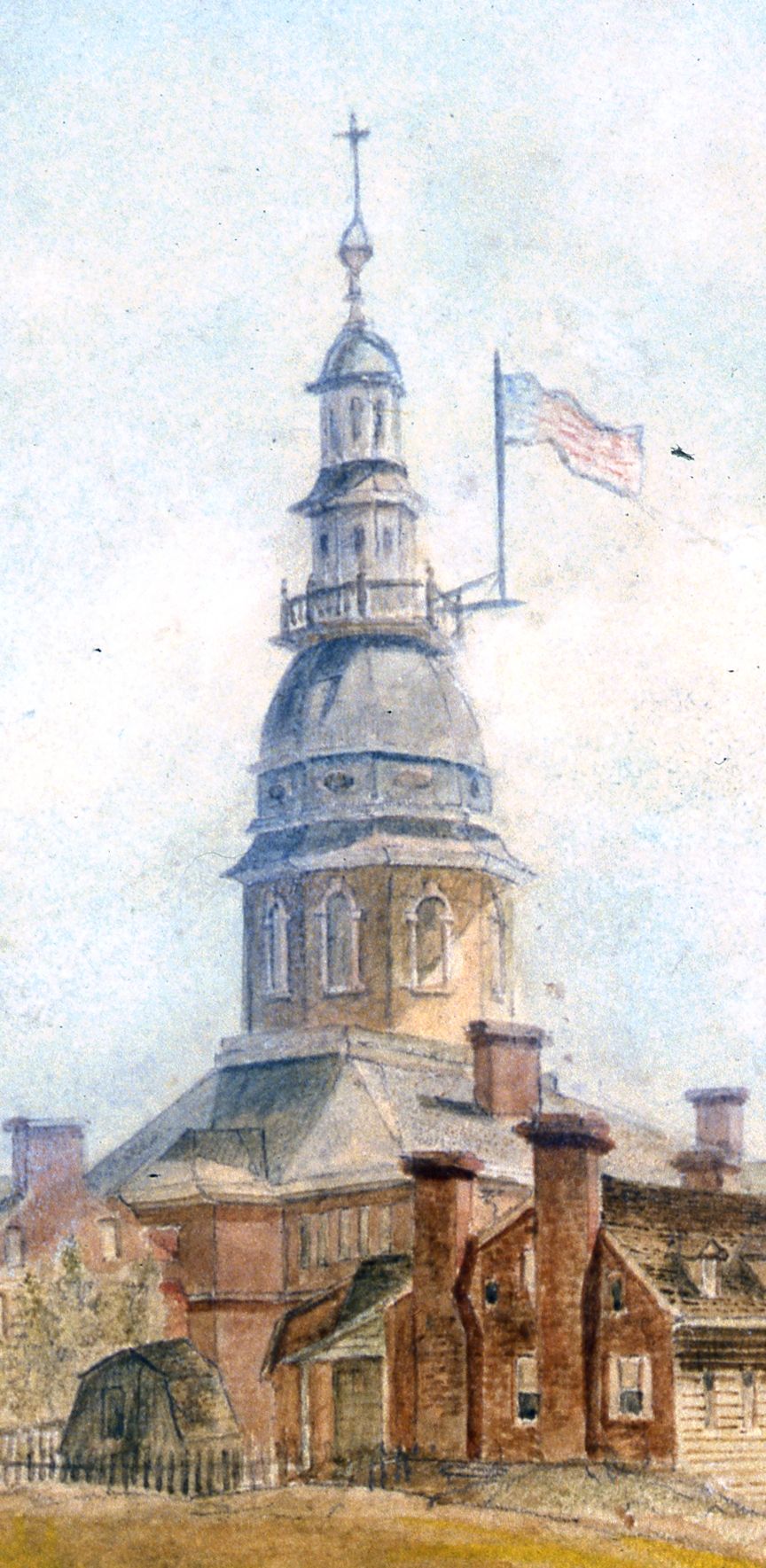
On February 1815, the schooner Transit arrived in Annapolis from France with Marylander Christopher Hughes, Jr. Esq., carrying a copy of the Treaty of Ghent, signed in Ghent, Belgium by the American and British commissioners on December 25, 1814 ending the War of 1812. News of the treaty was conveyed onboard the schooner Adeline with Colonel John S. Skinner, U.S. State Department agent to  inform Captain James Claville, RN, with his blockading squadron in the Chesapeake Bay. On February 23rd the City of Annapolis was illuminated. In the midst of this light, the State House ” was conspicuous for its elevation and splendor.” The State House hall was decorated with a full length portrait of George Washington, suspended from the center of the inner dome.

On February 22, 1815, Annapolis cabinet-maker and keeper of the armory John Shaw, fired a national salute with artillery from the illuminated Maryland State House on account of Washington’s birthday and the confirmation of peace.

Maryland now began the rebuilding process of the depredations destruction of the tidewater region and  the economic loss of her trade during the embargoes, and expanding once more to Europe and as far as Canton, China on board the once privateer Chasseur. A new national song “The Star-Spangled Banner” now gave Maryland a sense of national pride and symbolic emblem into what it meant to be an American.

Sources:“Maryland Armory Book, 1813-1820, John Shaw” Records of the War Department, Adjutant General’s Office, National Archives; Maryland Gazette, February 23, 1815.

Published in: on March 21, 2011 at 10:25 pm  Comments Off on Illumination – The Treaty of Peace and Amity  

Rembrandt Peale (1778-1860): Relics & Paintings of the War of 1812

Rembrandt Peale Self Portrait

On August 15, 1814 artist Rembrandt Peale opened his Museum and Gallery of Fine Arts at North Holiday Street in Baltimore, America’s first designed public museum. The museum, designed by Robert Cary Long, was advertised predominately as an arts and sciences museum, displaying only works of art and manufactured products.

In the weeks after the Battle for Baltimore Peale displayed the “Rockets, Bomb Shells, &c., of every description thrown into Baltimore during the bombardment.” Peale’s museum became the first to display the relics of Britain’s naval arsenal for the curiosity for those who had heard, but not seen a British shell or Congreve rocket, so eloquently noted in “The Star-Spangled Banner.” Captain Joseph Hook of the 36th U.S. Infantry at Fort McHenry donated a 190 lb. cast iron British mortar shell for exhibition at the museum. On September 28, Peale placed on exhibition the first engraving entitled “Battle of Patapsco Neck” by artist Andrew Dulac, a rifleman in the Baltimore Yagers. Such relics and paintings became a regular museum features within months after the bombardment.

On September 13, 1830 during the sixteenth anniversary of the Battle of North Point, Louisa Armistead, the widow of Lt. Colonel George Armistead, graciously loaned to the museum the original bombardment flag that had flown during the bombardment with a Mr. Mercer singing “The Star-Spangled Banner.”

That same year, the museum was sold to the City of Baltimore and used as the first City Hall until the present City Hall was built in 1875. In 1931, the building reopened as a museum, serving as the repository for the city’s historic collections as well as a venue for local artists. At its closure in 1977, the remaining artifacts were transferred to the Maryland Historical Society.

Today as we approach the 200th anniversary, the tradition of displaying relics and remembrances of the Battle for Baltimore continues at Fort McHenry and the Maryland Historical Society. Several of the “bomb bursting in air” and other relics made famous in “The Star-Spangled Banner” may be found at these sites carrying on the tradition of America’s first designed public museum.

Sources: The Peale Museum, National Historic Landmark, National Park Service; American and Commercial Daily Advertiser, August 3, 1815, July 4, 1815; Baltimore Patriot, January 11, 1815; Bernard B. Perlman, “The City Hall, Baltimore,” Maryland Historical Magazine 47 (March 1952): 40-54; Sun October 19, 1997.

Published in: on March 18, 2011 at 10:35 pm  Comments Off on Rembrandt Peale (1778-1860): Relics & Paintings of the War of 1812  

Commodore Joshua Barney (1759-1818) & the U.S. Chesapeake Flotilla

The most famous naval officer in Maryland waters during the war was Captain Joshua Barney, born on his fathers’s upper Bear Creek farm in Baltimore County on July 6, 1759. At seventeen years of age he began his naval career among various vessels during the Revolutionary Wa on board the schooners Hornet, Wasp, Sachem, frigate Virginia and the sloop of war Saratoga.

In 1794 while accompanying U.S. Ambassador James Monroe to France, Barney entered the French naval service which gave him a captain’s commission and made him commander of a squadron – thus the title of commodore. In 1800 he resigned and returned to America. In June 1812 he became one of the first sea captains to receive a privateer commission out of Baltimore for his private armed schooner Rossie. His first and only cruise of the war was very sucessful returning to his home in Elkridge, Anne Arundel County.

On July 4, 1813, Barney submitted a plan for the defense of the Chesapeake to conists of a fleet of gunboats, barges and a schooner. On August 20 he was commissioned a captain in the U.S. Flotilla service – that became known as the U.S. Chesapeake Flotilla. In April 1814 the flotilla sailed south from Baltimore to the lower Maryland on the Patuxent region to defend the Chesapeake tidewater.

For the next four months, Barney engaged the British own flotilla barges in a series of naval skirmishes that summer at Cedar Creek and upon St. Leonard’s Creek, then in the Patuxent River, where at Pig Point, knowing the British superior numbers and unable to navigate further upriver, Barny ordered the flotilla to be “blown to atoms” to prevents its capture.

On August 24 his five hindred sailors marched overland to defend the Capitol at the Battle of Bladensburg making a heroic but futile stand against an overwhelming British army and were the last, along with the U.S. Marines to leave the battlefield. The American defeat left the road to Washington undefended, the British entered the city and burned it.

At Bladensburg Barney was severely wounded and was paroled that day upon the field by none other than Rear-Admiral George Cockburn, RN, Barney’s nemesis and the co-arsonist of the Washington. The musket ball remained in his thigh as he recuperated on his Elkridge farm. Four years later while traveling west near Pittsburg, Barney died on December 1, 1818  and was buried in  Pittsburg Cemetery.

Sources: A Biographical Memoir of the Late Commodore Joshua Barney by Mary Barney (Boston: Gray and Brown, 1832): Flotilla: The Patuxent Naval Campaign in the War of 1812 by Donald G. Shomette (Baltimore: Johns Hopkins University Press, 2010).

Published in: on March 17, 2011 at 3:55 pm  Comments Off on Commodore Joshua Barney (1759-1818) & the U.S. Chesapeake Flotilla  

William Grason (1788-1868)

The son of Richard and Ann Grason, William Grason was born on March 11, 1788 in Queen Anne’s County, Md.  He attended St. John ‘s College in Annapolis (c. 1801); enlisted in the U.S. Navy (1802) and later in 1813 served as a 3rd sergeant in the 38th Maryland Regiment under Colonel William H. Nicholson at the Battle of Queenstown, August 13, 1813 on the Chester River. He attained a commission as lieutenant on Sept. 12, 1813.

After the war he served in the Maryland House of Delegates (1828-29); Governor of Maryland (1839-1842); and as Maryland Senator (1852-1853). He died on July 2, 1868 at the age of 80 years and was buried on his estate “Wye River Farm” near Queenstown, Queen Anne’s County, Md.

Sources: Marylanders Who Served the Nation by Gerson G. Eisenberg (Annapolis: Maryland State Archives, 1992); The Sun, July 4, 1868.

Published in: on March 13, 2011 at 7:10 pm  Comments Off on William Grason (1788-1868)  

His Britannic Majesty’s Brig Bloodhound, July 1812

On July 18, a month after the declaration of war, HM Brig Bloodhound (10 guns), Capt. Charles Rubridge (1787-1873) commanding, entered the Chesapeake having left Plymouth, England on June 28.  On board was a Mr. Shaw, the King’s messenger with dispatches for the England’s Minister Plenipotentiary to the United States in Washington, Mr. Augustus J. Foster (1780-1848).

At anchor in the harbor was the Letter of Marque Cora of  Baltimore, Actg. 1st Officer Richard Weathers, cmdg. He was awaiting the arrival of Captain Joseph Gold and ships owner to board from the city. Arriving in port on July 21, HMB Bloodhound was unaware of the U.S. declaration of war of June 18 having been at sea. As they approached Annapolis under the guidance of a black pilot, she was boarded by the crew of the Cora and placed her under the guns of Fort Madison.

While lying under the guns of Fort Madison, her crew were sequestered in the forts barracks and kept under guard for protection. Mr. Shaw having delivered his dispatches to Washington returned with an order for the Bloodhound and her crew for their immediate release. The U.S. government held the capture and any prize of the Cora to be improper as Capt. Rubridge was unaware of the war declaration. She was released and returned with dispatches to Plymouth. She was the second  British national vessel to be taken in the Chesapeake. The first was on July 10, at Hampton Roads, Va., of  HBM schooner Whiting, Capt. Carroway by the Baltimore privateer Dash, under similar events. HMS Bloodhound was restored to her colors.

Sources: An Autobiographical Sketch by Captain Charles Rubidge, R.N. 1870, pp 4-5; Daily National Intelligence, July 11, 21, 28, 1812.

Published in: on March 12, 2011 at 11:25 am  Comments Off on His Britannic Majesty’s Brig Bloodhound, July 1812  

Baltimore Quotes of War:1814

“We should have to fight hereafter, not for ‘free trade and sailors’ rights,’ not for the conquest of the Canadas, but for our national existence.” (Captain Joseph Hopper Nicholson, May 20, 1814)

“I think the handsomest sight I ever saw was during the bombardment to see the bums and rockets flying and the firing from our three forts. It was much handsomer at night than in the day…I could see plenty of redcoats but could not get within musket shot of them” (Lt. John Harris, U.S. Marine Corps, Hampstead Hill, September 27, 1814.)

“…after a night of awful darkness, interrupted by the yet more awful fires of bombardment, while the thunder of hostile squadrons poured its long and terrific echo from hill to hill around our alters and our homes, our wives and children, the flag of the Republic waves on our ramparts; scattering from every undulation, through an atmosphere of glory, the defiance of the free, and the gratitude of the delivered…” (Sermon, Reverend James Inglis, First Presbyterian Church to the 1st Regiment, Maryland Artillery , October 2, 1814.)

We could see the shot strike the frigates in several instances, when every heart was gladdened, and we gave three cheers, the music playing Yankee Doodle.” (Private Isaac Munroe, U.S. Volunteers, Fort McHenry, September 17, 1814.)

“…the houses in the city were shaken to their foundations for never, perhaps from the time of invention of cannon to the present day, were the number of pieces fired with so rapid a succession….” (Niles’ Weekly Register, September 1814.)

“It is, at this moment, said the enemy are now standing up the river for this place with about 40 sail. I shall stay by my ship and take no part in the militia fight.” (Commodore Oliver Hazard Perry, US frigate Java, Fells point, September 12, 1814)

“The attack on Fort McHenry, by nearly the whole British fleet was distinctly seen from Federal Hill, and from the tops of houses which were covered with men, women, and children…the whole awful spectacle of shot and shells, and rockets, shooting and bursting through the air.” (Salem Gazette, Massachusetts, September 28, 1814)

“At the first dawn, every eye was directed towards the Fort, to see whether the American banner still waved there; and when the morning mists had sufficiently dispersed, we were filled exultation at beholding the stars and stripes still floating in the breeze.” (Private John Dagg, 57th Virginia Regt., Federal Hill, September 1814)

“All this night the bombardment continued with unabated vigor; the hissing of rockets and the fiery shells glittered in the air, threatening destruction as they fell; whilst to add solemnity to this scene devastation, the rain fell in torrents – the thunder broke in mighty peals after each successive flash of lightening, that for a moment illuminated the surrounding darkness…” (Midshipman Robert Barrett, HM frigate Hebrus, September 1814)

“All hearts and able hands have cordially united in the common cause…At this moment we cannot have less than 10,000 men under arms…all sorts of people, old and young, white and black, in so much we expect that every vulnerable point will be strongly fortified.” (George Douglass, Merchant, Baltimore, September 2, 1814)

“Your birthplace may be in different countries, and your national names different. – But united with us in affection and interest, asserting our cause against an implacable enemy, you are one with us…prepare the musket; sharpen the bayonet; take the tent for your house; and your dinner from the knapsack…A Militia Man of 1776.” (Baltimore Patriot, August 22, 1814)

“After a night of awful darkness…while the thunder of hostile squadrons poured its long and terrific echo from hill around our altars and our homes, our wives and children, the flag of the Republic waves on our ramparts; scattering from every undulation, through an atmosphere of glory, the defiance of the fire and the gratitude of the delivered.” (Baltimore Mayor Edward Johnson, November 5, 1814)

Published in: on March 12, 2011 at 10:16 am  Comments (1)  

Last British Warships in the Bay: March 1815

Of the one hundred and thirty-eight known royal naval vessels to have served in the Chesapeake during the war, the last known ship fell upon Captain John Clavell (1776-1846), commanding H.M. frigate Orlando. Clavell had entered the navy in 1781 and later served as first lieutenant onboard HM ship-of-the-line Royal Sovereign at the Battle of Trafalgar in 1805 and promoted to captain the following year.

During the war in the Chesapeake, on December 13, 1814, Rear-Admiral Cockburn issued orders before his departure for the Carolina-Georgia coast, to establish a rigid blockade of the Chesapeake with five vessels (Havannah, Dauntless, Pandora, Sarcacen, and Dotterell) under his command for the winter. They would depart the following February.

On March 10,1815 Captain Clavell received the last known order issued to an officer in the Chesapeake. Admiral Cockburn informed him that the Treaty of Ghent had been ratified on February 17 and that he was to remove all royal property on Tangier and St. George’s Islands and leave the Chesapeake. Soon thereafter H.M. ship Orlando cleared the Virginia Capes. The last known British warships of the War of 1812 left the Chesapeake.

Source: The Gentleman’s Magazine, (London, 1846), 643; Admiral Cockburn to Captain Clavell, Cumberland Island, Ga., March 10, 1814; The Naval War of 1812: A Documentary History (Washington: Naval Historical Center, 2002) vol. 3, 349. Ships under Clavell’s command at time of departure: Dauntless and Dotteral.

Published in: on March 12, 2011 at 12:00 am  Comments Off on Last British Warships in the Bay: March 1815  

Christopher Hughes, Jr. (1786-1849)

Born on 1786, Christopher Hughes, Jr., was the son of Baltimore famed silversmith Christopher Hughes, and the brother of Louisa (Hughes) Armistead, wife of Maj. George Armistead. A law graduate of Princeton University in 1809, in 1811 he married Laura Sophia Smith, daughter of Maj. Gen. Samuel Smith. In March 1813 Hughes received a commission as captain of the Baltimore Independent Artillerists, 1st Regt. Md. Artillery that defended Fort McHenry in 1814. With his militia tour of duty expired in August he relinguished his command. On February 2, 1814, Hughes was appointed to be “secretary of the joint mission for negotiating a treaty of peace and of commerce with Great Britian” at Ghent, Belguim.

On Oct 23, 1814, the American flag-of-truce vessel Fingal left New York for LOndon, then on to Ghent, Belgium arriving on November 24. Mr. Hughes having received letters from home entered the following in his dairy:

“Received per Ship Fingal on the 24th November 1814 in Ghent, giving me the most acceptable news of the Health of my inestimable Laura & of all my Family. This letter occasioned me the happiest emotions; it had been written but a Month [ago and] gave me the account of the brave and honorable conduct of my Brother-in-law Major Armistead; and the manly conduct of Thomas Russell & of all my company [Baltimore Independent Artillerists]. The exemplary behavoir of my Townsmen of Baltimore under the management of Gen’l [Samuel] Smith afforded me the sincerest satisfaction…”

As Legation Secretary to the American Peace Commission at Ghent, Belgium, a treaty was signed by the Plenipotentiaries of both powers on December 24, 1814. Leaving Bordeaux, France he arrived in Annapolis on board the U.S. schooner Transit on February 13 carrying the treaty to Washington.

He returned briefly to Maryland serving in the Maryland House of Delegates (1815-1816), afterwards resuming his diplomatic service as U.S. Charge d’affaires in the Netherlands until retirement in 1845.

Source: U.S. Secretary of State James Monroe to Hughes, February 2, 1814. Christopher Hughes Papers, Clements Library, University of Michigan; “Christopher Hughes, Jr. At Ghent, 1814.” Maryland Historical Magazine, 1971; Baltimore Patriot, August 21, 1813;

Published in: on March 11, 2011 at 11:54 pm  Comments Off on Christopher Hughes, Jr. (1786-1849)